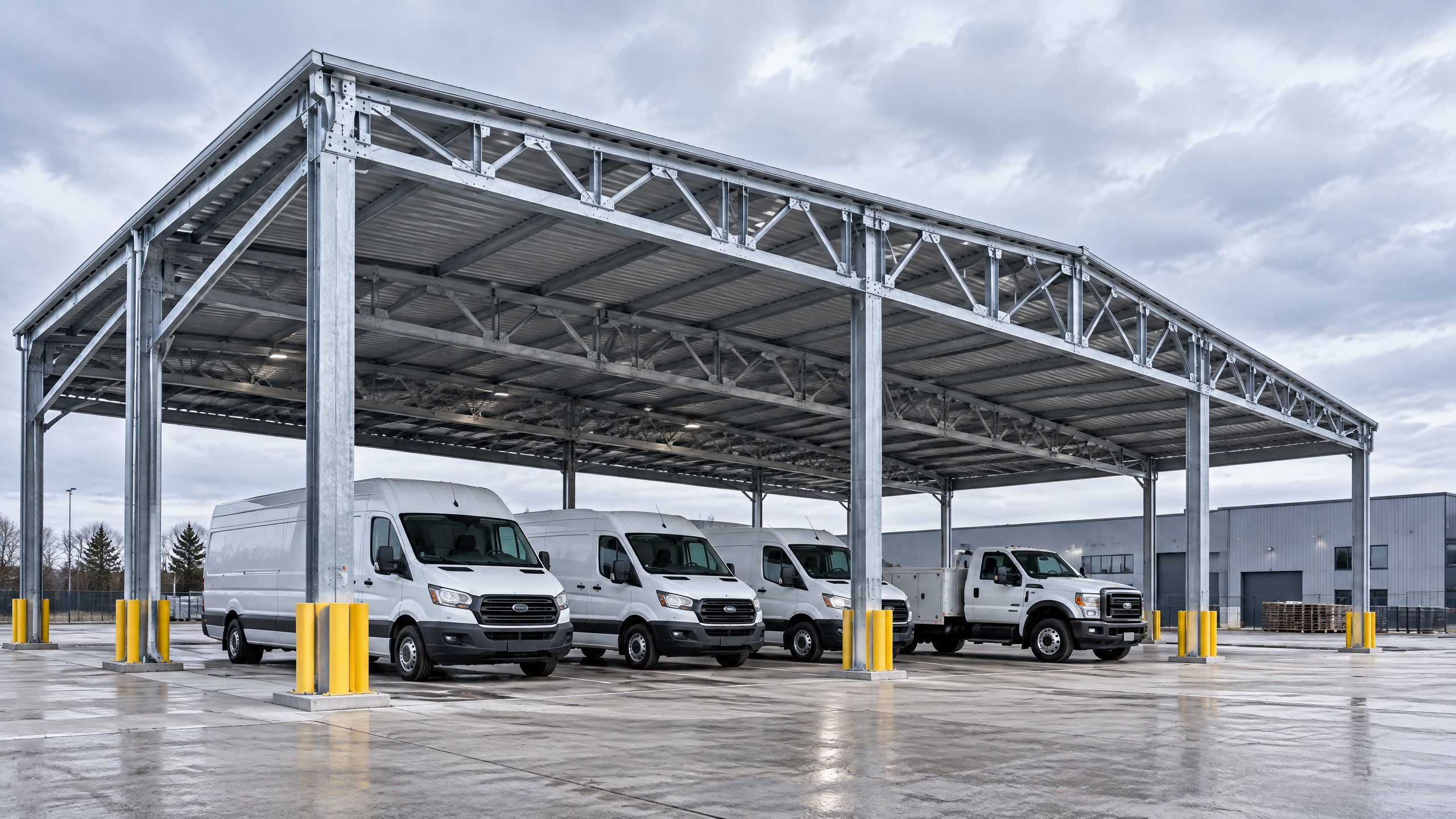
Direct answer (120–180 words) Confirm that a commercial parking canopy supplier can demonstrate the specific capabilities and interfaces your project needs: a documented portfolio of similar commercial and industrial projects; clear delineation of which party provides the commercial parking canopy structural system and which provides site-specific engineering; defined responsibilities for commercial parking canopy project design, factory fabrication and on-site work; records of partner installation teams or approved installers and how they qualify as a commercial parking canopy installation contractor; end-to-end logistics and delivery planning; and the available post‑installation support and spare‑parts process. Ask for drawings, connection details, test reports, and installation sequences so your engineer can validate site suitability. Do not accept high-level claims alone — obtain roles and deliverables in writing, confirm interfaces with utility providers and permitting authorities, and engage local qualified professionals for final sign‑off and approvals.
Why this confirmation matters for B2B buyers
Selecting a commercial parking canopy supplier is not only about product specs. For distributors, architects, contractors, developers, solar EPCs and fleet operators, supplier boundaries determine liability, schedule risk and who must adapt site engineering. A supplier that supplies only canopy components differs from a turnkey provider that manages the commercial parking canopy structural system, site engineering, and installation. Confirming scope prevents gaps between fabrication and on‑site delivery that can cause delays, cost overruns and rework.
Six confirmation categories every buyer should verify
- Supplier role and contractual scope: What the supplier will deliver versus what remains with the buyer, developer or installation contractor.
- Engineering and design deliverables: Who provides the commercial parking canopy project design, which drawings and at what stage.
- Structural system interfaces: Which party defines the commercial parking canopy structural system, load paths and connection details.
- Installation and supervision: Whether the supplier provides a certified commercial parking canopy installation contractor or just recommends partners.
- Manufacturing and quality control: Whether the supplier is the commercial parking cover manufacturer or subcontracts; inspection and traceability practices.
- Logistics, spares and aftercare: Delivery packaging, on-site handling requirements, spare-part lists and planned maintenance interfaces.
Decision table — Supplier role and deliverables
| Confirmation topic | What to ask for | Red flag / follow-up |
|---|---|---|
| Contractual scope | Written scope, drawings list, milestone deliverables | Scope described only in marketing language |
| Design responsibility | Who issues structural drawings, who stamps them | Supplier refuses to state which deliverable they will produce |
| Installation responsibility | Name and qualification of commercial parking canopy installation contractor | No named installer or reliance on "local subcontractors" without vetting |
| Manufacturing source | Are they the commercial parking cover manufacturer or a reseller? | No factory information or inspection access |
| Warranty and service process | Process to claim remedial works; contact points | Warranty terms promised orally only (see scope boundaries) |
How to evaluate the commercial parking canopy structural system
Ask for assembly and connection drawings that show load paths from canopy roof to foundations and to any photovoltaic array interfaces if applicable. The term commercial parking canopy structural system should appear in scope documentation and should be accompanied by:
- Typical connection details (e.g., column–foundation, beam–column, roof‑to‑beam).
- Material specification and finishing schedules.
- Tolerances and on‑site adjustment allowances.
Decision table — When to accept supplier structural deliverables vs require your own engineer
| Project phase | Supplier deliverable | When buyer’s engineer must produce/verify |
|---|---|---|
| Preliminary | System outline, typical details | Always verify feasibility and gridline layout |
| Design development | Fabrication drawings, connection concepts | Require stamped shop drawings for site-specific loads |
| Pre-construction | Installation sequence, tolerances | Third‑party review if complex or in hazard zone |
| Construction | As-built drawings, adjustment records | Final verification by local licensed engineer |
Note: This guide does not promise structural capacity or code compliance. Final structural calculations, permitting and sign-off must come from local qualified professionals.
Commercial parking canopy project design — what to request
Request a deliverables schedule for the commercial parking canopy project design that itemizes:
- Concept drawings and alignment options.
- Engineering deliverables (loads, calculations, stamped drawings where applicable).
- Electrical interface drawings if integrating PV or lighting.
- Bill of materials (BOM) and schedule of finishes.
Confirm the revision process and responsibilities for design changes once site surveys or utility surveys reveal constraints.
Identifying and qualifying the commercial parking canopy installation contractor
Many suppliers either provide an in‑house installation crew, approved local installers, or leave installation to the buyer. For each installation model confirm:
- Installer qualifications, supervisory staffing and past project references.
- Proposed installation sequence and on‑site safety plan aligned with local regulations (see OSHA for general construction safety practices) [3].
- Interfaces with other trades (electrical, paving, drainage).
- Packing and handling requirements to avoid damage to aluminium extrusions or finishes.
If the supplier names an installation firm as part of their offering, ensure the contract identifies the commercial parking canopy installation contractor and the scope of their responsibilities.
Manufacturing and supply-chain transparency
Determine whether the supplier is the commercial parking cover manufacturer or a reseller/agent reliant on subcontracted factories. For manufacturing clarity, request:
- Factory location(s) and production lead times.
- Quality control checkpoints and inspection regimes.
- Material certificates (for aluminium alloys, coatings) and finishing spec sheets.
- Packing, shipping and on-site storage guidance.
Knowing the manufacturer status affects inventory control, spare‑part sourcing and long‑term maintenance.
Compliance, site risk and external approvals
This guide does not promise permit approval, code compliance, lead time, price, energy yield or warranty. Buyers must engage local qualified professionals, authorities, utility providers and installers to confirm:
- Accessibility and parking layout requirements (follow applicable guidance where required) [1].
- Flood risk and elevation requirements when applicable (consult FEMA maps for U.S. sites) [2].
- Construction safety and on-site regulatory obligations (see OSHA) [3].
- Roadway, highway or right-of-way constraints that may trigger additional permits (consult FHWA where federal rights-of-way or highway interfaces apply) [4].
Flag any site constraints early (utilities, tree protection, underground services) so the supplier and your civil engineers can align on foundation design and access.
Commercial terms, lead times and logistics to confirm
Request explicit answers for:
- Order acceptance criteria and changes policy.
- Standard lead time estimates and defined logistics milestones (fabrication start, shipment, arrival window).
- Packaging and unloading requirements on site (lifting equipment, crane reach).
- Spare-part lists and lead times for each major component.
Do not treat supplier lead‑time guidance as binding without contractual terms and accepted milestones.
Two common procurement models and their trade-offs
| Model | Typical scope | Pros | Cons |
|---|---|---|---|
| Component supplier (manufacturer only) | Supplies fabricated components, bolts, fasteners | Lower unit cost, direct factory control | Buyer or contractor handles installation and shop drawing responsibilities |
| Turnkey supplier (supply + design + install) | End‑to‑end delivery, installation, commissioning | Single point of contact, clearer liabilities | Often higher cost; requires rigorous vetting of subcontractor performance |
Choose the model that matches your team’s capacity to manage design, permitting and on‑site coordination.
Five-step Buyer Workflow — “VERIFY” workflow
- Validate requirements: Document parking capacity, vehicle types, canopy use (shade, EV charging, PV), loading criteria and site constraints.
- Evaluate suppliers: Pre-qualify commercial parking canopy supplier candidates using portfolio, manufacturing status and references.
- Review technical package: Obtain the commercial parking canopy structural system details, sample connection drawings, and the commercial parking canopy project design deliverables for third‑party review.
- Integrate contractors: Confirm installer, civil and electrical contractors; ensure commercial parking canopy installation contractor responsibilities are recorded in contracts.
- Yard-to-site execution: Agree logistics, unpacking, on‑site supervision and final inspection protocols; close out with as‑built drawings and spare parts handover.
Assign clear owners for each step (buyer, supplier, engineer, installer) and record deliverables in the contract.
Mid-article call to action
If you are ready to clarify scope with a potential supplier, open a formal conversation to get a deliverables list and design sample. Start an inquiry with Carportiva to request a scope checklist or share project parameters: /inquiry or contact info@carportiva.com.
Practical due-diligence checklist before award
- Obtain and review three recent project references with similar scope.
- Validate manufacturing origin: is the supplier the commercial parking cover manufacturer?
- Ensure the supplier provides a detailed installation scope or names contracted installers.
- Require complete package of drawings — concept to shop drawings — before fabrication.
- Confirm logistics route, offloading and storage requirements with your site team.
Integration with photovoltaic or EV infrastructure
If integrating PV modules or EV charging, ensure electrical and mechanical interfaces are clearly scoped:
- Load and support assumptions for canopy-mounted PV arrays.
- Cable routing, combiner box locations and utility interconnection responsibilities.
- Thermal expansion, module attachments and O&M access planning.
These interfaces should be part of the commercial parking canopy project design package.
Aftercare planning and spare parts
Work with the supplier to define expected routine checks, spare fasteners and replacement parts inventory. Confirm escalation paths and lead times for critical components. If the supplier is not the commercial parking cover manufacturer, confirm who will be responsible for sourcing and replacement parts.
How to handle disputes about scope or defects
Ensure the contract assigns responsibilities for latent defects, installation errors and interface failures. Keep documentation of design revisions, site records and inspection reports. Use neutral third‑party engineering review for disputed technical issues when required.
Links to further Carportiva resources
- See Carportiva system range for product options and modular systems: Carportiva system range
- Review other product families and specifications: all systems
- For more procurement and project planning articles: sourcing guides
Related sourcing terms
In project research, these connected terms should be reviewed against the same live brief: commercial parking cover supplier. They are search phrases, not separate technical guarantees.
FAQ
Q: What documentation should a supplier provide to prove they can deliver a commercial project? A: At minimum: project portfolio, shop drawings, BOM, factory origin, installer references, and a clear scope matrix. Local structural calculations and permit packages should be produced or coordinated by the responsible party and local licensed engineers.
Q: Can the supplier guarantee permitting or code compliance? A: No. This guide does not promise permit approval or code compliance. Permits and local code compliance are governed by authorities having jurisdiction and must be confirmed by local qualified professionals.
Q: Should I prefer a supplier that is also the commercial parking cover manufacturer? A: There are pros and cons. A manufacturer can offer direct control over production and spares, while a reseller or system integrator may provide broader design‑and‑install services. Evaluate based on the buyer’s risk appetite and project complexity.
Q: What should I expect from a commercial parking canopy installation contractor? A: Expect formal qualifications, a safety plan, project schedule aligned with the supplier’s deliveries, and clarity on interface work with civil and electrical trades.
Q: Who finalizes structural capacity and foundation design? A: Final structural capacity, foundation design and stamped calculations must be produced or verified by local licensed structural engineers and may be required by permitting authorities.
Conclusion
Confirming roles, deliverables and interfaces up front reduces risk and clarifies responsibility between your organisation, the commercial parking canopy supplier, manufacturers and installers. Use documented supplier commitments for the commercial parking canopy structural system and the commercial parking canopy project design as contract attachments. Always involve local qualified professionals, permitting authorities, utility providers and installers for final site‑specific decisions and sign‑off.
Ready to move from due diligence to detailed scope? Begin your project conversation: /inquiry or email info@carportiva.com.
References
- U.S. Access Board parking guidance: https://www.access-board.gov/ada/guides/chapter-5-parking/
- FEMA flood maps: https://www.fema.gov/flood-maps
- OSHA construction standards: https://www.osha.gov/laws-regs/regulations/standardnumber/1926
- Federal Highway Administration: https://highways.dot.gov/
Keep the project brief connected.
Bring the actual project brief to the engineering table.
Share your location, layout, target application and available technical inputs. Carportiva can help identify the relevant product-interface information before a project-specific commercial discussion.
Request a project discussion