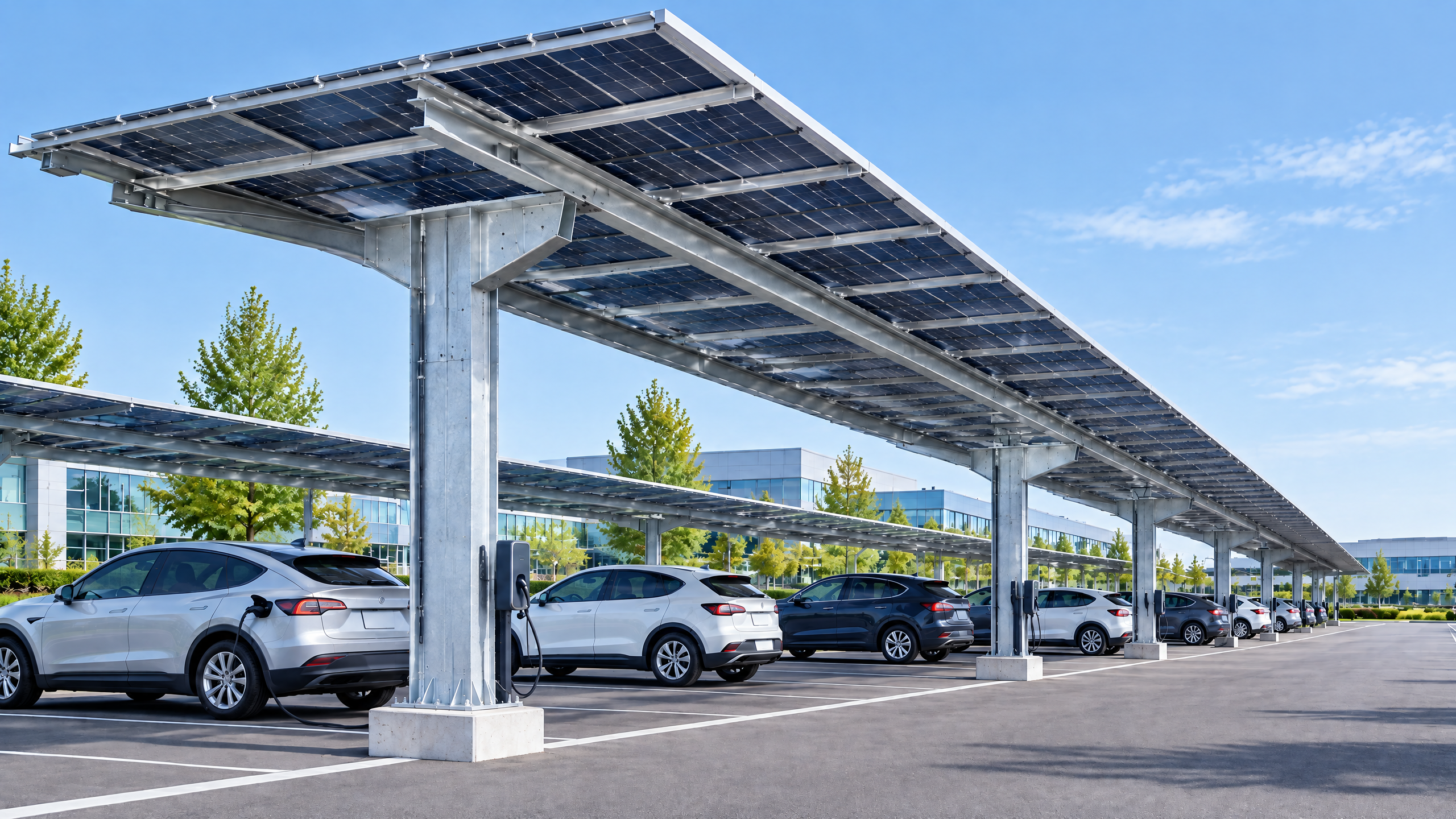
Direct answer (150 words) Confirm that any prospective solar carport structure supplier can clearly deliver and document the responsibilities, interfaces and verification tasks you need to complete your project — not vague product claims. At minimum, require written scope boundaries (what the supplier supplies versus what you must source), stamped structural assumptions and drawings for design integration, a defined solar carport structure engineering scope that identifies site geotechnical inputs, wind and snow load assumptions, and connection details to the building or foundations. Verify the supplier’s capability to coordinate the solar carport structure pv interface with PV module racking, inverters and the electrical contractor, and confirm logistics, installation supervision options and quality control steps for the solar carport structure steel frame or aluminium alternatives. Finally, get documented lead steps for permits, testing and handover, and require that local qualified professionals, authorities, utility providers and installers make final site-specific decisions.
Why a clear supplier confirmation matters
Buying a solar carport structure is buying system integration: architecture, structure, electrical and site services must interlock. Ambiguity causes scope gaps, delays and rework. The procurement goal is to convert assumptions into documented responsibilities so each party — distributor, architect, contractor, EPC or fleet operator — knows what deliverables, approvals and checks they must provide.
Below are practical confirmations to request, how to evaluate responses, and a buyer workflow you can use in procurement evaluations.
Core confirmations to request from a solar carport structure supplier
Request the following documents and statements before awarding work. Each item reduces risk by making decisions explicit.
- Written statement of supply scope: parts, drawings, documentation, and what is excluded.
- Solar carport structure engineering scope: list of design analyses to be provided (see expanded list below).
- Structural drawings and load assumptions (concept stage is fine for RFQ; final must be stamped by a licensed engineer local to the project).
- Connection and foundation interfaces, including template drawings for anchor positions.
- Solar carport structure pv interface details: module clamp points, racking attachment method, cable routing allowances, and access for PV installers and O&M.
- Material specification: steel or aluminium grade, finishes, and corrosion protection for site environment.
- Fabrication and quality control plan, including dimensional control, welding/NDT approach and factory inspection options.
- Installation scope: whether supplier provides supervision, mechanical assembly only, or full turnkey installation with civil works.
- Logistics plan: pack sizes, unloading and crane/telehandler assumptions, and on-site storage requirements.
- Testing and handover checklist: what inspections or tests the supplier will witness or sign off.
Note: Do not accept unqualified claims about capacity, code compliance, permit approvals, lead time, price, energy yield or warranty. Those require site-specific inputs and final decisions by local authorities and professionals.
What belongs in a solar carport structure engineering scope
A clear solar carport structure engineering scope reduces mismatch between the structural package and the PV/Electrical design team.
Typical items to include:
- Reference standards and design codes to be applied (client specifies jurisdiction).
- Geotechnical input requirements and who provides them.
- Design wind, snow and seismic assumptions (supplier may propose values but they must be verified locally).
- Foundation type options and load-transfer details.
- Details of connections between the solar carport structure steel frame (or aluminium alternative) and modules, racking and cable trays.
- Lifting and installation temporary load considerations.
- Drainage and canopy-water runoff routing if applicable.
- Tolerances and as-built drawing requirements.
Remember: final stamped designs must be issued by a local licensed engineer if your permit authority requires it.
Interface with PV systems and site electricals
A common failure mode is misaligned interfaces between structure and PV arrays. Confirm these items:
- Exact module dimensions ranges and mounting patterns that the structure supports.
- Solar carport structure pv interface drawings showing module clamp zones, available tilt and row spacing, and clear access for string combiner and inverter placement.
- Cable routing corridors, conduit entry points, and space reserved for junction boxes and combiner enclosures.
- Any constraints on module orientation or shading created by structural elements.
- Coordination plan for electrical contractor to avoid rework.
Supplier product choices matter. If you plan to pair the structure with a commercial PV platform such as Carportiva’s SolarGrid commercial solar system, request explicit interface checks and, if available, interface approval drawings: /products/solargrid. Cross-check supplier PV interface details with the PV designer and the chosen inverter/equipment supplier.
Cite NREL and PV modeling tools when you need to establish local generation estimates during planning rather than rely on structural suppliers [1][2].
Materials, fabrication and quality control
Confirm the following for long-term durability and constructability:
- Whether the supplier offers a steel frame or an aluminium solution; for steel, request steel grade and protective coatings.
- Fabrication tolerances and dimensional control that affect onsite assembly.
- Shop and finishing treatments (hot-dip galvanizing, paint systems, anodizing for aluminium).
- Welding, bolt grade and corrosion-resistant fasteners appropriate to the environment.
- Factory inspection options, witness testing and third-party QA if required by the client.
- Marking, packaging and labelling for site logistics.
Decision table: Material and QA confirmation checklist
| Item to confirm | Supplier response required | Buyer acceptance criteria |
|---|---|---|
| Material type and grade | Steel grade or aluminium alloy + finish | Written specification with test certificates option |
| Corrosion protection | Method and expected minimal film thickness | Coating spec and environmental suitability |
| Fabrication tolerances | Dimensional tolerances and alignment targets | Tolerances that match erection method |
| QA and inspection | Factory inspection plan and witness points | Option for third-party QA and hold points |
Logistics, installation and site services
A structural supplier can supply just the steel or the full installation plus civil works. Confirm early to avoid missing equipment, access or plant requirements.
- Who supplies foundations and foundation excavation? If supplier supplies foundation drawings, note that geotechnical inputs must be provided by the buyer and final foundation design must be by a local engineer.
- Crane, lifting equipment and personnel responsibilities.
- Erection sequencing and temporary works required.
- Site access constraints: narrow lanes, time-window restrictions, or staging area limits.
Decision table: Installation responsibility split
| Activity | Typical supplier responsibility | Typical buyer/EPC responsibility |
|---|---|---|
| Supply structural members and fasteners | Yes | No |
| Foundation design and construction | Sometimes (as engineering-only) | Typically buyer/local civil contractor |
| On-site erection supervision | Optional | Buyer to confirm if required |
| Electrical wiring and PV commissioning | No — coordinate | Electrical contractor / EPC |
| Permit submission for structures | No — may provide drawings | Buyer/local engineer or permit agent |
State explicitly at procurement: “The supplier’s role is X; the buyer’s role is Y.” This reduces surprises and schedule slips.
Procurement and commercial confirmations
Beyond technical deliverables, require these commercial confirmations:
- Bill of quantities and clear part numbers for tendering.
- Typical site pack and delivery weights/volumes.
- Supplier lead time ranges, with the caveat that final dates depend on order acceptance, design sign-off, and any factory inspection windows.
- Change order process and pricing mechanism for variations.
- Insurance, export compliance and shipping responsibilities for cross-border projects.
Do not accept blanket promises about lead time or price without a formal commercial offer tied to specified scope and site conditions.
Permits, codes and scope boundaries
Explicitly set boundaries in the contract and procurement documents. Common boundaries to specify:
- The supplier is not responsible for local permit approval unless explicitly contracted.
- The supplier may propose design code assumptions but the local licensed engineer or authority decides the final code compliance.
- Energy production, yield and grid interconnection steps are outside the structural supplier’s deliverables unless part of a separate EPC scope.
Local qualified professionals, authorities, utility providers and installers make final site-specific decisions.
For interconnection processes and utility requirements, engage your electrical engineer and consult interconnection resources early in planning [4].
Buyer workflow: six-step confirmation and decision workflow
Use this named workflow to structure procurement evaluation and contract preparation.
- Define requirements: Confirm site, rough load cases, geotechnical report requirement, PV module family and target inverters. Include how the structure must interface with EV chargers if applicable.
- Issue RFQ with mandatory documents: require solar carport structure engineering scope, supply/exclusion list, and provisional shop drawings.
- Evaluate technical submissions: verify material specs, pv interface drawings, and QA plans. Use the decision tables in this guide to score responses.
- Select preferred supplier and agree scope boundaries: sign a scope letter that states who will provide foundations, electrical work and permits.
- Final design and coordination: supplier issues final drawings for review; buyer secures geotechnical data and local engineer checks and stamps where required.
- Construction, inspection and handover: execute factory inspection, coordinate installation supervision, perform final checks and transfer documentation.
Mid-article CTA If you want supplier-level confirmation documents and an initial scope checklist tailored to your project, start an inquiry: /inquiry or contact info@carportiva.com.
Practical evaluation criteria for bidders
When comparing suppliers, assess these objective factors:
- Completeness of the supply/exclusion list and clarity of handover documents.
- Explicit solar carport structure pv interface drawings or interface letters.
- Evidence of fabrication capacity and QA processes (not promises).
- Willingness to coordinate with your PV/electrical teams and local engineers.
- Transparency on what needs local professional sign-off.
Rank bids by “fit to your required interfaces” more than price alone. A lower bid that leaves interface questions unresolved will cost more later.
When to engage other stakeholders
- Architect: for integration of carport aesthetics and canopy water routing.
- Structural engineer: to stamp local designs and confirm foundation designs.
- Geotechnical engineer: for borehole data that informs foundation design.
- PV designer/EPC: to verify module layout, stringing and inverter locations.
- Local authorities or permit agents: to verify local submission requirements.
- Utility: early contact can flag interconnection constraints or transformer requirements.
For EV-ready projects, consult alternative fuel infrastructure guidance early to ensure parking canopy design integrates charging hardware and power requirements [3].
Risk checklist for procurement
- Missing geotechnical data before final design.
- No stamped local engineering review before permit submission.
- Unclear responsibility for temporary works and lifting equipment.
- Ambiguous cable routing causing PV rework.
- Insufficient factory QA or no agreed witness points.
Make acceptance conditional on completing specific risk-mitigation steps.
Related sourcing terms
In project research, these connected terms should be reviewed against the same live brief: solar parking canopy design, solar parking canopy manufacturer. They are search phrases, not separate technical guarantees.
FAQ
Q: Can a supplier guarantee compliance with my local building code? A: Suppliers can design to referenced codes and propose assumptions, but final compliance and permit approval must be validated and stamped by a local licensed engineer and authority. The supplier should state their design assumptions in the solar carport structure engineering scope.
Q: Will the supplier size foundations for my site? A: Some suppliers provide foundation design as a deliverable based on buyer-provided geotechnical data; others only provide anchor templates and load assumptions. Confirm in the scope which party supplies foundation engineering.
Q: Who coordinates the PV module attachment and electrical commissioning? A: The structural supplier manages the mounting interface and mechanical attachment details. PV module installation and electrical commissioning are typically the responsibility of the PV installer/EPC. Ensure the solar carport structure pv interface is defined and reviewed jointly.
Q: Do I need to choose between steel and aluminium? A: Choice depends on environment, budget and architectural preference. Confirm whether the supplier offers both and request detailed material specs for the solar carport structure steel frame or aluminium alternatives to evaluate corrosion protection and weight implications.
Q: How do I validate energy yield estimates for a carport project? A: Use validated PV modeling tools and local irradiance resources; PVWatts and NREL publications are standard references for planning estimates [1][2]. Yield is not a structural supplier deliverable.
Conclusion
Procure with the explicit goal of converting assumptions into documented responsibilities. Require a clear solar carport structure engineering scope, documented solar carport structure pv interface drawings, and a precise split of who supplies foundations, electrical work and installation supervision. Use the six-step buyer workflow and decision tables to evaluate bidders by clarity of scope and integration capability rather than price alone. Always confirm that local qualified professionals, authorities, utility providers and installers will perform final, site-specific decisions.
If you want tailored supplier confirmation templates and a scope checklist for your next project, start an inquiry: /inquiry or email info@carportiva.com. For product integration details, see SolarGrid commercial solar system: /products/solargrid and explore our other options at /systems. For additional procurement reading, visit our sourcing resources at /guides.
Project inquiry
For a project-specific sourcing discussion, share the available site information, required application, target market and delivery scope through /inquiry or email info@carportiva.com. Carportiva can help frame a factory-supply discussion while local qualified professionals and authorities retain responsibility for final project decisions.
References
- National Renewable Energy Laboratory (NREL) — PV resources: https://www.nrel.gov/solar/
- PVWatts Calculator — NREL: https://pvwatts.nrel.gov/
- U.S. Department of Energy Alternative Fuels Data Center: https://afdc.energy.gov/
- Federal Energy Regulatory Commission — Interconnection resources: https://www.ferc.gov/electric-transmission/generator-interconnection
Keep the project brief connected.
Bring the actual project brief to the engineering table.
Share your location, layout, target application and available technical inputs. Carportiva can help identify the relevant product-interface information before a project-specific commercial discussion.
Request a project discussion