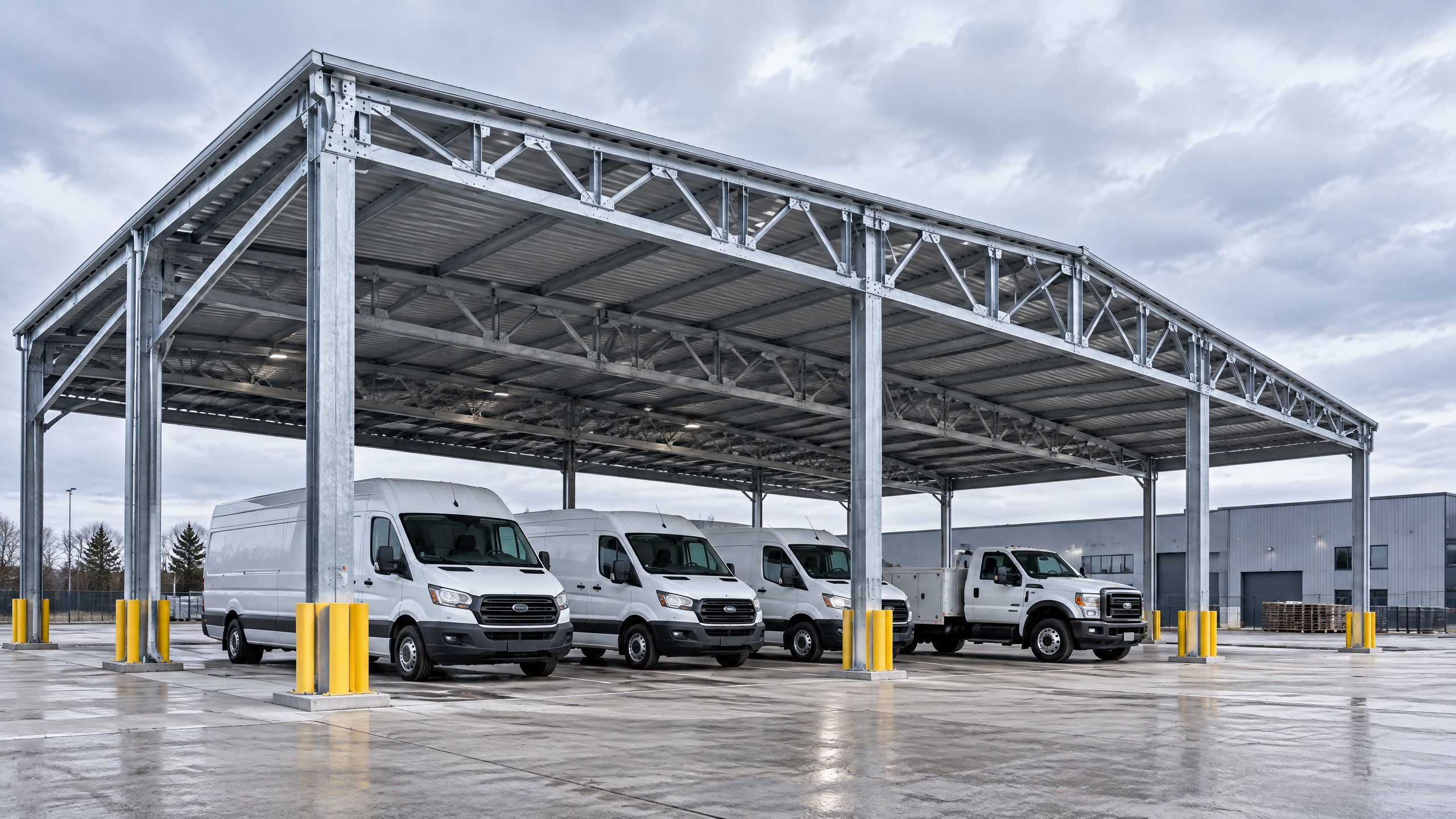
# What Should Fleet Operators Plan Before Procuring a Solar Carport Depot?
Direct answer (first 140 words) Fleet operators must plan depot layout, charging duty and dispatch windows, separate fueling/maintenance zones, electrical capacity and interconnection, photovoltaic (PV) layout, phased construction, and operational safety before procuring a fleet depot solar carport. This guidance focuses on actionable procurement decisions for vehicle fleets (light commercial vans, medium-duty trucks, and small buses) and site-specific responsibilities: operator defines duty cycles, dispatch schedules and on-site processes; the carport supplier engineers structural, PV and mounting systems to site geotechnical and wind/snow loads; the electrical utility or EPC specifies interconnection and metering. This article does not prescribe universal structural dimensions, energy yields, warranty outcomes or approval guarantees.
Buyer context and scope boundary
This guide is for procurement and planning teams in Europe and North America preparing to procure a solar carport system for a fleet depot. It covers decisions the buyer must make, how responsibilities split between buyer, carport manufacturer, electrical contractor and local authorities, and practical workflows for phased construction and operations. It assumes you are planning fixed-location carports over paved or prepared surfaces adjacent to depot buildings; it excludes rooftop photovoltaic on buildings, large grid-side generation plants, or mobile/temporary carports.
Core principle
Design and procurement succeed when site-operational requirements (vehicle duty, turn-around times, fueling and maintenance separation, on-site personnel flow) drive the carport layout and electrical design, and when technical specifications are matched to local codes, utility requirements and phased installation constraints. Make decisions early that lock layout and electrical routing; defer vendor-specific material choices until basic performance and compliance are fixed.
Key responsibilities — who decides what
- Buyer/operator: vehicle mix, duty cycles, dispatch windows, fueling/maintenance separation, required number and type of chargers, preferred phasing and operational continuity constraints, permits and liaison with town/utility.
- Carport manufacturer (e.g., structural supplier): structural layout, column grid, PV mounting system compatibility, integration with mounting products (/products/nordarch, /products/nordflat, /products/solargrid, /products/titan).
- Electrical contractor / EPC: local code compliance for switchgear, transformers, grounding, EV chargers, metering, interconnection studies and protection devices.
- Geotechnical/structural engineer: foundation design, anchor design and embedment comments per project soils and loads (/guides/carport-foundation-requirements).
- Permitting authority / utility: interconnection, fire and access requirements, stormwater treatment and drainage acceptance.
Decision 1 — Fleet duty, charging profile and dispatch windows
Why this matters Charging demand, charger types and PV sizing must align with vehicle duty cycles and dispatch windows. A mismatch leads to unavailable vehicles during peak dispatch or excessive grid demand charges.
Define vehicle types and energy demand per shift
- Create a vehicle roster with daily kilometer/mile targets, typical state-of-charge (SoC) at departure and required SoC on return. These inputs determine kWh requirements per vehicle and per shift. Responsibility: buyer/operator.
- Use duty-cycle histograms to identify peak simultaneous charging requirements and acceptable recharge windows.
Choose charging strategy: opportunity, overnight, or depot fast-charging
- Opportunity charging: short, frequent charges during layovers; requires power distribution near parking bays and chargers capable of many cycles.
- Overnight slow charging: lower peak power but requires parking control and longer dwell times.
- Depot fast-charging: reduces vehicle count needed but increases site peak power and may require utility upgrades and coordination with interconnection processes [DOE—EV charging infrastructure][DOE—workplace-charging-toolkit].
Responsibility: buyer defines; electrical contractor assesses utility impact and cost.
Plan dispatch windows and charging control
- Map out latest acceptable charge completion times and earliest charge start times to design charging schedules (V1G/V2G considerations may follow later).
- Consider smart charging and load management to shave peaks and align PV generation with mid-day operations. The operator should specify required availability SLAs; supplier/EPC evaluates feasibility.
Decision 2 — Layout, circulation and functional separation
Why this matters Carport column placement and circulation must support ingress/egress, turning radii, yard operations, and safe separation of fueling or maintenance to avoid conflicts and fumes.
Circulation and bay layout
- Use vehicle swept-path analysis for largest vehicle and for loaded/unloaded conditions. Define minimum aisle widths, entry/exit gates and queuing zones. Responsibility: buyer (operational inputs) with carport manufacturer verifying clearances.
- Avoid placing columns where delivery/recovery operations or pallet transfers occur.
Fueling and maintenance separation
- Legally and operationally, separate electrically charged parking from internal-combustion fueling and maintenance areas. Locate fueling/maintenance downwind of main parking and provide physical barriers and dedicated ventilation for internal-combustion maintenance bays [EPA—stormwater considerations].
- Define service vehicle routes for tow/recovery and emergency access. Responsibility: buyer/operator defines functional zones; carport and civil designers reflect zones in layout drawings.
Parking control, signage and pedestrian routes
- Specify staff and visitor parking allocation, pedestrian crossings, and emergency egress. Integrate ADA requirements for accessible spaces if public or employee ADA access applies [U.S. Access Board—parking guide].
Table: Example layout variables and who signs them off
| Variable | Typical buyer decision | Supplier/EPC responsibility |
|---|---|---|
| Number of chargers per bay | Buyer defines (based on duty) | Confirms electrical routing, breaker sizing |
| Column grid spacing | Buyer provides clearance needs | Engineering and structural design to meet loads |
| Maintenance/fueling location | Buyer selects location | Ensures exclusion zones and structural clearance |
| Pedestrian crossings & ADA spaces | Buyer/operator defines | Civil designer incorporates into drawings |
Decision 3 — Electrical distribution, utility interface and PV integration
Why this matters Electrical capacity, interconnection and meter arrangements determine the feasible charging rates and PV export or self-consumption strategies. Early coordination avoids costly rework.
Establish utility interconnection and metering strategy
- Early contact with the utility is essential. Initiate interconnection studies to determine whether upgrades (transformer, primary feed) will be required and their lead times. Responsible party: buyer usually initiates; EPC supports and submits studies [DOE—interconnection checklist].
- Decide metering strategy: central meter for site plus submetering for chargers; or per-bay meters for cost allocation. Confirm local metering and revenue metering rules with utility.
Electrical one-line and distribution siting
- Determine locations for switchgear, distribution panels and transformer pads. These should minimize trench lengths from carports to main switchgear while respecting setbacks and maintenance access. Responsibility: EPC produces one-line; buyer approves location relative to depot operations.
- Consider redundancy and segregation of circuits to avoid single-point failures affecting all chargers.
PV and inverter siting, DC/AC routing and equipment selection
- PV arrays integrated into carports reduce cable runs for DC circuits if string inverters are located locally; central inverter stations may require separate enclosures and cooling. Responsibility: carport manufacturer and PV designer define PV layout and module/inverter selections with buyer approving performance goals.
- Include shading analysis from buildings, trees, and stackers as shading severely impacts PV output; buyers should provide future site plans to avoid retrograde shading issues [NREL—PV installation best practices].
Table: Typical electrical items to resolve early
| Item | Why early resolution matters |
|---|---|
| Transformer rating & location | Affects trenching, protection, and footprint |
| EV charger type and communications | Affects cabling, conduit runs and OCPP integration |
| PV export limit policy | Shapes inverter selection and curtailment strategy |
| Load management hardware | Enables peak shaving and EV scheduling |
Decision 4 — Structural, geotechnical and foundation considerations
Why this matters Foundations fix column positions and are costly to relocate. Ground conditions and site constraints set foundation type and procurement timelines.
Geotechnical input and scope
- Commission a geotechnical report to identify frost depth, bearing capacity, groundwater, and obstructions. The report informs foundation types (spread footings, piles, or drilled shafts) and anchorage specifications. Responsibility: buyer commissions; manufacturer requires the report to finalize structural design (/guides/carport-foundation-requirements).
Anchor rods, base plates and embedment coordination
- Anchor rod type, embedment depth and base-plate details should reference project-specific engineering and local code guidance (anchor-rod inspection and installation practices) [AISC—anchor rods information] and relevant special inspection requirements [ICC—IBC Chapter 17].
- Coordinate with precast pavement or concrete curbs to avoid conflicts. Responsibility: supplier details; buyer ensures site preparation meets drawings.
Corrosion protection and materials specification
- Specify material and corrosion protection strategies for the environment (galvanizing, paint systems, or aluminum). Use recognized standards for protective coatings and galvanizing inspection [AGA—specification and inspection; ISO 12944-2]. Responsibility: buyer sets exposure class and desired service life; supplier specifies coatings consistent with standards (/products/titan and /products/nordarch material options).
Decision 5 — PV module, racking and certification path
Why this matters PV modules and racking choices affect performance, maintenance access, and certification tests required for electrical and structural approvals.
Racking compatibility and product selection
- Select racking systems that are certified for the local load cases and that integrate with the carport profile (flat vs pitched; see product lines /products/nordflat, /products/nordarch). Provide the supplier with the approved module list (if buyer has preferences) and performance targets.
Certification and testing expectations
- Plan for required testing and documentation: mechanical load calculations, UL or local equivalents for PV racking and clamping devices, and module documentation [UL—PV racking]. Responsibility: supplier/EPC compiles and provides documentation; buyer confirms acceptance criteria.
O&M access and module replacement strategy
- Specify safe access paths for module cleaning and inverter servicing without disrupting dispatch. Include spare module and inverter allocations for critical fleet bays. Responsibility: buyer defines acceptable downtime windows; supplier designs access.
Construction phasing and continuity of operations
Why this matters Depots often must remain operational; phased construction reduces downtime but increases complexity and costs.
Agree phasing and isolation plans
- Define live-bay tolerances: which bays must remain available during each phase and which may be taken offline. Responsibility: buyer sets continuity requirements; construction manager prepares phased installation and traffic control plans.
Safety and temporary works
- Require site-specific safety plans that address steel erection and concrete readiness, referencing OSHA steel erection and load-keeping standards [OSHA—1926.752; OSHA—1926.1425]. Include fall protection, exclusion zones and lifting plans. Responsibility: contractor provides site safety plan; buyer approves and enforces.
Temporary power and provisional chargers
- Where prolonged construction would impact fleet readiness, specify temporary charging solutions or swappable batteries to maintain operations. Responsibility: buyer identifies need; EPC/contractor supplies temporary equipment.
Operations, maintenance and safety planning
Why this matters Operational readiness determines fleet reliability and long-term asset performance of PV and carport infrastructure.
O&M scope, inspection and documentation
- Define who performs routine inspections, cleaning, and maintenance of PV modules, racking and structural elements. Reference NREL O&M best practices for PV and energy storage [NREL—O&M best practices]. Responsibility: buyer chooses between manufacturer-supplied O&M, third-party PV O&M, or in-house teams.
Special inspections and commissioning
- Identify special inspections required by local building code (for example, IBC Chapter 17 special inspections) and structural anchor inspections [ICC—IBC Chapter 17]. Plan for a commissioning phase to validate charger operation, PV export limits, and control systems. Responsibility: buyer ensures inspections are scheduled; contractor supports testing.
Safety rules and emergency response
- Create site emergency procedures for electrical isolation, EV incidents and battery fires. Train staff and maintain a clear line-of-sight to all operational bays. Responsibility: buyer/operator creates and enforces procedures; contractor provides hazard documentation.
Six-step buyer workflow
- Define operational inputs: fleet roster, duty cycles, dispatch windows, acceptable downtime and required charger availability. (Buyer)
- Commission geotechnical survey and obtain utility interconnection pre-application info. (Buyer)
- Issue RFQ to carport manufacturers and EPCs including duty cycles, layout constraints, phasing, and required deliverables (anchor details, one-line, PV layout). Reference product preference if any (/products/solargrid; /products/nordarch). (Buyer)
- Evaluate responses for integrated proposals: structural drawings, electrical one-line, interconnection plan, foundation design assumptions and a phased construction plan with safety measures. (Buyer)
- Finalise contract with clear responsibilities for permits, special inspections, acceptance testing and O&M handover. (Buyer + Supplier)
- Execute construction in agreed phases, complete special inspections, commission chargers and PV, and establish O&M schedules and spare-part inventories. (Contractor + Buyer)
Mid-article CTA If you need an integrated proposal that aligns fleet duty cycles with carport PV and charger planning, start the procurement conversation: /inquiry or email info@carportiva.com for a project checklist and template RFQ.
Procurement documents and technical specification checklist
Why this matters A clear technical package reduces ambiguity and aligns bidders.
Minimum documents to include in RFQ
- Site plan with elevation and utility point-of-connection.
- Geotechnical report and subsurface utility survey (or instructions for party responsible).
- Vehicle schedules, expected simultaneous charging and dispatch windows.
- Performance objectives for PV self-consumption vs export and any required inverter behaviors.
- Phasing constraints and continuity requirements.
- Acceptance criteria for structural and electrical commissioning and who pays for rework.
Sample acceptance tests
- Visual and torque checks for anchor rods and base plates per AISC best practices; bolt torque verification at erection [AISC resources].
- Electrical commissioning: insulation and polarity checks, ground-fault tests, functional tests for chargers and energy management systems.
- PV commissioning: IV curve checks, string continuity and inverter protection functional tests. Responsibility: contractor supplies test records; buyer retains copies.
Risk areas and mitigation strategies
Why this matters Reducing procurement risk reduces schedule and cost overruns.
Utility upgrade delays
- Mitigation: early utility engagement and options for temporary generation or phased charger roll-out to match available capacity.
Unforeseen site conditions
- Mitigation: geotechnical scope clarity, contingency funds, and decision gates that allow design iteration without contract disputes.
Interference with depot operations
- Mitigation: detailed traffic management plans, temporary chargers, and enforced exclusion zones.
Costing and procurement strategy (practical pointers)
Why this matters Tender clarity on responsibilities prevents change orders.
Lump-sum vs. unit-price elements
- Consider lump-sum for carport supply and structural erection, unit-price or provisional sums for foundations where soil uncertainty exists. Responsibility: buyer chooses contracting model.
Vendor pre-qualification
- Pre-qualify vendors with demonstrated carport installations in similar climates and documented references. Request evidence of material standards compliance (galvanizing spec, aluminum designation per ANSI H35, etc.) [Aluminum Association; AGA].
Warranty and spare parts
- Require defined spares list and lead times in bid. Avoid asserting universal warranty performance; instead require manufacturer warranty terms as part of the contract.
Safety, codes and standards to reference (practical list)
- Structural loads: ASCE/SEI 7-22 (US) and Eurocode 1 (Europe) for wind, snow and other actions [ASCE 7-22; Eurocode 1].
- Anchor rods and embedments: AISC anchor rod guidance and installation practices [AISC].
- Special inspections: IBC Chapter 17 for jurisdictional special inspection triggers [ICC—IBC Chapter 17].
- Steel/aluminum material standards: Aluminum Association design manual and aluminum standards [Aluminum Association].
- Galvanizing and paint systems: American Galvanizers Association and ISO 12944-2 for corrosivity and paint system selection [AGA; ISO 12944-2].
- PV racking certification and testing: UL or local equivalent standards for PV racking and mounting devices [UL—PV racking].
- Site safety: OSHA steel erection and load keeping and load separation standards during erection [OSHA—1926.752; OSHA—1926.1425].
- Stormwater and runoff planning: EPA guidance for urbanization and stormwater runoff where new impermeable area is added [EPA—stormwater runoff].
FAQ
Q: Who is responsible for obtaining the interconnection agreement with the utility? A: Typically the buyer initiates contact and provides authorization for the EPC or chosen contractor to submit applications; contractually assign submitting and paying responsibilities in procurement documents. The utility may require the site owner to be the applicant for some processes [DOE—interconnection checklist].
Q: Can PV offset charger peak demand fully? A: That depends on PV sizing, dispatch windows and charger power. PV typically reduces energy consumed from the grid during daylight but rarely eliminates peak demand unless paired with energy storage and active load management. Determine objectives early and plan for demand-management hardware in the scope.
Q: Who must sign off special inspections? A: Local building officials follow code triggers; IBC Chapter 17 lists typical special inspection requirements. The project should list responsible parties for scheduling and funding special inspections in the contract [ICC—IBC Chapter 17].
Q: How do I manage snow and ice for carport-mounted PV? A: Snow load design and drift effects must be addressed in structural calculations. If frequent manual snow clearing is expected, specify safe access and module handling procedures. Refer to local snow load standards and product guidance (/guides/aluminium-carport-snow-load-guide).
Q: What about stormwater from increased impermeable areas? A: Incorporate stormwater mitigation in civil design per EPA guidance. Carport roof runoff may be routed to infiltration, attenuation or municipal systems per permit conditions [EPA—stormwater runoff].
Q: Where should I specify corrosion protection? A: Define exposure class and desired service life in the procurement documents. Require compliance with galvanizing inspection standards and paint system specifications (ISO 12944-2) and list material standards (Aluminum Association design manual).
Conclusion
Fleet depot solar carport procurement hinges on early, clear decisions: set your fleet duty cycles and dispatch windows, separate fueling/maintenance areas, secure utility interconnection inputs, commission geotechnical work, and require phased construction and rigorous safety and inspection regimes. Define responsibilities in your RFQ so bidders deliver coordinated structural, electrical and PV designs that match depot operations. Carportiva products and guidance can be referenced during procurement stages: /products/nordarch, /products/nordflat, /products/solargrid, /products/titan and planning guides (/guides/carport-foundation-requirements; /guides/aluminium-carport-snow-load-guide).
Closing CTA Ready to translate your fleet duty data into a procurement package? Start with our project checklist or request a scoping call: /inquiry or info@carportiva.com.
References
Bring the actual project brief to the engineering table.
Share your location, layout, target application and available technical inputs. Carportiva can help identify the relevant product-interface information before a project-specific commercial discussion.
Request a project discussion