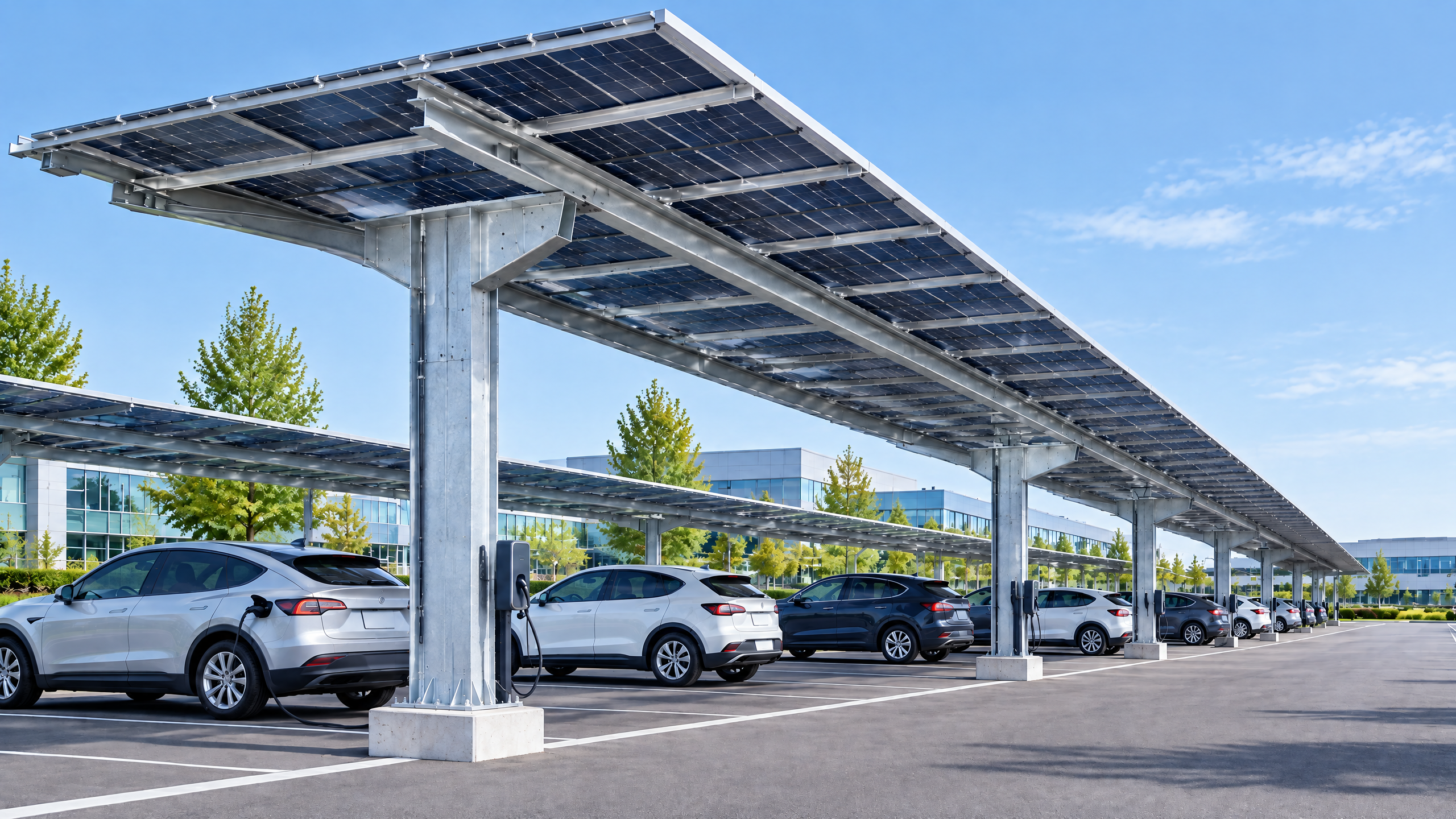
Direct answer (150 words) Buyers assessing a university parking canopy solar ready solution should treat it as a combined civil, structural, electrical and operational project rather than a simple product order. Prioritize a decision framework that balances site-specific constraints (parking demand, vehicle clearance, stormwater and flood exposure), functional interoperability (PV system, EV charging, lighting, signage) and procurement model (turnkey EPC, supply-only, design-build). Require documented evidence of structural canopy specification, factory quality control, installation readiness and performance guarantees before award. Validate the proposed commercial parking layout and vehicle clearance planning against campus circulation and accessibility standards [1][4], and build an explicit project phasing plan that protects campus operations during construction. Engage local qualified structural and electrical engineers, permitting authorities and installers early: site-specific structural capacity, foundations, permits, electrical design, approvals, lead time, price, energy yield and warranty require a documented project basis and relevant local qualified professionals, installers, utilities and authorities.
Buyer context and scope boundary: what "solar ready" means for campus projects
What buyers often mean by "solar ready" differs. For universities the term should be scoped precisely: is the canopy intended to carry PV modules at handover, or to be structurally and electrically prepared for later PV installation? For procurement clarity, define whether the scope includes:
- Full solar integration (PV modules, inverters, metering and interconnection).
- Structural and electrical provisions only (rails, conduits, provisional combiner/AC rooms).
- A hybrid phased delivery (canopy now, PV later under defined phasing).
Distinguishing these options matters for structural sizing, electrical routing, site safety and campus operational coordination. University sites typically combine high pedestrian traffic, variable vehicle types (shuttles, delivery trucks) and formal campus access/permit regimes; that elevates the importance of formal design interfaces and an agreed project phasing plan.
Scope boundary checklist (typical items to confirm in RFQ/RFP):
- Structural scope: permitted loads for PV and snow/wind, foundation type.
- Electrical scope: inverter siting, AC/DC routing, metering and grid interconnection.
- Civil scope: drainage, curbs, lighting, pavement reinstatement.
- Operational scope: traffic management, ADA-accessible parking, campus scheduling.
- Warranty and maintenance: canopy structure, PV warranty (if included), workmanship.
Include the phrase "university parking canopy solar ready" in the procurement documents to make clear the specific requirement for structural and electrical preparation for PV.
Core decision principle: minimize lifecycle integration risk
The core procurement principle is to minimize lifecycle integration risk by reducing the number of unresolved technical interfaces at contract close. For B2B buyers this means preferring solutions that:
- Provide a single accountable technical lead for structural and electrical interfaces, or an explicitly defined integration manager when multiple vendors are used.
- Deliver factory-validated structural components with traceable material certification and quality records.
- Include documented installation readiness evidence (shop drawings, foundation design, sequencing and safe access plans).
- Align warranty windows so structural warranty covers the period during which PV installation occurs (if phased).
A decision matrix framed around integration risk, schedule control and capital allocation helps buyers select the procurement route that fits campus risk appetite and operational constraints.
Decision table 1 — Procurement model comparison (high-level)
| Procurement model | Integration risk | Schedule control | Single-point accountability | Typical best fit |
|---|---|---|---|---|
| Turnkey EPC (canopy + PV) | Low | High | Yes | Campus wanting single supplier and minimal integration risk |
| Design-Build (canopy + PV subcontracted) | Medium | Medium | Often yes | Projects requiring design flexibility with fewer contracts |
| Supply-only canopy (PV later) | High | Buyer controls PV schedule | No | Universities managing their own solar program or phased budgets |
| Design-Bid-Build (separate canopy and PV contracts) | High | Low | No | When procurement rules force separate contracts or competitive trades required |
Use this table to decide early whether the canopy supplier will deliver PV or only enable it; the chosen path drives the rest of procurement documentation and timelines.
Planning inputs: data and stakeholder inputs you must collect first
A defensible campus procurement starts with data. The following inputs define feasibility and sizing for a university parking canopy solar ready solution.
Site and usage data
- Existing and anticipated commercial parking layout, peak occupancy, reserved spaces, and ADA-required spaces. Reference accessible parking guidance where applicable [1].
- Vehicle typology and maximum vehicle height for vehicle clearance planning (buses, shuttle coaches, delivery vehicles, maintenance trucks).
- Traffic flows, ingress/egress constraints and emergency access routes.
Environmental and geotechnical data
- Geotechnical report: bearing capacity, groundwater table, depth to rock and frost line.
- Flood and inundation risk: use local flood mapping and FEMA guidance for U.S. campuses [2].
- Wind and snow load criteria per local codes and insurers.
Electrical and infrastructure data
- Point of interconnection, existing switchgear capacity, available fault-current data.
- Campus metering architecture and tariff structure.
- Space for inverters, batteries (if any), SCADA and communications.
Regulatory and approvals
- Local building codes, electrical codes and campus permitting processes.
- Utility interconnection requirements and study lead times.
- Accessibility and traffic control requirements; consult [1] and FHWA guidance for roadway/parking integration [4].
Stakeholders and operational constraints
- Campus operations managers, security, facilities maintenance, IT/networking, sustainability office and procurement/legal teams.
- Operations windows and preferred seasons for construction.
- Project phasing constraints: exam weeks, move-in/move-out periods, commencement.
Planning inputs determine the structural canopy specification and inform whether the project requires a full PV installation or only preparatory works.
Decision table 2 — Planning inputs and minimum evidence required
| Input category | Evidence required for procurement | Typical source/responsibility |
|---|---|---|
| Parking layout & demand | Marked plan showing existing spaces, reserved/ADA spaces, peak counts | Campus transportation/planning |
| Clearance & vehicle types | Max vehicle height envelope and swept path diagrams | Fleet manager/operations |
| Geotechnical | Borehole logs, bearing capacity, groundwater level | Geotech engineer |
| Flood risk | Elevation certificates/flood maps | Campus civil or local authority (FEMA maps for U.S.) [2] |
| Electrical capacity | Single-line diagram, switchboard ratings, fault current | Campus electrical engineer/utility |
| Permits & approvals | List of required permits and estimated lead times | Local permitting authority / campus compliance |
| Program constraints | Construction windows, phased openings | Campus scheduling/operations |
Use these evidence items as prescriptive RFQ attachments — bidders should price to the documented basis; if a bidder assumes additional risks, they must price them.
Technical specification and interfaces: what to require in the RFP
The technical section of the RFP must define both the equipment performance and the interface responsibilities. When evaluating "university parking canopy solar ready", include explicit clauses for:
Structural and materials
- structural canopy specification: design loads (dead, live, snow, wind and seismic), material grades (aluminium alloy grade, galvanic isolation where dissimilar metals contact), corrosion protection (architectural coating or anodizing details).
- Module support system: rail spacing, module clamps, tilt (if required) and module replacement access.
- Foundation types and design assumptions (embed depth, anchor bolt pattern). Note: final foundation design must be based on local geotechnical reports and not treated as a standard item unless a site investigation is supplied.
Clearances and circulation
- Vehicle clearance planning: minimum vertical clearance for each parking type and delineated pedestrian zones and canopies’ overhang limits.
- Pedestrian pathways and accessibility clearances to comply with campus accessibility standards and local regulations [1].
Electrical interfaces
- Conduits and raceways: designated pull points and lengths, conduit sizes for DC and AC runs, separation requirements for high-voltage systems and data/communication cables.
- Dedicated space for inverters, combiner boxes, metering and AC distribution; coordinate with campus electrical rooms.
- Earthing and lightning protection: earthing strategy aligned with campus practice and electrical codes.
Operational interfaces
- Operational access coordination for deliveries, waste collection and emergency services during construction and operation.
- Lighting integration and control (photocell/timer requirements), signage, and CCTV supports.
Installation and maintainability
- Installation readiness: provide fabrication drawings, Erection Method Statements (IMS), lifting plans and temporary works designs for approval before site mobilisation.
- Maintenance access: clear access routes for module cleaning, inverter replacement and canopy inspection.
Performance and compatibility
- If PV is included, specify module and inverter performance standards (IEC/UL where applicable), monitoring requirements and acceptance tests.
- If PV is deferred, require documentation that the canopy’s electrical provisions are compatible with the campus’ preferred inverters and equipment types.
Reference codes and safety
- Reference local building and electrical codes; require compliance statements. Include OSHA requirements for construction safety and fall protection in the contractor’s plan [3].
Insisting on these interfaces reduces silent assumptions and potential scope gaps between canopy and PV contractors.
Procurement and factory evidence: what proofs to demand pre-award
In addition to price and schedule, B2B buyers should assess supplier capability through documentary evidence. Accepting a canopy that is “solar ready” without factory and test evidence compounds risk.
Minimum procurement evidence checklist
- Manufacturing quality system: ISO 9001 or equivalent process documentation, factory inspection procedures and non-conforming product handling.
- Material certification: mill certificates for alloys, fasteners, weld procedures and coating certificates.
- Shop drawings and B.O.M.: clearly identify all structural components, finishes, and dimensional tolerances.
- Load calculations and signed structural design by a qualified structural engineer licensed in the project jurisdiction (or an agreement to supply such stamped drawings prior to fabrication).
- Factory Acceptance Test (FAT) plan: outline of tests to be performed on critical assemblies, welding inspection regimen and dimensional checks.
- Pre-shipment inspection reports and packaging protocols.
- Lead times and production schedule linked to committed milestones.
- Traceability and as-built documentation: weld maps, torque records, as-built drawings and commissioning records.
When PV is supplied alongside canopy, require additional evidence:
- Module and inverter datasheets, certifications (e.g., IEC/UL where applicable), performance warranty commitments from module/inverter manufacturers.
- SCADA and monitoring interface details.
- Grid interconnection responsibility statement indicating who will manage utility applications and commissioning.
Evaluation criteria
- Technical completeness of response (shop drawings, BOM).
- Demonstrated local delivery / installation experience or credible installation partners in the jurisdiction.
- Factory control and supply chain visibility for critical components (aluminium sections, fasteners, glass).
- Responsiveness of post-contract support and spare parts availability.
Link procurement to product lines: if you are considering integrated systems, request specifics about the SolarGrid commercial solar system and how it integrates with the canopy structure. For broader exploration, review all systems and our sourcing guides for procurement templates and supplier comparison frameworks.
Site installation, operations and campus coordination
Installation of parking canopies on a live campus is a logistics exercise. Execution planning must cover traffic management, safety, staging, storage, hoisting and contingency plans.
Installation readiness checklist
- Site has clear temporary storage areas and lifting zones; routes from storage to installation points are defined and obstruction-free.
- Erection method statements, temporary works design and crane lifts are approved by campus authorities.
- Traffic management plan: temporary closures, signed diversions and coordination with campus security and transport teams.
- Staged demolition or removal of existing infrastructure is sequenced to maintain minimum operational parking and avoid critical massing during events.
- Installation teams have defined access windows to avoid peak campus activity; identify after-hours or weekend work requirements where necessary.
Operational access coordination is critical: coordinate with vehicle departments, shuttle services and emergency services to prevent disruptions. Provide a single operations liaison that campus teams can contact during delivery and installation.
Safety and training
- Require contractor site safety plan, site-specific risk assessments and personnel certifications.
- Provide campus-specific inductions for all site workers and ensure ID/badging and restricted-area procedures are followed.
- Include fall protection, electrical isolation procedures and confined-space protocols consistent with OSHA and local safety rules [3].
Commissioning and handover
- For PV-inclusive projects, define tests: insulation resistance, string IV curves, inverter functional checks, protection coordination and utility meter installation.
- Deliverable list: as-built drawings, O&M manuals, spare parts list, maintenance access instructions and warranty certificates.
- Training: operator and maintenance staff training sessions and written maintenance schedules.
Logistics and environmental controls
- Dust suppression, noise management and waste handling plans (especially in academic settings).
- Protection of campus landscaping and underground utilities during foundation works.
Operationally, consider phased opening of parking bays to maintain revenue and user satisfaction during the works.
Implementation risk: common failure modes and mitigation strategies
Understanding and mitigating risk is the heart of B2B procurement for "university parking canopy solar ready." Common failure modes include hidden ground conditions, misaligned electrical interfaces, insufficient clearances and scheduling conflicts.
Risk register highlights and mitigations
- Incomplete geotechnical data: mitigate by commissioning a targeted geotechnical program before issuing the final RFP. Include allowance for rock or high groundwater conditions.
- Undefined electrical interconnection responsibility: assign responsibility and require bidders to confirm utility application ownership and timeline.
- Mismatch between canopy anchor layout and existing drainage/utility routes: require utility locate drawings and underground service scans prior to foundation design.
- Insufficient vehicle clearance for maintenance and special vehicles: incorporate vehicle clearance planning into earliest design stages and validate with swept path analysis.
- Delivery and storage constraints on compact campuses: plan just-in-time deliveries and temporary off-site storage where necessary; require logistics plan in the tender.
- Warranty and maintenance ambiguity when suppliers split responsibilities: contractually tie warranties to a single accountable party or specify interface-tested warranty obligations.
- Scheduling conflicts with campus events and academic calendar peaks: develop a project phasing plan that identifies non-working windows and sanctions for schedule overruns.
Insurance and contract clauses
- Require performance bonds or parent company guarantees for high-value turnkey contracts.
- Define liquidated damages for missed operational milestones that impact campus activity.
- Clearly specify latent defect periods and operational acceptance criteria.
Remember: do not assume that "solar ready" removes responsibility for final PV integration; contractual clarity prevents downstream disputes.
Six-step buyer workflow (named and actionable)
This named workflow gives procurement teams a structured path from feasibility to handover.
- Define — Campus Basis of Design (BOD)
- Produce a succinct BOD that includes parking counts, vehicle clearance envelopes, electrical interconnection point and preferred procurement model (turnkey vs supply-only).
- Deliverable: BOD document and a confirmed list of stakeholders.
- Investigate — Site and Technical Surveys
- Commission geotechnical boreholes, topographic survey, utility locate and vehicle swept-path studies.
- Deliverable: Site survey pack and geotechnical report.
- Specify — Technical RFP and Integration Requirements
- Draft a technical RFP that includes structural canopy specification, electrical raceway layout, foundation assumptions and installation readiness requirements.
- Deliverable: RFP with evaluation criteria and contractual sample terms.
- Procure — Evaluate Bids and Validate Suppliers
- Evaluate bids for technical compliance, factory evidence, lead times and local installation capability. Conduct supplier factory or third-party inspections as required.
- Deliverable: Supplier selection report and negotiated contract with milestones.
- Execute — Construction, Coordination and Commissioning
- Implement construction with staged traffic management, operational access coordination and safety oversight. Conduct commissioning tests and handover.
- Deliverable: Commissioning report, as-built drawings and training sessions.
- Operate — Warranty Handover and Maintenance Regime
- Ensure warranty certificates, maintenance plans and spare parts are delivered. Monitor initial performance and resolve defects during the defect liability period.
- Deliverable: Complete project file, warranties and maintenance schedule.
Use this workflow as a procurement checklist; each step should produce a short, sign-offable deliverable before proceeding.
FAQ — focused practical answers for B2B buyers
Q: What is the difference between "solar ready" canopy and a canopy with PV installed? A: “Solar ready” commonly means the structure and electrical provisions (rails, conduits, structural capacity) are provided to accept PV modules later. A canopy with PV installed includes modules, inverters, monitoring and interconnection. The two have different technical, warranty and integration implications.
Q: How should I handle ADA and accessible parking requirements? A: Integrate accessible parking planning early and confirm requirements with campus compliance officers. Designated accessible bays must meet dimensions and access aisle requirements; consult the U.S. Access Board guidance where applicable [1].
Q: What vertical clearance should be specified? A: Specify clearances based on the tallest expected vehicles plus a safety margin. Document this in the RFP and verify with vehicle clearance planning and swept-path analysis.
Q: Who should design the foundations? A: Foundation design must be based on local geotechnical data and a qualified structural engineer’s analysis. The foundation responsibility should be contractually assigned and tied to site investigations.
Q: What are typical lead times? A: Lead times vary by system, finishes and site complexity. Require bidders to provide a committed production and delivery schedule. Lead time estimates should be backed by factory capacity statements and agreed milestones.
Q: How do I manage phased delivery (canopy now, PV later)? A: Require that structural warranties cover the period until PV is installed and define the extent of electrical provisions delivered. Include an agreed installation readiness checklist so later PV installers can connect without rework.
Q: What do I require for electrical interconnection? A: Require a single-line diagram showing proposed PV connection, inverter locations, AC distribution and metering. Define who obtains utility approval and coordinates the interconnection study.
Q: Are there campus-specific safety concerns? A: Yes. Campus projects often need site-specific inductions, background checks, and controlled working hours. Safety plans must consider pedestrian mixing and campus events.
Q: How do I evaluate manufacturer claims about corrosion resistance or coatings? A: Require material certificates and coating process documentation (e.g., type and thickness of powder coat or anodizing) and, where available, third-party test reports. Do not accept marketing claims without evidence.
Q: Who manages warranty claims when canopy and PV are supplied separately? A: Contractually define warranty holders and interface obligations. Where possible, require interface-tested agreements and defined escalation pathways for defects involving both structure and PV.
Evidence and verification: what to inspect before and after award
Pre-award verification
- Factory inspection: dimensional checks, weld quality, coating inspection and sample assembly.
- Review of structural calculations and signed engineer stamps where local law requires.
- Confirmation of material certificates and fastener traceability.
Pre-shipment and on-site verification
- Check packaging, lifting points and sea/land transport restraints.
- Verify anchor bolt templates, embedment accuracy and foundation as-built against the shop drawings.
- Validate conduit and raceway placement before pavement reinstatement.
Post-installation and commissioning
- Structural inspection for alignment, bolt torque checks and coating touch-ups.
- Electrical insulation and polarity tests, verification of inverter settings and protection coordination.
- Final acceptance tests and signed commissioning records.
Document retention
- Ensure the supplier provides a comprehensive project folder: as-built drawings, FAT and SAT reports, material certificates and maintenance manuals.
Contracts, warranties and long-term maintenance
Procurement documents should clearly define warranty periods, scope of coverage and responsibilities for latent defects. For phased projects, align the structural warranty start/stop dates with the timing of PV installation.
Key contractual items
- Warranty: structural warranty period, corrosion warranty terms and workmanship coverage.
- Performance guarantees: if PV is included, define yield guarantees and measurement methodology.
- Spare parts and critical component support: lead times for replacement modules, clamps and electronics.
- Service-level agreements for response times to defects and emergency repairs.
Maintenance planning
- Establish regular inspection intervals: structural inspections after extreme weather events, electrical inspections per inverter manufacturer recommendations.
- Define cleaning schedules and acceptable cleaning methods for modules (if PV active).
- Require training for campus maintenance staff and documented maintenance checklists.
Conclusion — pragmatic procurement choices for campus decision-makers
When evaluating "university parking canopy solar ready" solutions, buyers must combine rigorous technical specification, evidence-based supplier evaluation and carefully sequenced execution planning. The most successful campus projects reduce interface ambiguity, align responsibility for critical outcomes and build an installation and commissioning pathway that protects daily campus operations. Early investment in accurate site surveys, geotechnical data and explicit design requirements minimizes change orders and preserves energy and operational value over the canopy’s lifetime.
If you are preparing an RFP or want to evaluate integrated options, ask suppliers for the specific documentation outlined above and require proof of factory processes and installation readiness. For integrated canopy-plus-PV solutions, review options such as the SolarGrid commercial solar system for product-level compatibility with canopy structures.
Start a procurement conversation with our team: /inquiry or info@carportiva.com
Note: site-specific structural capacity, foundations, permits, electrical design, approvals, lead time, price, energy yield and warranty require a documented project basis and relevant local qualified professionals, installers, utilities and authorities.
Closing CTA
For project-specific guidance, RFP templates or to review integration with our product range including all systems and to access sourcing guides, contact our technical procurement team: /inquiry or info@carportiva.com
References
- U.S. Access Board parking guidance: https://www.access-board.gov/ada/guides/chapter-5-parking/
- FEMA flood maps: https://www.fema.gov/flood-maps
- OSHA construction standards: https://www.osha.gov/laws-regs/regulations/standardnumber/1926
- Federal Highway Administration: https://highways.dot.gov/
References
- U.S. Access Board parking guidance: https://www.access-board.gov/ada/guides/chapter-5-parking/
- FEMA flood maps: https://www.fema.gov/flood-maps
- OSHA construction standards: https://www.osha.gov/laws-regs/regulations/standardnumber/1926
- Federal Highway Administration: https://highways.dot.gov/
Keep the project brief connected.
Bring the actual project brief to the engineering table.
Share your location, layout, target application and available technical inputs. Carportiva can help identify the relevant product-interface information before a project-specific commercial discussion.
Request a project discussion