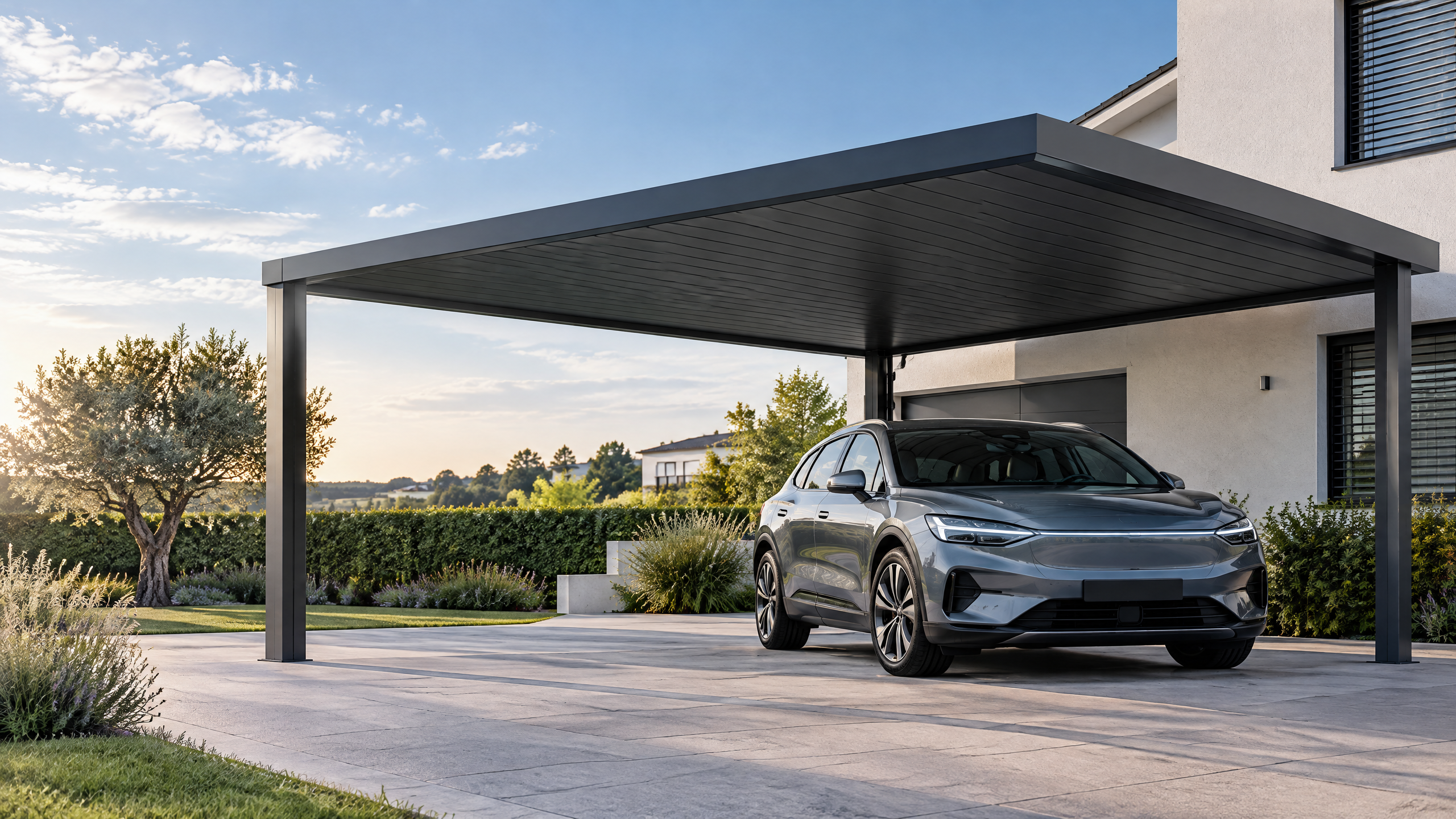
Direct answer (120–180 words) Confirm that the architectural carport supplier can deliver a complete, auditable design and delivery package that matches your site constraints, procurement model and integration needs. At a minimum verify: contract drawings and clear architectural carport details for interfaces and finishes; complete architectural carport specifications that list materials, tolerances and coatings; evidence of appropriate material performance for aluminium carport roof panels and thermal needs including aluminium carport roof insulation; a documented aluminium carport roof drainage layout; foundation and anchor interface requirements; manufacturing QA and traceability; logistics, installation scope and responsibility split; spare parts and maintenance access. Do not assume structural capacity, permit approval, code compliance, lead time, price, energy yield or warranty coverage without documented, project-specific confirmation from the supplier and local qualified professionals. Final site decisions must be made by your engineers, authorities and installers.
Why this checklist matters for B2B sourcing
Buying architectural aluminium carports is a systems decision: aesthetics, site logistics, thermal performance, drainage, and installation risk are tightly coupled. Confirming the items below reduces risk during design review, tender evaluation and contract handover. This guide focuses on objective verification steps you can require of any architectural carport supplier prior to contract signature.
What to request up front from any architectural carport supplier
- A complete design package: drawings, section details, connection details, and a bill of materials.
- Clear lists of architectural carport details and architectural carport specifications: finishes, tolerances, fasteners, and sealants.
- Roof system particulars: type and material of aluminium carport roof panels, their spanning and fixings, and any insulation system specified (aluminium carport roof insulation).
- Drainage design: a marked aluminium carport roof drainage layout showing fall, outlets, gutters and interface with site stormwater.
- Manufacturing & QA evidence: process descriptions, material traceability, and checklists used during fabrication.
- Logistics and installation scope: who supplies foundations, scaffolding, electrical interface, earthing, and commissioning tasks.
Use the supplier’s package as the baseline for your own procurement documents and for tender clarifications.
Design deliverables to evaluate (decision table)
| Deliverable | Minimum content required | How you use it |
|---|---|---|
| General arrangement drawings | Plan, elevations, gridlines, module repeats | Confirm site fit and vehicle/clearance requirements |
| Connection & foundation drawings | Anchor types, embedment, recommended ground conditions | Provide to structural engineer for ground verification |
| Architectural carport details | Joints, flashing, edge trims, parapets | Review aesthetic and interface details with adjacent works |
| Architectural carport specifications | Material grade, finish, fastener types, production tolerances | Include in purchase order and quality control plan |
| Aluminium roof data | aluminium carport roof panels data sheets, fastener pattern | Confirm water, wind and load interface with structural engineer |
| Drainage drawings | aluminium carport roof drainage layout, outlet sizes, fall | Integrate with site stormwater and building drainage plans |
Materials, finishes and thermal performance
Confirm the exact alloy, temper and surface finish for all exposed aluminium elements. Ask for manufacturer datasheets and for the supplier to identify coatings or anodising processes used. Include the NordArch architectural aluminium system or equivalent in your review if you require standardised extrusions and interfaces from known systems.
When roof thermal performance matters, review the specified aluminium carport roof insulation and any vapour control layers. The specification should state thermal values, material thickness, fixings and fire classification where applicable. Do not rely on generic statements — require measurable data and installation detail for on-site verification.
Relevant questions:
- Are panel joints thermally insulated or thermally broken?
- How are condensation and thermal bridging addressed where roof meets structure?
For broader system choices, consult your procurement team’s approved product lists or refer to the company’s systems pages for standardised options (all systems).
Water management and drainage
An explicit aluminium carport roof drainage layout is essential. The drawing should show fall direction, gutter sizes, scuppers or outlets, and connection details to site stormwater. Confirm how the supplier handles ponding limits, overflows, and snow/drift loads if relevant to your climate.
Decision table — Drainage acceptance criteria
| Drainage item | Acceptable evidence | Decision trigger |
|---|---|---|
| Fall and capacity | Calculated fall, gutter capacity, outlet sizes | Accept if capacity meets site's design rainfall or requires modification |
| Outlet locations | Outlets marked relative to modules and structure | Accept if clear for integration with site drains |
| Waterproofing detail | Flashing, membrane junctions, sealant specification | Accept with installation methodology and inspection points |
| Ice/snow provision | Drip edges, heated outlets or overflow | Require design change if site climate demand not shown |
Integration with site drainage is a civil/structural responsibility — share the supplier’s drainage layout early with civil engineers and local utility providers.
Structural interfaces and foundations
The supplier must provide anchor and interface details that allow your structural engineer to check ground conditions and foundation sizing. These are not structural calculations; they are inputs. Require the supplier to specify anchor types, allowable pull-out values or recommended embedment, and any pre-cast or cast-in components.
Remember: suppliers provide interface drawings and recommended anchor loads; only a local qualified structural engineer may approve foundation designs and certify compliance with applicable codes (for example local adoption of Eurocodes) [1]. Do not accept assumptions about capacity without those professional confirmations.
Manufacturing, quality assurance and factory acceptance
Request a documented QA plan and traceability for primary materials. For aluminium products, standards and best practice around alloy selection and surface treatment are relevant; verify material certificates where needed [2]. Ask for inspection points, dimensional tolerances, and a factory acceptance test (FAT) protocol that you or your representative can observe.
Typical FAT items:
- Dimensional check of modular extrusions
- Sample coating/anodising report
- Fastener and hardware match tests
- Pre-assembly fit check for standard modules
Include a clause that defines acceptance criteria and non-conformance processes.
Logistics, installation scope and handover
Define who is responsible for:
- Site storage and protection
- Offloading and temporary handling equipment
- On-site assembly and final fixings
- Interfaces with electrical, solar, lighting, or security trades
- Final cleaning, protection removal and snagging
If your project integrates PV or fleet charging, confirm electrical interface points, structural allowances for additional loads, and cable routing. Clarify what is included in the supplier’s installation scope and what requires a specialist installer.
For project planning and procurement best practices consult related materials on procurement strategy in our sourcing guides.
Procurement decision table — supplier evaluation
| Evaluation area | Good evidence | Red flags |
|---|---|---|
| Design completeness | Full drawings, material schedules, details | Missing interface or drainage drawings |
| Material traceability | Certificates, alloy & finish specs | No traceability or vague material names |
| QA & testing | FAT protocol, inspection checkpoints | No QA plan or undefined acceptance criteria |
| Installation scope | Clear responsibilities, lifting plans, installation drawings | Vague scope, “by others” without clarity |
| Logistics | Lead-time windows, packing plans, transport size | Unverified transport dimensions; unclear handling |
Use this table to score suppliers objectively and shortlist for tender.
Named buyer workflow: The CARPORT procurement path (5 steps)
- Confirm Requirements — Collect site data, clearances, design intent and required integrations (PV, lighting, charging).
- Request Package — Issue an RFQ requesting drawings, architectural carport details, architectural carport specifications, and drainage layout.
- Review & Verify — Share supplier deliverables with structural, civil, MEP and local authority consultants for comment.
- Negotiate & Contract — Finalise scope, installation responsibilities, QA acceptance, and spare parts. Include provision for on-site variation process.
- Mobilise & Handover — Accept FAT, schedule delivery, supervise installation and confirm handover package with as-built drawings and maintenance instructions.
This workflow aligns procurement milestones with technical verification and helps avoid scope gaps.
Mid-article CTA Ready to request a complete supplier package? Submit your project brief through our inquiry path: /inquiry or contact us at info@carportiva.com.
Commercial terms, lead time and risk allocation
Insist on transparent contract terms that define:
- What is included with delivery vs installation
- Milestone payments tied to deliverables (drawings, FAT, delivery, commissioning)
- Spare parts, fasteners and field adjustments
- Liability split during transport and installation
- Inspection and acceptance criteria
Do not accept lead times, price or warranty statements without written, project-specific confirmation. These items are outside the scope of product data and must appear in the commercial contract.
Scope boundaries and final decision authority
This guide identifies what to confirm and how to evaluate supplier data. It does not promise structural capacity, permit approval, code compliance, lead time, price, energy yield or warranty. Those are site-specific and contractual matters.
Final approvals and site-specific decisions must be made by:
- Local qualified structural and civil engineers for foundations and load capacity
- Authorities having jurisdiction for permits and code compliance
- Utility providers for drainage and electrical connections
- Accredited installers for on-site assembly and commissioning
Carportiva or any supplier provides documentation and recommendations; they do not replace local professional approval.
Handover documentation you must require
- As-built drawings and revision history
- Maintenance schedule and spare parts list
- Coating/finish certificate and manufacturer recommendations
- Installation completion checklist and signed acceptance
- Drainage as-built showing actual outlet positions
These documents support future maintenance and warranty administration.
Frequently asked questions
Q: What is the difference between architectural carport details and architectural carport specifications? A: "Architectural carport details" are drawing-level items—junctions, trims and interface specifics—while "architectural carport specifications" are textual and tabular descriptions of materials, finishes, tolerances and performance requirements used in procurement and QA.
Q: Will you provide structural calculations? A: Suppliers provide connection and anchor details and recommended design inputs. Structural calculations and approvals must be produced or reviewed by your local structural engineer or a qualified professional (see scope boundaries).
Q: Are aluminium carport roof panels supplied with insulation? A: The supplier should specify whether panels are single-skin or part of an insulated roof system; the specification must show the chosen aluminium carport roof insulation product, thickness and fixation method. Confirm this in the specification package.
Q: What should be included in the aluminium carport roof drainage layout? A: The layout should show fall direction, gutter/outlet sizes, outlet locations tied to module gridlines, overflow provisions and the connection to site drains so civil engineers can confirm capacity and interface.
Q: How do I confirm finish durability? A: Require coating/anodising certificates, accelerated test reports if available, and manufacturer maintenance recommendations. Match the specified finish to the expected environmental category defined by your local standards.
Conclusion
B2B buyers must treat architectural carports as integrated systems. Require a complete, auditable set of drawings, specifications and QA protocols that explicitly show architectural carport details, architectural carport specifications, aluminium carport roof panels, aluminium carport roof insulation and an aluminium carport roof drainage layout. Use the procurement workflow and decision tables in this guide to score suppliers and to ensure handover quality. Remember that local engineers, authorities and installers make the final, site-specific decisions.
Final CTA To request a supplier package or start a project inquiry, use /inquiry or contact info@carportiva.com.
References
- European Commission Eurocodes: https://eurocodes.jrc.ec.europa.eu/
- The Aluminum Association: https://www.aluminum.org/
- American Architectural Manufacturers Association: https://aamanet.org/
- ISO Online Browsing Platform: https://www.iso.org/obp/ui/
Keep the project brief connected.
Bring the actual project brief to the engineering table.
Share your location, layout, target application and available technical inputs. Carportiva can help identify the relevant product-interface information before a project-specific commercial discussion.
Request a project discussion