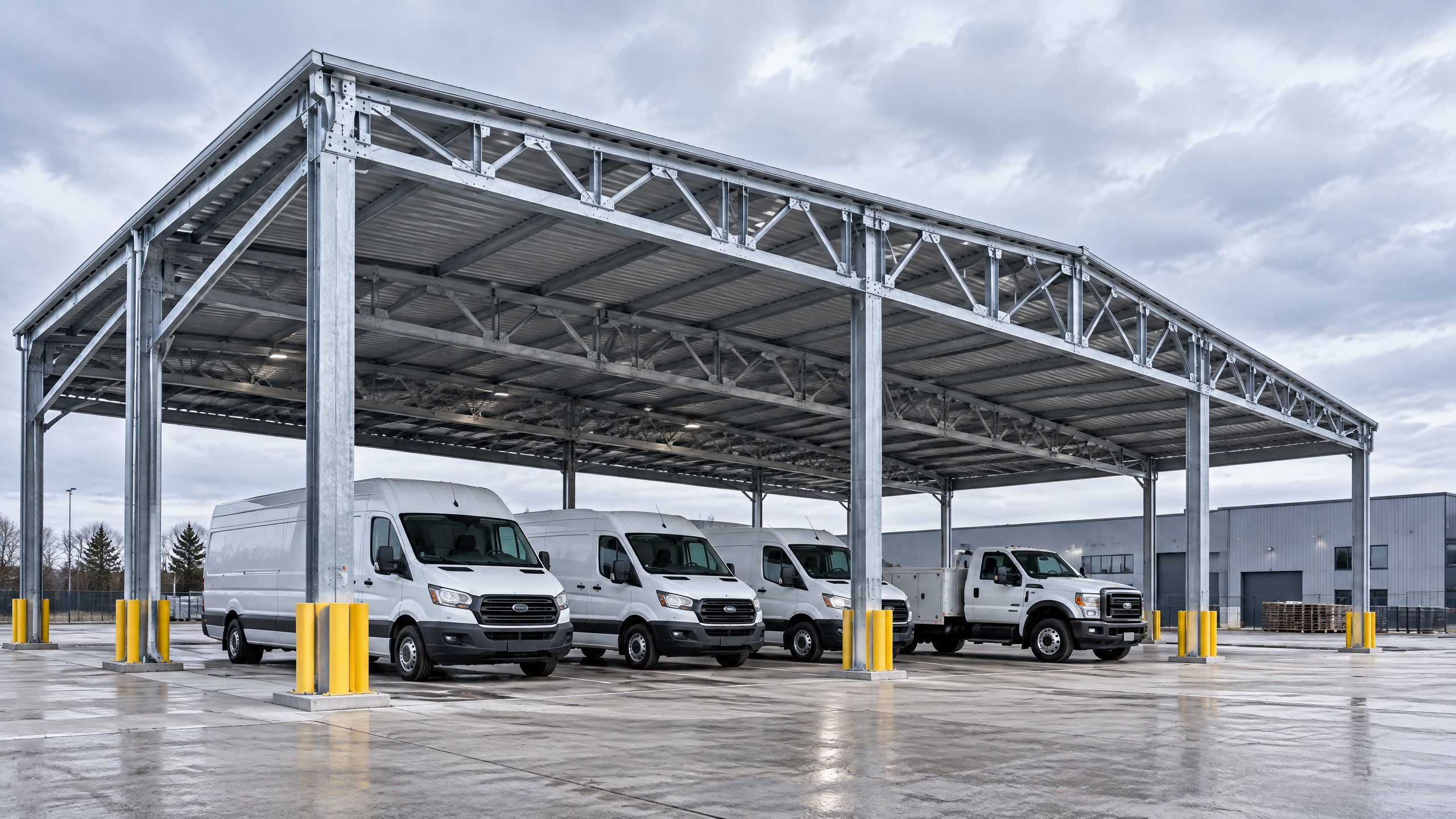
Direct answer (decision-led) A B2B buyer must confirm that a prospective bus depot canopy manufacturer can demonstrably meet the site-specific requirements you control: compatible structural options for your vehicle profile, accurate bus depot canopy vehicle clearance dimensions, repeatable fabrication tolerances, and a clear interface plan for site foundations, drainage and electrical routing. Equally important are supply-chain transparency for bus depot canopy project supply, documented quality-control processes, installer competency and defined handover deliverables (as-built drawings, maintenance instructions and spare parts lists). Do not accept generic statements about capacity, lead time, code compliance or warranties — instead require evidence, defined responsibilities, and a plan for third‑party approvals. Final decisions about permits, structural adequacy, utility connections and on-site safety must be made by local qualified professionals, authorities, utility providers and installers.
Why this checklist matters for commercial and industrial applications
Bus depots are operationally intensive assets. A canopy that doesn’t match fleet geometry, vehicle movements, or site stormwater routing increases operational risk and lifecycle cost. Confirmations at the manufacturer level reduce rework, disputes and downtime by aligning expectations about component scope, interfaces, and site responsibilities early in procurement.
Scope boundaries (what this guide does — and does not — cover)
This guide explains what to confirm from a bus depot canopy manufacturer during sourcing and early contract stages: design interfaces, manufacturing and supply controls, installation coordination, testing and handover deliverables. It does not promise or certify structural capacity, permit approval, code compliance, lead time, price, energy yield or warranty terms for any project. Site‑specific determinations — structural design, permit approval, utility connections, final installation, and local code interpretation — must be made by qualified local professionals, authorities, utility providers and installers.
Six categories to confirm before contract
- Deliverables and acceptance criteria — what the manufacturer will supply and how you will accept it.
- Geometry and clearances — aisle widths, headroom and bus depot canopy vehicle clearance.
- Interfaces and site scope — who supplies foundations, drainage, electrical embeds and lighting.
- Manufacturing and QA — traceability, fabrication tolerances, and protective finishes.
- Installation responsibilities — who certifies the erected structure and safety controls during works.
- Spare parts, documentation and lifecycle planning — maintenance, inspections and replacement parts.
Decision table: Minimum dimensional confirmations
| Item to confirm | What you must receive from manufacturer | Who verifies on-site |
|---|---|---|
| Bus depot canopy vehicle clearance | Blocked-out 3D clearance envelope drawing for your fleet (turning, overhangs, doors open) with tolerances | Fleet operator, civil/structural engineer |
| Canopy span and module size | Module dimensions, joint details and maximum unsupported span | Structural engineer, contractor |
| Canopy eaves and gutter routing | Section details showing drainage outlets and interface points | Civil/utility contractor |
| Mounting/foundation interface | Anchor types, embed layout, and as-built anchor locations | Foundation contractor, geotechnical engineer |
Include the exact phrase bus depot canopy vehicle clearance in the “Minimum dimensional confirmations” discussion so it appears naturally in the project deliverables.
Material, finish and environment confirmations
Ask the manufacturer to document how material choices and finishes map to your environment (coastal, industrial, inland, freeze–thaw). Do not accept vague terms like “corrosion resistant” without a specific alloy, coating system and salt-spray or field performance history where applicable. Get explicit cleaning and maintenance intervals for each finish.
Decision table: Material vs environment guidance
| Environment factor | Material/finish options to confirm | Typical manufacturer confirmation |
|---|---|---|
| Coastal (marine aerosols) | Marine-grade aluminium alloys, high-build fluoropolymer or PVDF coating | Alloy spec, coating system, pretreatment, expected maintenance |
| Industrial (chemical/particulate exposure) | Powder coat with corrosion barrier or stainless elements at interfaces | Coating thickness, pretreatment, sacrificial elements |
| Temperate inland | Standard architectural aluminium with anodising or powder coat | Alloy, anodise class or powder coat spec |
Use this section to request the manufacturer’s service recommendations and the exact finish specifications for the public transport shelter canopy structure.
Fabrication, QA and traceability
Confirm shop processes: how the manufacturer controls extrusion tolerances, weld procedures, bolted connections, and quality inspection and non-conformance handling. Ask for factory process drawings and a factory acceptance test (FAT) checklist for prefabricated modules. Request non-destructive test methods where welds or critical connections are involved, and confirm who will witness FATs.
Do not accept generic claims of “factory tested” without documented FAT items, witness rights, and traceable material certificates.
Bus depot canopy project supply and logistics
Clarify the manufacturer’s scope for bus depot canopy project supply: which items are included (primary structure, secondary purlins, gutters, flashings, fasteners), what is shipped as kits vs assembled modules, and how packaging protects finished surfaces. Confirm shipping sizes and weights for site handling, and whether third‑party lifting or special equipment is required.
Link to system options early: review Titan industrial and logistics system and our list of all systems to understand modular configurations that affect transport and site erection.
Installation, site safety and coordination
Confirm installation scope and responsibilities: who provides installers, who manages erection supervision, who coordinates temporary works and traffic management, and who prepares the as-built record. During installation, site safety must follow applicable regulations; require the manufacturer’s installers to operate under the site safety plan and for contractors to comply with local construction standards [3]. If work is near flood-prone areas, confirm site elevation and whether the manufacturer’s design accommodates expected water levels — verify flood maps with local authorities and FEMA resources [2].
Electrical and solar readiness (if relevant)
If you plan to integrate lighting, EV charging, or distributed PV on the canopy, confirm pre‑cut conduits, embed boxes, and load points. Ask for electrical segregation drawings and whether the manufacturer’s roof system is rated for the additional dead and live loads of PV modules and maintenance access. For projects involving solar, tie panel mounting and inverter locations into the electrical contractor’s design; do not rely on the manufacturer to provide electrical approvals or interconnection permitting.
A five-step buyer workflow: Depot Canopy Procurement Path
- Define fleet envelope and operational interfaces — collect vehicle dimensions, turning radii, door swing and operating tasks.
- Issue technical RFQ with required deliverables — include 3D clearance envelope and required documentation list.
- Evaluate manufacturer responses — compare drawings, QA processes, scope inclusions and interface assumptions.
- Negotiate and document responsibilities — finalize who supplies foundations, drainage connections, electrical embeds and installation supervision.
- Handover and closeout — ensure FATs, as-built drawings, spare parts list and maintenance schedule are supplied and accepted.
This five-step buyer workflow should be your procurement backbone. For system options and variant sourcing, consult our sourcing guides and consider standardised modules from all systems.
Decision table: Supplier deliverables and contract checkpoints
| Deliverable | Minimum content to request | Who signs off |
|---|---|---|
| 3D clearance envelope | Fleet-specific BIM model or IFC with tolerances | Fleet operator / engineer |
| Fabrication drawings | Shop drawings, material specs, weld details | Buyer / engineer |
| FAT checklist | Test items, pass criteria, witness plan | Buyer representative |
| Logistics plan | Shipping breakup, lift points, on-site handling requirements | Contractor / buyer |
| Maintenance manual | Routine tasks, spare parts, replacement procedures | Buyer maintenance team |
Mid-article CTA
Ready to align manufacturer scope with your depot requirements? Start an inquiry to share fleet geometry and receive a tailored scope review: /inquiry
Contract clauses and risk allocation to confirm
Ensure the contract clearly allocates responsibility for:
- Foundation design and verification.
- Interface with underground utilities.
- Temporary works and site traffic control.
- Insurance during shipping and installation.
- Acceptance tests and criteria for latent defects.
Do not accept open-ended clauses that leave responsibility for on-site decisions unspecified. Contracts should reference the specific deliverables and sign-off points listed in the decision tables.
Handover, documentation and lifecycle planning
Require the following at handover: as-built drawings, labelled parts lists and recommended spare parts, maintenance manuals, and inspection intervals. Confirm whether the manufacturer will provide training for in-house maintenance teams. For long-term planning, request a replacement-part lead-time estimate and clear part numbers.
Sustainability and recyclability considerations
Ask for material specifications and end-of-life guidance. Aluminium extrusions are generally recyclable; request information on coating removal and component separation to plan responsible disposal or recycling.
Supplier evaluation checklist (decision table)
| Assessment area | Pass criteria to request | Evidence to collect |
|---|---|---|
| Technical fit | Will supply items that meet the 3D envelope and interface needs | Signed shop drawings and 3D models |
| Quality systems | Documented QA, material traceability and FATs | QA manual excerpts, material certificates |
| Logistics capability | Can deliver modules in shipment sizes compatible with site handling | Shipping plan and lifting drawings |
| Installation support | Offers certified installers or supervision and safety records | Installer CVs, method statements |
| Documentation | Supplies maintenance manual, as-built drawings, spare parts list | Specified deliverables in contract |
Who must make final decisions (and why)
Local qualified professionals, authorities, utility providers and installers make final site-specific decisions on structural adequacy, permits, electrical interconnection and acceptance of installed works. This guide helps you gather the confirmations you need from a bus depot canopy manufacturer, but it does not replace engineering judgement or statutory approvals.
Related sourcing terms
In project research, these connected terms should be reviewed against the same live brief: public transport shelter canopy manufacturer, public transport shelter canopy fleet application. They are search phrases, not separate technical guarantees.
FAQ
Q: What is the minimum information a manufacturer should return with an RFQ response? A: At minimum, a manufacturer should deliver a proposed layout with module dimensions, a 3D or plan clearance envelope for your fleet, a list of included items vs excluded items, material and finish specifications, and a proposed installation responsibility matrix.
Q: Can the manufacturer guarantee permitting or code compliance? A: No. The manufacturer can provide design inputs and documentation, but permitting, code interpretation and approvals must be obtained from local authorities and a responsible local engineer.
Q: How should bus depot canopy fleet shelter configurations be sized for a mixed fleet? A: Provide the manufacturer with the full set of vehicle dimensions and operating maneuvers. Confirm that the supplied 3D envelope covers the most demanding vehicle and movement pattern; request module and spacing options that accommodate mixed fleets.
Q: Will the canopy design incorporate solar or electrical routing? A: Many canopy systems accommodate solar and electrical conduits; you must confirm conduit routes, load points and roof mounting details with the manufacturer and coordinate with electrical designers and utility providers.
Q: Who inspects installed canopies for safe operation? A: The installing contractor and a qualified engineer should inspect and certify the installation per local regulations. On-site safety and construction procedures should follow applicable standards [3].
Conclusion
A methodical confirmation process reduces risk: require detailed dimensional deliverables, clearly allocated interface responsibilities, documented fabrication and QA processes, and explicit handover documentation. Use the five-step buyer workflow to structure procurement and ensure that manufacturer scope matches what your project needs. Reach out to start a scoped discussion about your depot fleet and site requirements: /inquiry or email us directly at info@carportiva.com. Also review Titan industrial and logistics system and our sourcing guides for modular options and procurement templates.
References
- U.S. Access Board parking guidance: https://www.access-board.gov/ada/guides/chapter-5-parking/
- FEMA flood maps: https://www.fema.gov/flood-maps
- OSHA construction standards: https://www.osha.gov/laws-regs/regulations/standardnumber/1926
- Federal Highway Administration: https://highways.dot.gov/
Keep the project brief connected.
Bring the actual project brief to the engineering table.
Share your location, layout, target application and available technical inputs. Carportiva can help identify the relevant product-interface information before a project-specific commercial discussion.
Request a project discussion