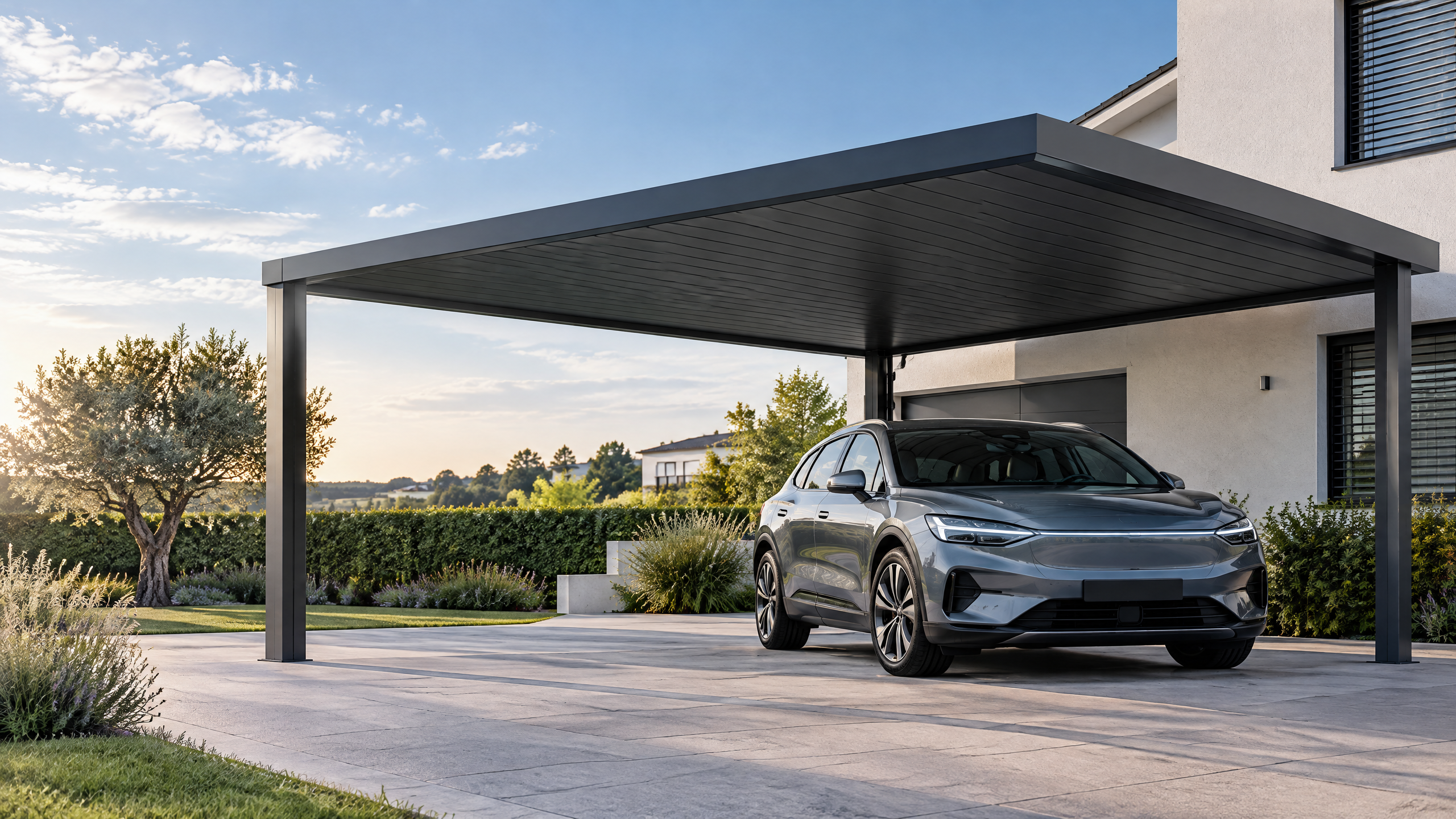
Buyers should confirm five things before committing to a carport procurement in coastal zones: the site-specific corrosivity assessment, the materials and coating system selected, fastener isolation and detailing, drainage and water management, and an operable maintenance regime. For coastal exposure you must verify actual salt and humidity loading at the site (not only regional climate labels), the specification for alloy and anodic protection or powder/fluoropolymer coatings, and how dissimilar metals are electrically and physically isolated to prevent galvanic corrosion. Confirm that drainage, runoff and debris traps prevent standing moisture at interfaces, and that the maintenance plan allocates inspection frequency, cleaning method and touch-up procedures. Finally, validate that fire access and parking layout considerations—emergency routes, clearance planning and operational access—are incorporated into the corrosion design so that corrosion mitigation does not conflict with egress or emergency vehicle operations. Local engineers, authorities and installers must make final site-specific decisions.
Why coastal exposure changes procurement priorities
Coastal atmospheric conditions accelerate many corrosion mechanisms: chloride-induced pitting in aluminum alloys, accelerated anodic dissolution of dissimilar metal couples, and coating degradation from UV and salt. These effects change specification and sourcing priorities because they influence long-term durability, inspection intervals, and lifecycle cost. For B2B buyers (distributors, architects, contractors, developers, solar EPCs, fleet operators) the practical consequence is that procurement documents and vendor evaluations must move beyond generic “marine grade” labels to explicit, verifiable design and execution controls.
Key confirmations to request from suppliers and designers
Below is a practical checklist to request from any supplier or design team before issuing purchase orders or drawings. These items concentrate the decisions that materially affect life-cycle resilience in coastal exposure.
| Confirmation item | What to request |
|---|---|
| Site corrosivity assessment | Written assessment referencing local salt spray, wind exposure, and microclimate (e.g., open coastline, estuary, sheltered bay) |
| Base metal and alloy | Exact alloy grades for extrusions, posts and brackets (e.g., specific aluminum series) |
| Coating specification | Detailed carport corrosion design coating specification including surface preparation, film thickness and system cure |
| Fasteners and isolation | Full list of fastener materials, sacrificial anodes and carport corrosion design fastener isolation details |
| Drainage and detailing | Drawings showing runoff, drip edges, and prevention of standing water at interfaces |
| Maintenance plan | A draft carport corrosion design maintenance plan with inspection intervals and touch-up procedures |
| Fire and access | Confirmation that carport fire access emergency routes, carport fire access parking layout and carport fire access clearance planning are preserved |
Materials, coatings and specification detail
When evaluating bids, ask for explicit coating data sheets and application records rather than paraphrases. The phrase carport corrosion design coating specification should appear in the contract and include:
- Substrate preparation method (mechanical/chemical) and acceptance criteria.
- Coating manufacturer, product code, minimum dry film thickness (µm/mils), UV resistance class where available.
- Compatibility with anodizing where used; sequence of pretreatments.
- Expected adhesion test protocol and acceptance criteria.
Avoid accepting generic labels such as “marine grade paint.” Require measurable parameters you can verify on delivery and acceptance.
Fasteners, connections and isolation detailing
Galvanic corrosion often starts at concealed fasteners and mixed-metal interfaces. Request a detailed fastener schedule and isolation details. The contract should explicitly include carport corrosion design fastener isolation showing:
- Fastener material grades and surface treatments.
- Non-conductive washers or polymer sleeves where aluminum contacts stainless steel or steel.
- Use of sacrificial anodes only where specified by the corrosion engineer.
- Details of penetrations through coatings and the method for sealing and touch-up.
Decision table — fastener approaches
| Option | Typical use case | Pros | Cons |
|---|---|---|---|
| All-aluminum fasteners with anodic finish | Aluminum-only structural assemblies | Eliminates galvanic couple with aluminum | Availability and tensile grade limitations |
| Stainless steel fasteners with isolation sleeves | Mixed-metal assemblies where stainless is required | Reliable strength, good corrosion resistance if isolated | Requires positive isolation to prevent galvanic attack |
| Coated carbon steel fasteners | Economical where steel is primary substrate | Cost-effective | Coating damage exposes steel; careful specification needed |
Drainage, detailing and flood/fog considerations
Coastal sites can subject carports to salt spray, wave splash and frequent fog. Designing to avoid water traps is essential:
- Provide positive slope on exposed members and fixing points.
- Detail drip edges and weep paths to prevent pooling at post bases and brackets.
- Seal and finish baseplates to avoid wicking into concrete or timber interfaces.
- Consult FEMA flood maps to identify flood-prone areas and ensure column detailing does not retain water in recesses [4].
Confirm that detailing for corrosion control does not compromise carport fire access emergency routes, carport fire access parking layout or carport fire access clearance planning. For example, raised curb channels should not impede emergency vehicle maneuvers.
Fire and access integration
Corrosion mitigation must be reconciled with life-safety and operational access:
- Confirm that bracket, post and canopy configurations maintain required emergency routes, turning radii and egress paths.
- Provide drawings showing carport fire access emergency routes and how columns, protective bollards and landscaping interact with carport fire access parking layout.
- Ensure clearance planning balances structural protection, corrosion management and the footprint for emergency apparatus. Reference local fire authority requirements during procurement; do not presume design or approval.
Inspection and maintenance: the living part of the design
A written carport corrosion design maintenance plan is essential and should be part of the procurement package. The plan should at minimum cover:
- Inspection frequency by trained personnel tied to exposure severity (for example, quarterly in high-chloride environments).
- Checklist items: visible corrosion, coating breaks, fastener integrity, sealant condition, water pooling.
- Cleaning methods and acceptable detergents or fresh-water rinsing rates to remove salt deposits.
- Touch-up paint and sealing procedures and parts kit listing.
- Escalation policy when corrosion or structural compromise is suspected.
Maintenance is a cost item and a safety activity. Neglecting it reduces expected life and can create hazards, so include maintenance obligations in commercial terms.
Delivery, installation and QA on site
Quality at the factory and on site both matter. Confirm the following in procurement documents:
- Factory QA: test and inspection regime for surface preparation and coating application (e.g., adhesion tests).
- Site controls: how the installer will protect coated elements during handling, storage, and erection.
- Post-install inspection: acceptance checklist and dispute-resolution in case coating damage occurs during installation.
- Coordination with utility providers and civil works: drainage changes or landscaping that could affect corrosion exposure.
Do not accept hand-waving on site protection: request photographic records of key stages (unloading, mid-install, completion) as contract evidence.
Procurement decision tables
Decision table — coastal mitigation strategies
| Strategy | Typical elements | Suitable exposure | Buyer confirmation |
|---|---|---|---|
| High-spec aluminum + fluoropolymer coating | Corrosion-resistant alloy, pretreatment, topcoat | Severe coastal, direct salt spray | Ask for carport corrosion design coating specification and QA records |
| Anodized aluminum with sealed interfaces | Anodize + sealants, isolated fasteners | Moderate coastal, sheltered sites | Verify anodize class and carport corrosion design fastener isolation |
| Sacrificial/coated steel with thermal break | Steel structure with protective systems | When geometry or loads require steel | Confirm isolation from aluminum and detailed maintenance plan |
| Hybrid approach | Mixed materials with strict isolation and inspection | Variable exposure across site | Ensure contract mandates isolation and inspection |
Decision table — acceptance checklist at handover
| Item | Accept/Reject criteria |
|---|---|
| Coating thickness | Meets specified minimum dry film thickness |
| Fastener isolation | Insulators installed, no metal-to-metal contact where specified |
| Drainage | No visible standing water in details; weep paths open |
| Documentation | As-built drawings, maintenance plan, QA records provided |
| Fire/Access | As-built layout maintains emergency routes and clearances |
Contract language and delivery of technical documents
Include the following deliverables in the contract schedule:
- Site corrosivity assessment and reference meteorological data.
- Detailed material and fastener schedule with part numbers.
- Full carport corrosion design coating specification and factory QA records.
- Installation method statement describing handling, protection and touch-up methods.
- As-built drawings and maintenance plan at handover.
Do not accept vague statements like “marine-grade treatment applied.” Require documentary evidence tied to measurable parameters.
Buyer workflow: five-step workflow for coastal carport procurement
- Scope & site assessment — Commission or obtain a site corrosivity assessment and confirm fire access constraints and utility interfaces.
- Specification development — Draft material, fastener and carport corrosion design coating specification; include maintenance plan and QA checkpoints.
- Competitive tender & evaluation — Request vendor responses with specified deliverables and photographic or test evidence.
- Contract and pre-production approval — Approve shop drawings, coating datasheets and fastener schedules before production.
- Installation, QA & handover — Require site protection, post-install inspections, and delivery of as-built documents and the agreed carport corrosion design maintenance plan.
This workflow is a decision tool; local engineers, authorities, utility providers and installers must make final site-specific decisions.
Mid-article CTA If you want Carportiva to review specification alignment or discuss system options, start an inquiry at /inquiry.
Scope boundaries — what this guide does not promise
This guide does not and cannot promise structural capacity, permit approval, code compliance, lead time, price, energy yield or warranty terms. Statements about loads and design are directional; final structural calculations, permit submissions and code compliance must be completed and certified by local qualified professionals and the relevant authorities. Utility interconnection and site-specific fire authority approvals are outside the scope of this document.
Sourcing notes specific to different buyer roles
- Distributors: Require supplier traceability, batch coating records and spare parts lists. Negotiate the inclusion of a maintenance kit with orders.
- Architects: Integrate corrosion details in construction documents and confirm that the carport fire access parking layout and clearance planning are coordinated with site circulation plans.
- Contractors/installers: Validate handling and installation method statements before mobilising teams and ensure storage on-site prevents salt contamination.
- Solar EPCs: Coordinate PV mounting and electrical bonding with corrosion isolation details; verify that PV attachment methods do not breach coating systems.
- Fleet operators/developers: Ask for lifecycle cost scenarios that model inspection frequency and expected touch-up cycles rather than seeking unsupported lifespan claims.
Link to Carportiva system range for select systems and to all systems and our sourcing guides for wider procurement guidance.
FAQ
Q: How often should coastal carports be inspected? A: Inspection frequency depends on exposure severity; require a written carport corrosion design maintenance plan that sets intervals. Typical high-exposure schedules are quarterly to semi-annual, but a local corrosion engineer should set the exact interval.
Q: Can anodizing replace paint for coastal sites? A: Anodizing is durable for many coastal settings but must be chosen by alloy and anodize class; additionally, interface sealing and fastener isolation remain critical. Specify requirements rather than assuming anodize alone is sufficient.
Q: Will stainless steel fasteners always prevent corrosion problems? A: Stainless fasteners reduce corrosion risk but can form galvanic couples with aluminum if in electrical contact; carport corrosion design fastener isolation details are necessary.
Q: How should I confirm a supplier’s coating claims? A: Require coating product codes, technical data sheets, factory QA records (including adhesion and thickness tests), and pre-production approval of the coating process.
Q: Does this guide cover emergency vehicle access design? A: It explains how corrosion design must integrate with carport fire access emergency routes, carport fire access parking layout and carport fire access clearance planning, but site-specific access approvals must be obtained from local fire authorities.
Conclusion
Procurement for carports in coastal environments requires documentable confirmations rather than general assurances. Prioritise a clear site corrosivity assessment, measurable coating and material specifications, fastener isolation details, drainage detailing, and a formal maintenance plan. Ensure the corrosion strategy is integrated with fire access and parking layout decisions so durability and safety are concurrent objectives. Use the five-step buyer workflow to structure decisions, and require verifiable documentation at every stage. Local qualified professionals and permitting authorities must make the final determinations for structural and regulatory compliance.
Closing CTA To discuss specification alignment or request system options and documentation, contact us via /inquiry or email info@carportiva.com.
References
- European Commission Eurocodes: https://eurocodes.jrc.ec.europa.eu/
- ASCE 7 structural loading standard overview: https://www.asce.org/publications-and-news/asce-7
- OSHA construction standards: https://www.osha.gov/laws-regs/regulations/standardnumber/1926
- FEMA flood maps: https://www.fema.gov/flood-maps
Keep the project brief connected.
Bring the actual project brief to the engineering table.
Share your location, layout, target application and available technical inputs. Carportiva can help identify the relevant product-interface information before a project-specific commercial discussion.
Request a project discussion