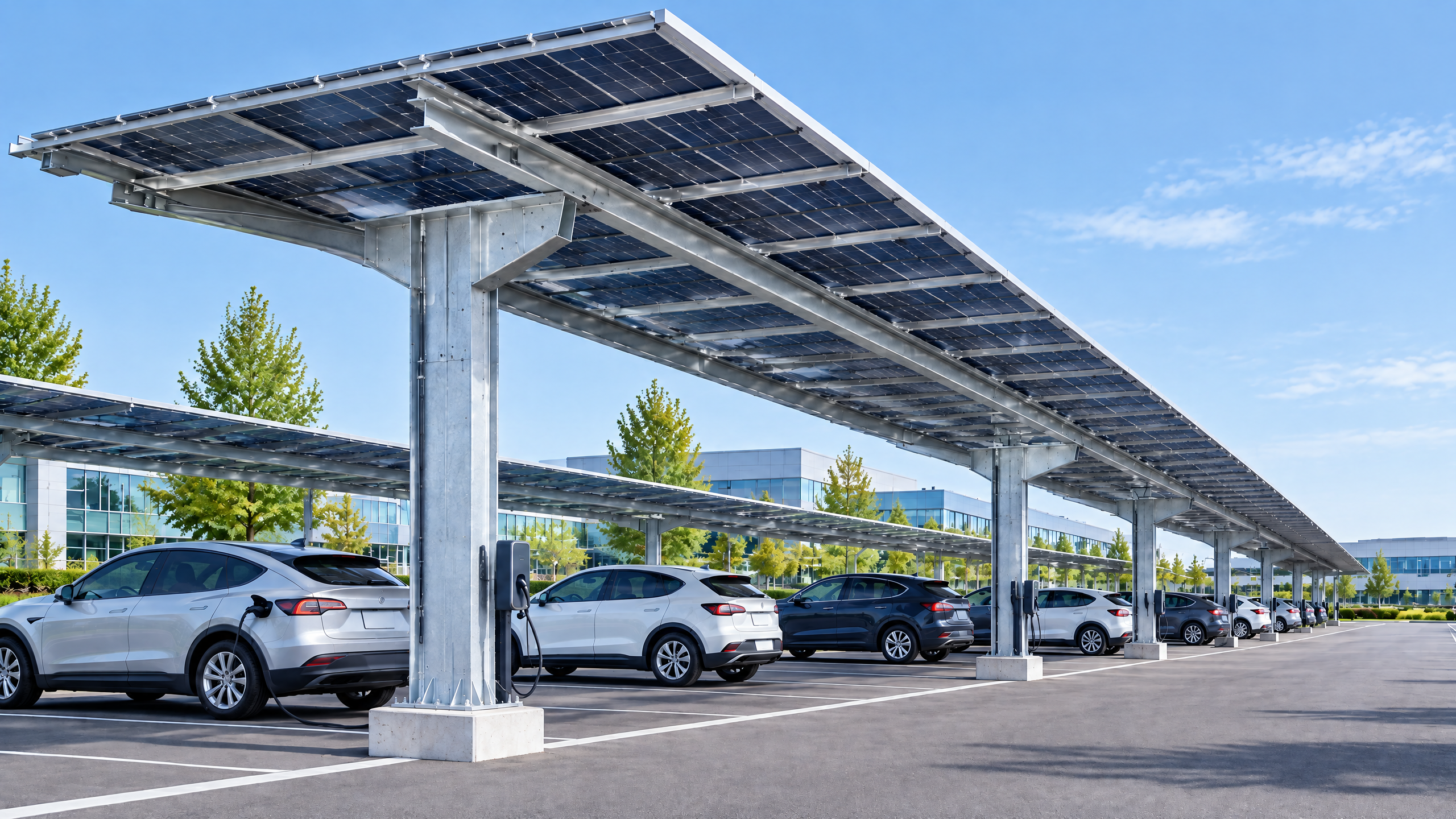
Direct answer (120–180 words): Before awarding and signing for commercial solar canopy project supply, B2B buyers must confirm six categories of facts: verified site data (topography, soils, obstructions, utility access), the supplier’s scope and exclusions (engineering, foundations, PV modules, electrical balance of system), design inputs (snow/wind loads to be applied by the buyer’s engineer, module layout and attachment scheme), logistics and packaging (staged delivery, unloading and crane needs), quality and factory controls (materials, coatings, QA steps) and installation interface responsibilities (civil, electrical, testing). Confirm supplier identity and track record as both a solar parking structure manufacturer and/or solar parking structure supplier, and require clear drawings and a parts list that map to procurement and installation milestones. Do not assume permits, structural adequacy, energy yield, lead time, price or warranty details — these are site-specific and must be verified by local qualified professionals, authorities, utility providers and installers.
Scope and what this guide covers (and does not)
This guide focuses on practical confirmations and procurement checks for commercial solar canopy project supply: how to translate site conditions into supplier requirements, what to require in drawings and documentation, how to align logistics and installation responsibilities, and how to compare offers. It does not promise or determine structural capacity, permit approval, code compliance, lead time, price, energy yield or warranty. Final, site-specific decisions must be made by local qualified professionals, authorities, utility providers and installers.
Related resources: see SolarGrid commercial solar system, a catalogue of our commercial options; browse all systems and review other sourcing guides for broader procurement context.
Key confirmations to get from the supplier
Ask for and verify the following before commitment:
- Formal scope of supply and scope exclusions (what’s supplied, what’s buyer-supplied).
- Fully dimensioned drawings: plan, elevations and anchor/foundation details.
- Bill of materials (BOM) with manufacturer part numbers and finish specifications.
- Load assumptions used for design (wind, snow, seismic) and reference standards.
- PV module layout and attachment details including stringing and junction box access.
- Foundation recommendations with location coordinates and embedment depths.
- Electrical single-line diagram showing inverter, combiner, disconnect locations and metering points.
- Logistics plan: packing lists, containerization, delivery sequence and site handling needs.
- Quality control documentation: material certificates, welding procedures, coating specs.
- Installation interface matrix: who does foundations, trenching, cable pulls, testing, commissioning.
Call out explicitly whether the supplier acts as a solar parking structure manufacturer or is a solar parking structure supplier who sources components. Confirm which party provides stamped engineering, if required.
Decision table — Supplier deliverables vs buyer confirmations
| Supplier deliverable | Buyer must confirm | Typical acceptance evidence |
|---|---|---|
| Fabricated steel canopy frames | Connection details match foundation design | Review of stamped drawings and anchor bolt templates |
| PV module canopy mounting system | Module compatibility and pv module layout | Mounting detail and module cut sheet alignment |
| Electrical balance of system (if supplied) | One-line diagram and interconnection point | Signed single-line and interconnection plan |
| Packaging & delivery plan | Offloading, storage and crane requirements | Logistics schedule and site receiving plan |
Site data and verification required
Gather this site information before soliciting firm offers:
- Topographic survey with elevations and control points.
- Geotechnical report with bearing capacity and groundwater depth.
- Utility as-built maps and electrical service point locations.
- Existing drainage, curb and grading features.
- Clearances for fire lanes, accessible parking, and overhead lines.
- Permitting constraints and any historic/landscape overlays.
Decision table — Site data vs required supplier input
| Site data item | What the supplier needs to know | Why it matters |
|---|---|---|
| Geotech report | Foundation type recommendation and anchor size | Ensures anchor design interfaces with subgrade |
| Topography | Column location tolerances and shim requirements | Prevents misalignment on sloped bays |
| Utility location | Cable trench routes and inverter siting | Impacts cable length, losses, and construction access |
| Clearance constraints | Column size and overhang limits | Affects bay spacing and module tilt |
Note: Final foundation design typically remains with the buyer’s civil/structural engineer or a local engineer with jurisdiction authority.
Design inputs and drawings to require
At minimum, require the supplier to provide:
- General arrangement plans showing bay spacing, column locations, and module layout. Use the phrase solar parking structure pv module layout when specifying module stringing and access requirements.
- Elevation drawings showing tilt (if any), beam profiles and clearance to vehicle rooflines.
- Connection details between canopy steel and foundations, including anchor bolt templates.
- Cross-section through the canopy indicating waterproofing, guttering and cable routing if integrated.
- Roof access and photovoltaic maintenance access routes.
Confirm that the supplier’s proposed solar parking structure steel frame details integrate with your stormwater and lighting plans. If the canopy includes integrated EV infrastructure, coordinate electrical feed points early with utility providers and local codes; see interconnection resources for process guidance where applicable [4].
Supplier capability and factory QA
When evaluating a solar parking structure manufacturer or a solar parking structure supplier, verify:
- Factory capacity: fabrication yard, coating lines and QA process flow.
- Welding procedures and welder qualifications.
- Material certificates for aluminium or steel alloy and protective coatings.
- Prototype or sample detail approvals and pre-shipment inspection options.
- Traceability for critical fasteners and connections.
Ask for factory test plans and the right to witness critical tests where practical. Require a packaging and marking plan to avoid parts loss during multi-stage logistics.
Logistics, packaging and site delivery
Confirm delivery as part of commercial solar canopy project supply:
- Delivery milestones and whether supply will arrive in staggered lots or single shipment.
- Required site equipment for offloading (cranes, forklifts) and any temporary storage constraints.
- Identification of long-lead items and whether these will be shipped separately.
- Marking system for parts that matches on-site assembly drawings (tagging by bay/column/part).
- Import/export documentation and customs responsibilities if items originate overseas.
Plan receiving windows and confirm refusal/return policies. Explicitly state who is responsible for short-shipped or damaged goods acceptance.
Electrical coordination and interconnection
Confirm electrical scope with supplier and electrical contractor:
- Who provides inverters, combiner boxes, DC disconnects and monitoring hardware.
- Conductor routing through the canopy structure and weatherproofing of roof penetrations.
- Access to junction boxes for module replacement and PV module pv module layout that preserves serviceability.
- Point of interconnection and utility requirements; consult utility early for distributed generation interconnection procedures [4].
- Metering, telemetry and O&M access provisions.
Estimate generation and site yield using established tools such as PVWatts if you want preliminary production estimates, and use local resource data for planning [2][1]. These estimates are planning inputs only and do not replace site-specific engineering.
Procurement, contract terms and responsibilities
Clarify contractual items tied to supply:
- Firm scope list and exclusions with corresponding line items on the purchase order.
- Acceptance criteria for pre-shipment inspections, on-site delivery acceptance and final handover.
- Spare parts list and the lead time for replacements (listed but not guaranteed).
- Hold points and required documentation: test reports, material certificates, as-built drawings.
- Dispute resolution paths and damages for non-conformance.
Do not rely on oral commitments; require changes to be captured in formal change orders.
Five- or six-step buyer workflow
Carportiva six-step buyer workflow — concise steps B2B buyers can follow:
- Project initiation and data package — assemble scope, topography, geotech, utility info.
- Technical RFP and drawings — issue requirements including solar parking structure site planning and module layout needs.
- Supplier pre-qualification — evaluate fabricator QA, references and tooling capability (manufacturer vs supplier role).
- Tender evaluation and selection — compare BOMs, drawings, delivery plans and exclusions.
- Contracting and procurement — finalize PO with clarified hold points and inspection rights.
- Delivery coordination and installation handover — manage logistics, site receptions, and commissioning interfaces.
Mid-article CTA: Ready to confirm supply scope and drawings? Start your project inquiry at /inquiry or email info@carportiva.com to request the SolarGrid commercial solar system options and our procurement checklist.
Installation, commissioning and handover checklist
Before commissioning, verify:
- Foundations installed per anchor bolt template with as-built measurements recorded.
- Canopy steel bolted and torqued according to supplier torque schedule.
- PV modules installed to the specified pv module layout and electrical stringing verified.
- Grounding and bonding continuity tested to electrical code and project specs.
- Inverter and monitoring commissioning completed and telemetry validated.
- Final as-built drawings and spare parts delivered.
Remember: final commissioning and interconnection approvals are performed by qualified installers and authorities, and utility approval processes should be followed for grid connection [4].
Commercial comparison table — What to evaluate in bids
| Bid element | Why it matters | Buyer red flags |
|---|---|---|
| Complete drawings and BOM | Enables accurate pricing and installation planning | Missing anchor templates or ambiguous foundations |
| Clear delivery and logistics plan | Reduces on-site delays and storage risk | No sequencing or offloading plan |
| Defined QA and inspection steps | Ensures material conformity | Vague QA, no material certificates |
| Scope exclusions listed | Prevents later scope creep | “Supplier to supply as required” without details |
| Responsibility matrix for interfaces | Clarifies who does civil/electrical/commissioning | Overlaps or gaps in responsibilities |
Coordination with other site disciplines
Ensure mechanical, civil, electrical, lighting and landscape teams are linked to canopy supply. For example, the solar parking structure steel frame footprint affects drainage and lighting pole relocations; the solar parking structure site planning should be integrated with vehicle circulation and EV charging locations early in design. If EV chargers are part of the project, coordinate feeder capacities and demand management strategies; U.S. DOE and alternative fuels resources can guide integration best practices [3].
FAQs
Q: What documentation should I demand before awarding supply? A: Full GA drawings, anchor bolt templates, BOM with part numbers, single-line electrical diagram, QA certificates and factory test plans. Also confirm delivery and logistics plans and defined scope exclusions.
Q: Who is responsible for foundation design? A: Responsibility varies by contract. Buyer should confirm in the bid documents whether the supplier provides foundation recommendations or stamped foundation designs; local qualified engineers typically finalize foundation details.
Q: Can a supplier guarantee energy yield? A: No. Energy yield is site- and system-specific and should be estimated with tools such as PVWatts and local resource data [2][1]. Final yield depends on modules, inverters, shading, orientation, and commissioning.
Q: How do I decide between a solar parking structure manufacturer and a solar parking structure supplier? A: Evaluate whether you need a single-source manufacturer responsible for design and QA or a supplier that aggregates components. Assess factory capabilities, QA processes, and the clarity of responsibilities.
Q: What is a common procurement pitfall? A: Accepting high-level offers without detailed drawings and anchor templates, which can lead to costly change orders during installation.
FAQ
Is commercial solar canopy project supply a standard product specification?
No. The phrase can guide an early sourcing discussion, but final dimensions, loads, materials, interfaces and documentation must follow the confirmed project brief and the responsible local design process.
What should a buyer provide before requesting a proposal?
Share the site location, intended use, available drawings, vehicle or parking geometry, exposure conditions, delivery constraints and any solar, electrical, finish or approval interfaces that are already known.
Can a supplier confirm local approval or final engineering from an online brief?
No. Local qualified professionals, authorities, installers and utility providers determine site-specific engineering, construction, approvals and operational requirements.
How should this topic be compared across suppliers?
Issue the same controlled project information to every bidder, record assumptions and exclusions, and compare the supporting drawings, materials, scope boundaries, quality evidence and delivery plan rather than a headline claim alone.
Conclusion
For successful commercial solar canopy project supply, procure with precise data and contract clarity: verified site inputs, stamped drawings or clear design assumptions, a mapped BOM, defined logistics and a documented installation interface. Confirm whether the vendor acts as a solar parking structure manufacturer or a solar parking structure supplier and require explicit documentation for the solar parking structure steel frame and pv layout. Do not rely on supplier statements for permits, structural capacity, code compliance, lead time, price, energy yield or warranty — those are determined by local qualified professionals, authorities, utility providers and the installing contractor.
Closing CTA: To begin procurement with a clear scope and supplier checklist, submit your project details at /inquiry or email info@carportiva.com.
References
- National Laboratory of the Rockies PV resources.
- PVWatts Calculator.
- U.S. Department of Energy Alternative Fuels Data Center.
- Federal Energy Regulatory Commission interconnection resources.
Keep the project brief connected.
Bring the actual project brief to the engineering table.
Share your location, layout, target application and available technical inputs. Carportiva can help identify the relevant product-interface information before a project-specific commercial discussion.
Request a project discussion