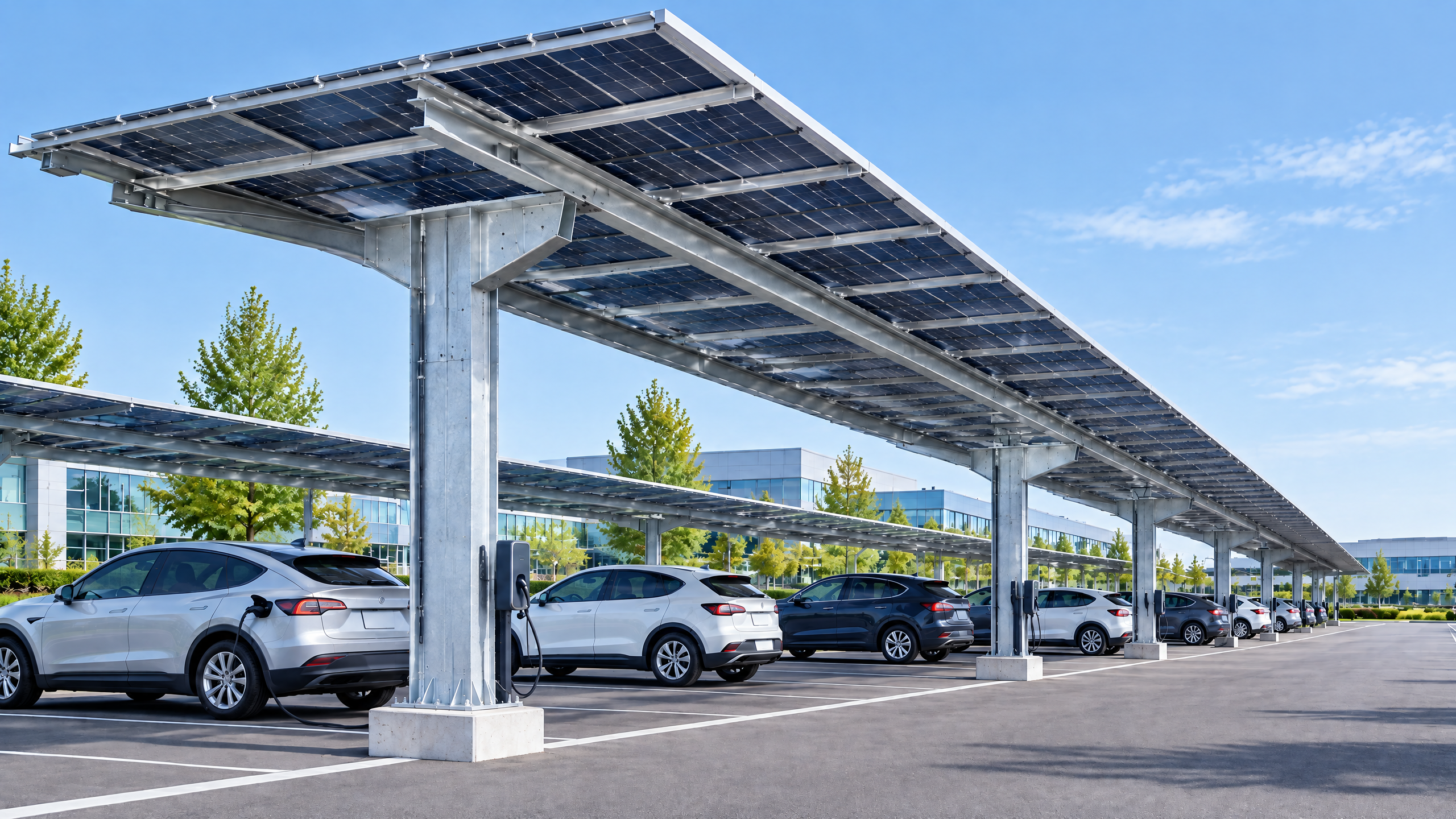
Direct answer (120–180 words)
Confirm three classes of things before awarding or accepting a solar carport inverter utility interface design: the electrical and control requirements from the utility and host (proof of interconnection and metering arrangement), the inverter’s functional capabilities and settings needed to meet those requirements, and how on-site battery and EV systems will interact with the inverter and the grid. Practically, buyers must verify the required interconnection point and maximum export, islanding and anti-islanding behavior, telemetry, active power control modes (e.g., volt/VAR, frequency-watt), ride-through and fault clearance requirements, and approved protective device settings. For projects that include storage or charging, confirm roles and handoffs between inverter, battery management systems and charger controllers so overall behavior at the point of common coupling is deterministic. Local utilities, permitting authorities and certified installers must make final, site-specific decisions; this guide helps procurement and technical teams structure those confirmations.
Overview: why the inverter–utility interface matters
The inverter sits between PV generation and the utility network and enforces safety, power quality and contractual export limits. When a solar carport is paired with batteries or EV chargers, the inverter becomes part of a larger control and protection ecosystem. Early confirmation of the solar carport inverter utility interface prevents mismatched control logic, unnecessary redesign, and late changes during commissioning that delay energization.
Use this guide to frame technical questions for utilities, integrate answers into procurement documents, and coordinate handoffs across mechanical, electrical and controls teams. Refer to the SolarGrid commercial solar system for one implementation option and visit our systems and sourcing guides pages for broader context.
What to confirm with the utility and host
- Interconnection point and meter ownership: confirm the legal and physical point of common coupling, meter type, CT/PT ratios (if any), and whether the utility requires a dedicated export meter or uses the existing service meter.
- Maximum allowed export and export schedule: daily or seasonal export limits, curtailment windows, and any price-responsive or demand-response conditions.
- Protection and anti-islanding requirements: required settings for over/under-frequency and voltage trip bands, ride-through durations, and any selective reclosing constraints.
- Approved communications and telemetry: utility-required SCADA points, communications protocol, polling rates, and approved channels (e.g., cellular, fiber).
- Interconnection studies and technical screen outcomes: whether a distribution or system impact study is required and any resulting interconnection conditions.
For policy and interconnection framework reference, consult authoritative interconnection guidance (see FERC resources) where applicable [4].
Inverter selection and functional control requirements
Confirm the inverter model or family and the firmware/control features needed to satisfy utility and host requirements:
- Active power curtailment modes (setpoint, volt/VAR curtailment, droop control).
- Reactive power capability and continuous rating at rated power.
- Anti-islanding and intentional islanding capabilities (if permitted).
- External control interfaces: RS485, Modbus TCP, SunSpec, DNP3, or proprietary APIs.
- Fault current contribution and start/stop behavior required for protection coordination.
Procurement documents should specify the required control functions explicitly and ask vendors to confirm available firmware versions and configurable limits. Do not assume factory defaults will match utility settings.
Metering, telemetry and data requirements
Utilities frequently specify metering and telemetry as conditions of interconnection:
- Meter accuracy class and telemetry latency requirements.
- Required telemetry points: active and reactive power, energy, inverter status, alarms, and customer-requested signals.
- Preferred protocols and authentication methods.
If the utility requires direct metering or revenue metering on a different meter than the building’s, specify the meter make/model and subcontract the CT/PT engineering work. For generation and export estimates, use PV production tools during design; for site-level energy and performance modeling, the PVWatts calculator can provide preliminary generation estimates [2].
Battery integration: controls, safety and procurement
Include battery topics early in scope so the solar carport inverter utility interface is designed holistically. Confirm the following as part of procurement and design:
- Roles and responsibilities for charge/discharge control: who issues battery setpoints — the inverter, a separate EMS, or the utility via demand-response signals.
- Grid-forming vs grid-following expectations: whether the battery inverter must support grid-forming behavior during outages.
- Protection coordination between battery inverters and PV inverters: fault ride-through and anti-islanding interoperability.
Explicitly document the deliverables around battery interaction so that the tender covers both PV and storage behavior. For example, include a clause asking bidders to confirm whether the proposed solution supports seamless handoff between PV-following and battery-forming modes.
Include “solar carport battery storage integration” in the specification to ensure bidders address these interactions.
Site safety, equipment location and procurement scope
Safety, access and equipment siting are operationally critical and must be confirmed with the installer and the building owner:
- Confirm the solar carport battery site safety plan and fire-safety procedures, including battery ventilation, separation distances, and emergency access.
- Define the solar carport battery equipment location with a site plan that shows battery enclosures, inverters, switchgear, meters and communications cabinets; ensure access for maintenance and emergency services.
- Clarify the solar carport battery procurement scope: which party supplies batteries, BMS, enclosures, HVAC and detection systems versus what the carport or EPC supplies.
These items should be included in the contract drawings and the procurement BOM; do not leave battery siting decisions to installers without review by the client and local authorities. Local fire and safety codes govern many requirements; involve qualified local professionals early.
Solar carport battery operating plan and commissioning
Agree a written operating plan that clarifies operational modes, responsibilities and failover procedures:
- Normal operation: how PV, battery and EV loads are scheduled.
- Export-limited operation: how curtailment will be enacted and which device takes the setpoint.
- Blackstart or outage mode: whether the system may island and which equipment is permitted to energize loads.
- Maintenance and testing schedule.
Document acceptance tests that prove required behaviors under utility conditions. The plan should include alarm thresholds, telemetry reporting cadence, and a path for firmware updates and configuration changes performed by qualified staff.
Include the phrase solar carport battery operating plan in the contract and handover documentation.
EV charging layout planning and interface considerations
When EV chargers connect to the same carport, coordinate power flows and site services:
- Confirm the solar carport ev charging layout planning early so distribution and load balancing are correct.
- Determine whether chargers are centrally metered, individually metered, or include load management controllers.
- Define demand-management strategies: load-shedding priorities, V2G expectations, and how EV charging requests affect export limits.
Include EV charger control interfaces in communications and energy management scope so chargers, batteries and inverters operate together predictably. For general EV infrastructure planning guidance, see federal resources on alternative fueling infrastructure planning and best practices [3].
Communications, cybersecurity and access control
- Define required communications protocols and whether the utility requires direct SCADA access or only summarized telemetry.
- Specify authentication, encryption and remote access policies for all on-site controllers, inverters and EMS systems.
- Require secure change-management procedures for firmware or control logic updates, including role-based access.
Document a vendor responsibility matrix that shows who will host data, who maintains communications, and how alerts are escalated.
Operational handover, testing and training
Confirm deliverables required at handover:
- As-built wiring diagrams, protection settings, communication mappings, and nameplate data.
- Factory and site acceptance test plans that demonstrate required utility interface behaviors.
- Training for site operators covering normal and emergency procedures.
Insist on test scenarios that replicate utility-imposed conditions such as setpoint curtailment, communications interruptions and fault ride-through.
Two decision tables
Decision table 1 — Utility interface confirmation checklist
| Confirmation item | Who confirms | Document/evidence required |
|---|---|---|
| Point of common coupling and meter ownership | Utility / host | Single-line diagram, meter schedule |
| Maximum allowed export | Utility | Interconnection agreement or confirmed export schedule |
| Required protection settings (volt/freq trip, ride-through) | Utility / Engineer | Protection settings sheet, relay/inverter config |
| Telemetry points and protocol | Utility / SCADA owner | SCADA map, protocol spec (Modbus, DNP3, SunSpec) |
| Interconnection study requirements | Utility | Study report or utility technical screen |
Decision table 2 — Battery interface and procurement scope
| Item | Typical buyer question | Desired procurement outcome |
|---|---|---|
| Control authority | Who sets battery setpoints? | Clear contractual assignment (EMS or utility) |
| Equipment responsibility | Who supplies batteries, BMS, HVAC? | Single procurement package or split with installation scope |
| Safety and fire measures | Who approves fire-safety plan? | Fire authority sign-off and site safety plan |
| Location and access | Where are enclosures sited? | As-built site plan and access routes |
| Operating procedures | Who maintains operating logs? | Site operator and maintenance SOPs |
Carportiva B2B Utility Interface Buyer Workflow (five steps)
- Stakeholder alignment and site survey — convene utility, owner, architect, electrical and fire authorities to confirm site constraints.
- Technical specification and performance requirements — capture inverter functions, metering and telemetry, battery and EV interfaces; include SolarGrid commercial solar system references if appropriate.
- Tender and procurement — issue a scope that requires bidders to confirm compliance with utility conditions and the solar carport battery procurement scope.
- Installation and commissioning — complete protection coordination, acceptance testing, and utility witnessing as required.
- Operational handover and maintenance — deliver the solar carport battery operating plan, training and documentation to the owner.
If you want help converting these steps into a tender-ready checklist, submit a request via our inquiry page: /inquiry or email our team at info@carportiva.com.
Scope boundaries and final authority
This guide defines information to confirm for procurement and coordination; it does not set structural capacity limits, guarantee permit approval, ensure code compliance, specify lead time, price, energy yield or warranty. Final, site-specific decisions — including approval of protection settings, structural adequacy, and permitting — must be made by the local qualified professionals, authorities having jurisdiction, utility providers, and certified installers contracted to the project.
Mid-article CTA
Ready to formalize your specification or get a procurement-ready checklist? Start a project inquiry at /inquiry or write to info@carportiva.com.
Frequently asked questions
Q: Who must approve inverter protection settings? A: The utility and the project’s protection engineer typically approve settings. The final settings are confirmed during interconnection study outcomes and commissioning tests.
Q: Does the inverter need to support grid-forming to work with batteries? A: It depends on operational requirements. For islanding or blackstart capability, the system must be specified to support grid-forming operation; otherwise, grid-following behavior is typical. Specify this in the procurement documents.
Q: When should EV charging be included in the electrical scope? A: Include EV charger locations and expected load profiles during the electrical design phase so feeder sizing, distribution, and the solar carport ev charging layout planning are properly coordinated.
Q: Who provides the revenue meter if the utility requires one? A: Meter ownership and responsibility vary by utility and contract; confirm meter ownership and vendor-approved models early and document in the procurement scope.
Q: What documentation should be delivered at handover? A: As-built single-line diagrams, protection and inverter settings, communications maps, the solar carport battery operating plan, test reports, and operator training records.
Conclusion
A reliable solar carport inverter utility interface hinges on clear, early confirmations: point of interconnection and metering, inverter functional controls, telemetry, battery and EV interface rules, and documented operating and safety plans. Use the decision tables and buyer workflow to structure procurement documents and tender questions; ensure local professionals, utilities and authorities make and certify the final site-specific decisions. For system options and broader procurement resources see SolarGrid commercial solar system, our systems page, and additional sourcing guides. To get procurement help or a tailored checklist, contact us at /inquiry or info@carportiva.com.
References
- National Laboratory of the Rockies PV resources: https://www.nrel.gov/solar/
- PVWatts Calculator: https://pvwatts.nrel.gov/
- U.S. Department of Energy Alternative Fuels Data Center: https://afdc.energy.gov/
- Federal Energy Regulatory Commission interconnection resources: https://www.ferc.gov/electric-transmission/generator-interconnection
Keep the project brief connected.
Bring the actual project brief to the engineering table.
Share your location, layout, target application and available technical inputs. Carportiva can help identify the relevant product-interface information before a project-specific commercial discussion.
Request a project discussion