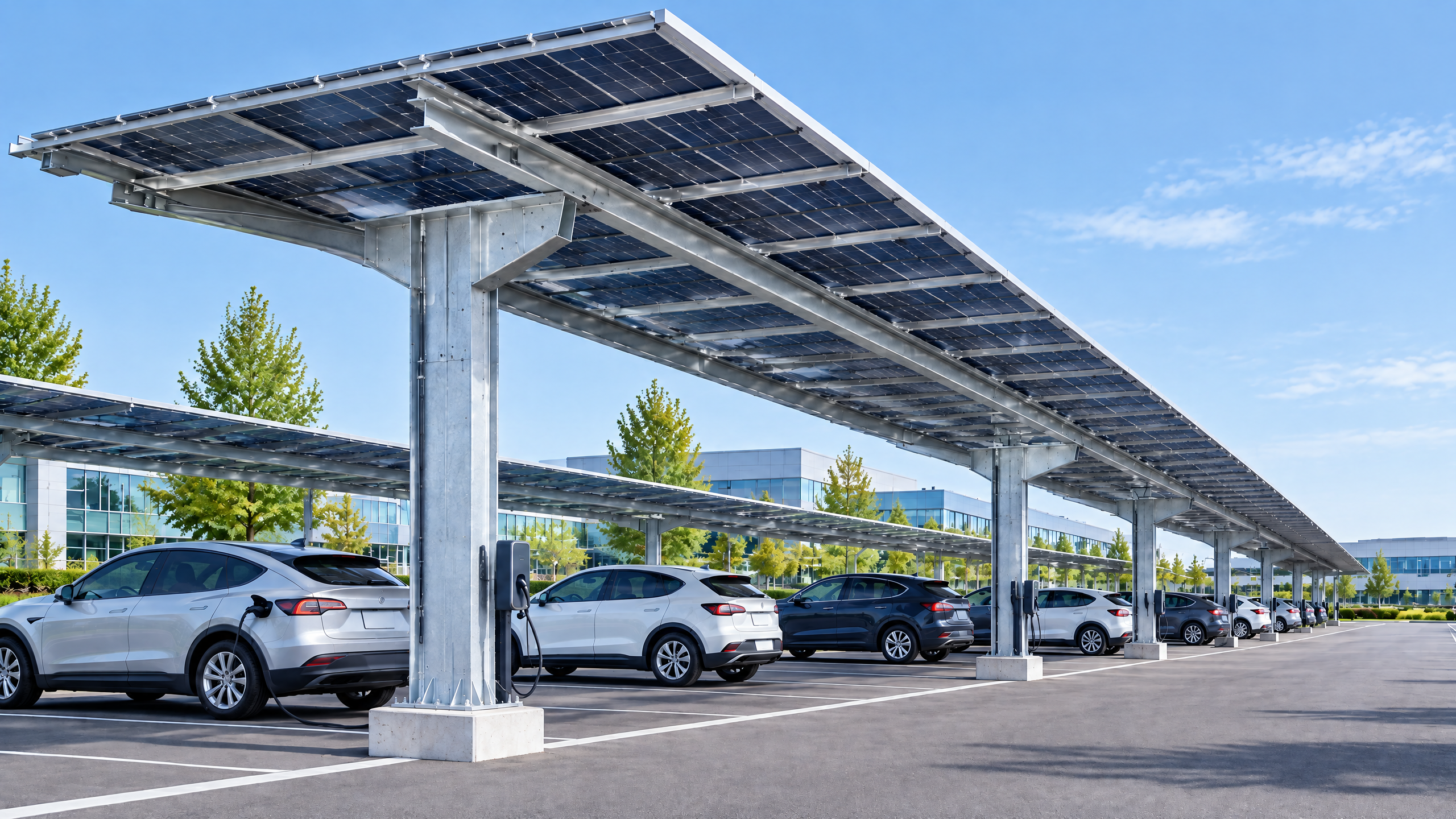
Commercial solar carport manufacturer selection matters at the points in a project lifecycle where design, procurement and long-term operation intersect—when structural integration, PV and electrical coordination, compliance and lifecycle costs are being settled. Choosing the right commercial solar carport manufacturer influences how reliably a scheme delivers energy yield, how quickly it progresses through permitting and interconnection, what warranty and maintenance regimes are realistic, and how well the carport integrates with parking, EV infrastructure, and site operations. For buyers—distributors, architects, contractors, developers, solar EPCs and fleet operators—the manufacturer is not just a supplier of metal and modules but a system partner whose engineering decisions inform foundations, PV equipment coordination, electrical pathway planning, and maintenance access planning. Select a manufacturer with demonstrable production controls, technical interface capabilities and the willingness to formalise responsibilities in contract documents early in commercial solar procurement.
Buyer context and scope boundary: who cares and when
Target audience and project types
- Distributors and resellers evaluating product lines for resale.
- Architects specifying carport form and finish for site fit and user experience.
- EPCs and contractors integrating PV and electrical systems.
- Developers and owners assessing capital and lifecycle cost, revenue and lease structures.
- Fleet operators planning covered charging infrastructure and shade.
- Public-sector procurers needing compliant specifications and procurement evidence.
Scope boundary for this guide
- Primary focus: the role and implications of the commercial solar carport manufacturer in project, procurement and implementation decisions.
- Secondary topics: how manufacturer-led choices affect structural interfaces, PV and electrical coordination, permitting and ongoing operations.
- This guide does not provide legal, structural or electrical design advice for specific sites; those matters require a documented project basis and relevant local qualified professionals, installers, utilities and authorities (see required statement below).
Required project-basis disclaimer (explicit)
- Site-specific structural capacity, foundations, permits, electrical design, approvals, lead time, price, energy yield and warranty require a documented project basis and relevant local qualified professionals, installers, utilities and authorities.
Why the manufacturer matters within this boundary
- Manufacturers translate design intent into producible, testable products. Their engineering tolerances, factory QA, supply chain resilience and willingness to participate in interface coordination determine how the installed solution performs against expected yield and lifecycle cost.
- In many jurisdictions the manufacturer’s documentation and factory evidence support permitting and warranty claims; for B2B buyers, that documentation reduces commercial risk and closes procurement gaps.
Core decision principle: when manufacturer selection changes project outcomes
Decision principle statement
- Choose the carport manufacturer when the manufacturer’s engineering choices materially affect cost, risk allocation or technical performance beyond standard marketplace variability.
Situations where the manufacturer is a primary decision driver
- Structural complexity: multi-span, long-span or bespoke architectural carports where manufacturer design significantly changes foundation loads and construction cost.
- Integrated PV: where the manufacturer is responsible for module attachment, module layout and PV equipment coordination.
- Embedded electrical scope: where the manufacturer provides integrated cable routing trays, junction boxes or EV-charger mounts and defines electrical pathway planning.
- Warranty risk transfer: when long-term warranty obligations depend on manufacturer test evidence and production controls.
Situations where the manufacturer is a lower-order choice
- Off-the-shelf canopy where structural and electrical interfaces are standard, and modules/electrical scope are handled entirely by a separate PV EPC.
- Simple replacement canopies with limited PV integration and standard foundations where local installers can adapt.
How to use the principle in procurement
- Evaluate whether manufacturing decisions will change foundation, interconnection, or site operations. If yes, require manufacturer-led interface deliverables (drawings, load cases, PV layout, electrical pathway plan) as bid deliverables.
- Use procurement terms to allocate responsibility for design verification, approvals and as-built documentation between buyer, EPC and manufacturer.
Planning inputs: what data the manufacturer needs early
Essential early inputs
- Site coordinates and solar resource expectation (use NREL resources for baseline solar maps) [1].
- Clearings and shading studies for the parking zones; LiDAR or site survey data for accurate obstructions.
- Parking layout: aisle widths, column sweet spots, vehicle circulation, ADA requirements.
- Intended PV goals: gross DC capacity, target AC export, revenue or behind-the-meter consumption, and if EV charging is included.
- Geotechnical report summary: allowable bearing capacity, shallow groundwater, frost depth, soil corrosivity.
- Utility connection intent: export limits, meter locations, and interconnection process assumptions.
- Local regulatory constraints: height limits, building codes, fire access, and snow/wind load codes.
Planning outputs you should expect from the manufacturer
- Structural load envelope and reactions for specified canopy geometry.
- Standard connection and foundation types with approximate depths and capacities.
- Module mounting details and recommended PV layout for optimal serviceability and yield.
- Electrical pathway planning inputs: cable routing corridors, preferred junction locations, and conduit capacities.
- Maintenance access planning recommendations: safe walkways, rooftop service routes, and module removal sequences.
Energy-yield and system sizing notes
- Use PVWatts or equivalent yield models for initial yield estimates. PVWatts provides a practical baseline for DC sizing and energy estimation under local irradiance conditions and is widely used for project scoping [2].
- Yield estimates must be validated with final module specifications, tilt, orientation, shading analysis and inverter clipping expectations conducted by the energy modeler.
Regulatory and utility interactions
- Early engagement with the utility is critical for the utility and permit interface; the manufacturer’s ability to provide electrical pathway planning and consistent as-built drawings will speed interconnection and approval discussions.
- Interconnection processes and technical screens vary; plan for iterative exchanges and include manufacturer-produced single-line diagrams for review. See FERC resources for interconnection context where applicable [4].
Technical specification and interfaces: where the manufacturer’s engineering matters
Structural interfaces (solar carport structural interface)
- The solar carport structural interface defines how canopy loads transfer to foundations and the building context. Manufacturer-supplied structural calculations must align with local code parameters and the geotechnical report.
- Key deliverables from the manufacturer: structural calculation package, connection detail drawings, bolt schedules, and uplift load cases for wind and snow combinations.
PV equipment coordination (PV equipment coordination)
- Manufacturer responsibility versus EPC responsibility must be explicit. If the manufacturer supplies module clamps, module frames, or integrated module rails, they must provide mechanical interface specifications (module frame clearance, torque requirements) and compatibility matrices.
- Co-design considerations: module mounting height for ventilation (relevant to energy yield and hot-weather derating), wiring routes, and ability to integrate optimisers or microinverters.
Electrical pathway planning
- Provide clear electrical pathway planning: conduit routes, cable tray capacity, recommended junction box locations, and busbar interfaces. Design for expected cable cross-sections and future capacity (EV chargers or capacity upgrades).
- Typical manufacturer deliverables: BIM models or 3D CAD for electrical routing, predetermined locations for combiner boxes, and preferred AC junction points.
Foundations and anchorage
- Foundation options (pile, spread footing, anchor) should be offered with associated design loads and expected excavation depths. The manufacturer should state any conditions where a foundation type is not recommended.
- Corrosion protection and detailing for damp or aggressive soils must be part of the technical spec.
Architectural finish and user experience
- Ensure that the manufacturer can meet architectural finish requirements (anodised aluminium, powder coating, custom trims) while maintaining warranties and corrosion protection.
- Carport height and geometry decisions affect usable parking space and signage. The manufacturer’s standard and custom options should be documented.
Roof drainage, stormwater and snow shedding
- The manufacturer should provide drainage paths, scupper locations and eave detail to integrate with existing site drainage plans. Where snow sheds are a risk, ensure load paths and clearances are clarified.
Maintenance and safety interfaces (maintenance access planning)
- Maintenance access planning must be included in the scope: safe module access for cleaning and repairs, fall-restraint attachment points, and specified clearances for module replacement.
- For PV technicians, the manufacturer should provide layout drawings that show safe walking zones, anchorage points and access sequences for module removal and inverter servicing.
Documented deliverables checklist (table 1)
| Deliverable | Typical Owner | Why it matters |
|---|---|---|
| Structural calculations and load cases | Manufacturer | Defines foundation design and compliance with wind/snow codes |
| PV mounting and clamp specification | Manufacturer | Ensures module compatibility and warranty alignment |
| Cable routing plan / conduit sizing | Manufacturer or EPC (if integrated) | Prevents rework and supports electrical inspections |
| BIM/3D models for coordination | Manufacturer | Reduces clashes with HVAC, lighting, and EV infrastructure |
| Maintenance access plan | Manufacturer | Minimises operational downtime and upkeep risk |
Procurement and factory evidence: what to request and how to evaluate
Why factory evidence matters
- For B2B commercial solar procurement, factory evidence documents production controls, material traceability and the capacity to deliver consistent assemblies to project specifications. This reduces surprises on site and helps in warranty claims.
Minimum procurement requirements to request
- Bill of Materials (BOM) with part numbers and material specifications.
- Manufacturer’s ISO or factory quality documentation where available (e.g., factory inspection process, incoming material inspections).
- Sample load test reports for representative connections or a statement of test procedures (not fabricated results).
- Paint and coating specifications, salt-spray or corrosion class references as applicable to the site environment.
- Supply chain lead times and procurement staging plan (long-lead items flagged).
- Factory packaging and shipping method, to assess site handling needs.
- Movement and handling weight data for lifting and crane planning.
Decision table — when to insist on factory evidence
| Project characteristic | Insist on full factory evidence | Supplier standard documentation acceptable |
|---|---|---|
| Complex bespoke structural design | Yes | No |
| High-corrosion or coastal environment | Yes | No |
| Standardised small canopy for local reseller inventory | No | Yes |
| Integrated PV module rails supplied by manufacturer | Yes | Partial (must include mechanical compatibility) |
| Tight schedule with multiple concurrent sites | Yes (staged production plan) | No |
Evaluating factory capability
- Factory capacity: does the manufacturer have sufficient fabrication capacity to meet lead times? Ask for production schedules rather than marketing claims.
- Quality controls: evidence of inspection plans, dimensional control and QC sign-off procedures for welded or extruded assemblies.
- Traceability: serialisation for critical components (e.g., high-strength bolts, custom rails) that may be needed for warranty or recall actions.
- Packaging and logistics: engineered packaging reduces site damage and labour costs.
Contractual risk allocation
- Specify acceptance criteria, punchlist processes, and responsibility for site corrections caused by manufacturing non-conformance.
- Include definition of latent defects period and required notification timeframe.
- For integrated systems, clarify responsibility for compatibility between modules, inverters and carport attachments.
Site installation, commissioning and operations
Site installation sequencing
- Site plan review: confirm delivery routes, crane access, temporary storage, and on-site staging.
- Pre-install checks: foundations and embedments must be verified against the manufacturer’s as-built foundation drawings before canopy erection.
- Erection tolerances: manufacturers will specify bolt-up tolerances and permissible deviations; ensure the contractor has alignment tools and procedures.
Interface with PV installer and electrical contractor
- Co-ordination meetings: schedule regular interface sessions between manufacturer, PV installer and electrical contractor to confirm combiner locations, cable lengths and DC/AC segregation practices.
- Functional testing: plan for continuity and insulation resistance tests for DC runs after installation and prior to inverter commissioning.
- Commissioning sequence: manufacturer-provided datasheets for module clamping torque and PV attachment instructions are necessary before energisation.
Operations and maintenance (O&M)
- Typical O&M deliverables from manufacturer: spare parts list, module replacement instructions, recommended cleaning regime and fastener torque guides.
- Maintenance access planning must include procedures for working at height, fall-protection requirements and safe isolation points for DC and AC systems.
Integration with EV infrastructure
- If EV charging is part of scope, coordinated locations for chargers, cable ducts, and meter placement should be agreed upon. Manufacturers should provide space and routes for future charger additions.
- For fleet operators combining PV and chargers, consider futureproofing conduit sizes and busway capacity.
Asset monitoring and performance
- Manufacturer role: provide as-built model and expected physical parameters for energy model validation.
- EPC role: deliver plant performance monitoring (SCADA, inverter telemetry) and agreed KPIs for availability and energy yield validation.
Useful handover items from the manufacturer
- As-built structural drawings and lifting points.
- Component manuals and replacement part numbers.
- Module clamping and torque schedules and maintenance checklists.
- Welding and surface treatment records where relevant.
Mid-article CTA
- To discuss how a manufacturer-integrated solution aligns with your site, contact /inquiry or learn more about SolarGrid commercial solar system, see our all systems overview and review our sourcing guides.
Implementation risk section: common failures and mitigations
Risk categories and mitigation strategies
- Structural misalignment and foundation mismatch
- Risk: On-site conditions differ from assumed soil or bearing capacity, causing redesign or rework.
- Mitigation: Require manufacturer foundation loads and embedment drawings early; confirm geotechnical report and allow contingency for varying soil strata.
- PV compatibility and module fit issues
- Risk: Module frame dimensions or glass edge clearances not compatible with manufacturer clamp detail.
- Mitigation: Require module-to-rail compatibility matrix and pre-build mockup where module format is non-standard.
- Electrical pathway bottlenecks
- Risk: Conduit or tray undersizing prevents planned cable routes; DC runs too long causing energy loss.
- Mitigation: Early electrical pathway planning, require cable sizing scenarios and future capacity corridors.
- Permitting and utility delays
- Risk: Interconnection or permitting hold-ups extend timeline and escalate cost.
- Mitigation: Early utility and permit interface; manufacturer delivery of single-line diagrams and structural documentation to speed review. Refer to interconnection guidance for context [4].
- Manufacturing and QA gaps
- Risk: Factory QA insufficient; assemblies arrive out of spec.
- Mitigation: Request factory inspection plans, staged sign-offs, and acceptance criteria in contract. Include right-to-inspect clauses.
- Unclear warranty and lifecycle responsibilities
- Risk: Overlapping or missing warranty coverage between module, inverter and carport.
- Mitigation: Require an integrated warranty matrix showing responsibility boundaries and contact points for claims.
- Operational access and safety issues
- Risk: Insufficient access for maintenance increases downtime.
- Mitigation: Include maintenance access planning and safe work method statements during procurement.
Monitoring, escalation and contingency
- Define KPI and reporting cadence for supply, delivery, installation milestones and energy performance.
- Ensure contractual remedies and defined escalation paths for missed milestones or quality defects.
Evidence-led procurement checklist and decision table
Procurement evidence checklist (table 2)
| Evidence item | Purpose | Minimum acceptance |
|---|---|---|
| BOM and material spec | Verify materials and replaceability | Complete BOM with part numbers |
| Structural calculation package | Confirm foundation and load cases | Peer-reviewed or stamped by qualified engineer |
| Electrical pathway plan | Prevent cable and conduit conflicts | Conduit sizes and junction box locations |
| Factory QA process description | Understand production controls | Documented inspection checkpoints |
| Lead time and production schedule | Plan project timeline | Confirmed weekly production plan |
| Maintenance access plan | O&M risk reduction | Clear access routes and anchorage points |
| Warranty matrix | Define responsibilities | Written matrix covering parts, workmanship, and interfaces |
| Transport and lifting plan | On-site readiness | Crate weights, lift points and handling instructions |
Decision guidance based on procurement size
- Small volume / commodity buys: Accept standard documentation and sample component checks.
- Mid-sized commercial projects: Require full BOM, factory QA description, structural package and electrical pathway plan.
- Large or bespoke projects: Insist on factory inspection rights, detailed QA evidence, peer-reviewed calculations and schedule-linked penalties/acceptance criteria.
Carportiva Six-Step Manufacturer Selection Workflow
Step 1 — Define scope and performance targets
- Clarify parking layout, DC capacity, target energy yield, EV charging needs and lifecycle objectives. Include stakeholders from facilities and operations.
Step 2 — Collect baseline site data
- Provide geotechnical summary, site survey, shade studies, and utility connection intent to bidders.
Step 3 — Prequalify manufacturers
- Request capability statements, production capacity, and examples of technical deliverables. Use the procurement evidence checklist above.
Step 4 — Issue detailed technical RFP
- Require manufacturer deliverables: structural loads, module interface specs, electrical pathway planning, maintenance access planning and factory production schedule.
Step 5 — Evaluate technical bids and commercial terms
- Score bids on technical compliance, evidence strength, lead time, warranty clarity and interface risk allocation. Request clarifications and staged demonstrations.
Step 6 — Contract with clear interface definitions
- Finalise contract with accepted equipment list, deliverable schedule, acceptance tests and a warranty matrix. Define responsibility for foundations, interconnection and any site modifications.
Workflow notes
- Hold design coordination workshops during Step 4–5 to surface conflicts early.
- Ensure procurement documents require that site-specific structural capacity, foundations, permits, electrical design, approvals, lead time, price, energy yield and warranty are confirmed on a documented project basis by local qualified professionals.
Frequently asked questions (FAQ)
Q: Is the carport manufacturer responsible for the PV modules and inverters? A: Only if contractually specified. In many projects the manufacturer supplies the structural system and mounting hardware, while an EPC supplies modules and inverters. If you want single-source responsibility, require it explicitly and ensure the manufacturer provides PV equipment coordination deliverables.
Q: How early should a manufacturer be engaged? A: Engage them early enough to affect foundation design, PV layout and electrical pathway planning—typically during schematic design or prior to issuing foundation drawings.
Q: Can a manufacturer provide guarantees on energy yield? A: Energy yield guarantees are typically offered by system integrators or EPCs that control module and inverter choice and O&M. Manufacturers can support yield through mounting design and minimising shading, but yield guarantees require validated modelling and contractual commitments from parties controlling electrical design.
Q: How do I manage warranties between module, carport and EPC? A: Require a warranty matrix in procurement documents that clearly assigns responsibility for module failure, mechanical failure, installation workmanship and corrosion issues. Consider escrowed spare parts or long-lead component retention.
Q: What documentation from the manufacturer will speed permitting? A: Structural calculations, stamped drawings (if applicable), wind and snow load cases, and single-line diagrams for electrical interface are commonly required by permitting authorities. Early submission of these items reduces review cycles.
Q: Where can I estimate energy production for budgeting? A: Use PVWatts for initial energy production estimates and then refine with detailed modelling that includes module specifications and site shading [2]. NREL provides broader resource data and tools for planning [1].
Q: What are typical lead times? A: Lead time depends on manufacturer capacity, finish complexity and supply chain. For bespoke aluminium extrusions or specialised coatings, lead times increase. Always request production schedules and staging plans during procurement.
Q: How should I handle change orders for site conditions? A: Define a change-order process in the contract with clear pricing mechanisms for variations due to geotechnical surprises or utility-imposed changes. Require manufacturer sign-off for changes affecting structural integrity.
Conclusion: when and how the manufacturer becomes pivotal
Selecting the right commercial solar carport manufacturer is pivotal when their engineering choices — structural geometry, PV equipment coordination, electrical pathway planning, and maintenance access planning — materially affect cost, schedule and operational outcomes. For B2B buyers in the solar, PV and EV infrastructure cluster, the manufacturer should be treated as a technical partner in projects that combine structural and electrical systems. Insist on evidence-led procurement: structural calculations, factory QA documentation, electrical routing plans and a clear warranty matrix.
Remember: the manufacturer can reduce risk when they provide clear technical interfaces and production controls, but site-specific structural capacity, foundations, permits, electrical design, approvals, lead time, price, energy yield and warranty still require a documented project basis and local qualified professionals, installers, utilities and authorities.
For tailored discussions about integrating structural carports with PV systems, contact /inquiry or email info@carportiva.com. Learn more about our offering at SolarGrid commercial solar system, view all systems and consult our sourcing guides.
References (selected)
- NREL solar resources and planning tools [1]
- PVWatts Calculator for early-stage yield estimates [2]
- U.S. Department of Energy Alternative Fuels Data Center for EV and charging context [3]
- Federal Energy Regulatory Commission interconnection resources [4]
References
- National Laboratory of the Rockies PV resources: https://www.nrel.gov/solar/
- PVWatts Calculator: https://pvwatts.nrel.gov/
- U.S. Department of Energy Alternative Fuels Data Center: https://afdc.energy.gov/
- Federal Energy Regulatory Commission interconnection resources: https://www.ferc.gov/electric-transmission/generator-interconnection
Keep the project brief connected.
Bring the actual project brief to the engineering table.
Share your location, layout, target application and available technical inputs. Carportiva can help identify the relevant product-interface information before a project-specific commercial discussion.
Request a project discussion