A concise decision answer (120–180 words)
Project teams procuring commercial solar carports should confirm a set of interdependent technical, contractual and execution items before awarding scope. At minimum, verify site boundary and load objectives; documented structural capacity and foundation constraints; electrical pathway planning and metering strategy; PV equipment coordination and module/inverter compatibility; utility and permit interface and interconnection timing; clear maintenance access planning and safety zones; factory quality evidence and inspection regimes; logistics and crane/installation constraints; and lifecycle warranty, performance guarantees and O&M scope. These confirmations reduce scope gaps between building, civil, electrical and solar disciplines and set procurement levers—price, lead time, risk allocation, and acceptance tests. For yield and financial modelling use established solar resource and performance tools (e.g., NREL/PVWatts) and reference local interconnection guidance. Crucially, site-specific structural capacity, foundations, permits, electrical design, approvals, lead time, price, energy yield and warranty require a documented project basis and relevant local qualified professionals, installers, utilities and authorities.
Buyer context and scope boundary: who must buy what, from whom, and why
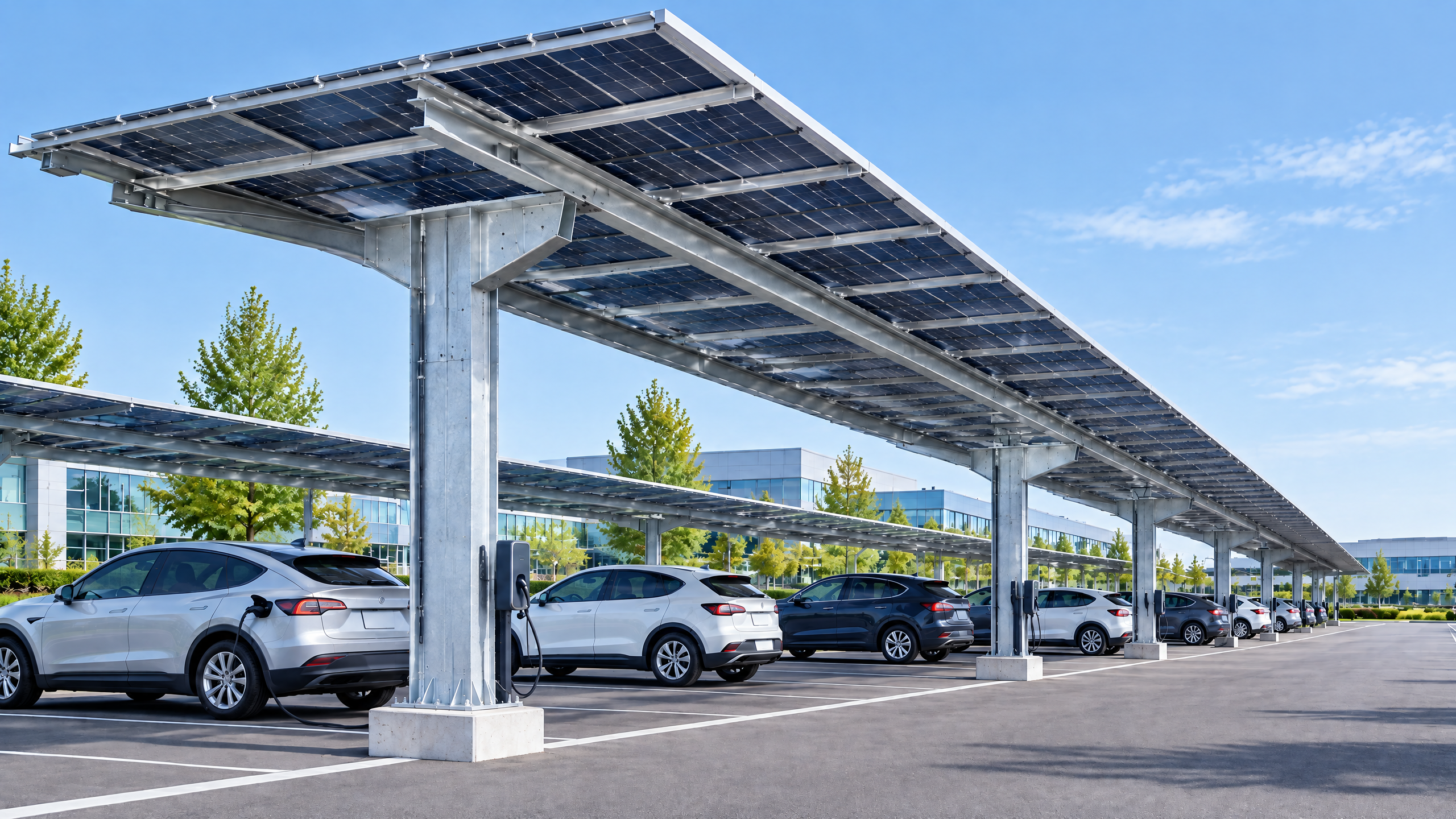
Commercial solar carports sit at the intersection of architecture, structural engineering, electrical distribution and PV supply chains. When addressing a commercial solar carport procurement guide, the buyer is typically a corporate real estate owner, developer, fleet operator, EPC, or contractor procuring a combined service set: architectural carport structure, PV array and balance of system (BOS), electrical connection, and often ancillary EV charging or lighting.
Key scope decisions to fix early
- Owner requirements: roof/roofline aesthetics, footprint, vehicle clearances, EV charging readiness, security, and insurance constraints.
- Performance targets: nameplate DC capacity, expected AC export percentage, on-site consumption profile, and availability windows.
- Contracting model: single-source turnkey (design, supply, install, commissioning), split contracts (civil/structure vs. electrical/PV), or supply-only (materials) with installer-managed assembly.
- Budget envelope and procurement constraints: capex ceiling, preferred vendors, lead-time tolerances, and currency/linkage for international sourcing.
Boundary clarity reduces friction between trade packages. Define which party holds responsibility for temporary works, site protection, traffic management, and interface milestones such as conduit handovers and roof penetrations.
Core decision principle: allocate risk to the party best able to control it
The guiding procurement principle is to assign each risk to the party with the most control and expertise over it. For example:
- Structural design and capacity risk should rest with the structural engineer and carport fabricator if they design and certify the structure; if the buyer supplies a site geotechnical report and foundation scope, the buyer retains that risk.
- Electrical pathway planning and interconnection timelines are controlled by the electrical contractor and the utility; the procurement should define who sequences approvals with the utility and who bears delay costs.
- PV equipment coordination and warranty claims are best handled by a supplier or integrator with manufacturer relationships and spare logistics.
Allocate warranty and performance risk using measurable milestones (e.g., performance baseline, acceptance test, date-certain commissioning) and financial instruments (holdbacks, liquidated damages, performance bonds). Avoid transferring unquantifiable regulatory or permitting risk to suppliers unless they have local presence and explicit responsibility.
Planning inputs: what documented data the team must gather first
Effective procurement is evidence-led. Before issuing RFQs or RFPs, collect and package these planning inputs:
- Site survey pack
- Topographic survey and cadastral boundaries.
- As-built utilities and conduit records; confirm non-invasive scans where needed.
- Vehicle swept paths and operational logistics zones.
- Geotechnical and structural baseline
- Soil report, groundwater table, and frost depth.
- Existing pavement and slab load-bearing data (if anchoring to pavement).
- Existing electrical single-line diagram and load profile
- Site meter configuration, transformer capacities, main switchgear locations.
- Annual and monthly load data; demand peaks.
- Energy/use case statement
- Owner’s expected export strategy (net-metering, feed-in tariff, behind-the-meter consumption).
- EV charging plans (number, power per charger, managed vs unmanaged).
- Permitting and local technical constraints
- Local building code excerpts that affect canopy structures and PV arrays.
- Utility interconnection rules and timelines (see FERC and local utility guidance) [4].
- Programme and date constraints
- Required in-service date tied to financing, occupancy or fleet roll-out.
Use PV resource and yield estimation tools early (NREL resources and PVWatts) to inform capacity selection and payback models [1][2]. For EV infrastructure coordination consult national AFDC guidance on vehicle chargers and grid impacts where relevant [3].
Technical specification and interfaces: items to confirm in specs and drawings
The technical specification is the contract’s control document. Confirm the following interface areas explicitly.
- Solar carport structural interface
- Structural load assumptions: snow, wind, seismic, live loads from maintenance activities, and concentrated loads during installation.
- Member sizing philosophy and connection detailing; galvanic isolation for aluminium-to-steel interfaces.
- Foundation type, depth and reinforcement, and the design responsibility or prescriptive anchor embedment if using pre-existing slabs.
- Vehicle clearance, canopy slope, drainage, guttering and thermal expansion details.
- PV equipment coordination
- Module form-factor, frame clearance, PV module layout and stringing plan, inverter locations, and DC combiner locations.
- Module attachment system compatibility with aluminium structure; module loading points and torque specifications.
- Provision for module replacement and spare module inventory.
- Electrical pathway planning
- Conduit routes, cable tray locations, and splice room locations from array to inverter to POI (point of interconnection).
- AC and DC cable length limits, voltage drop calculations and conductor sizing.
- Earthing/grounding scheme consistent with local code and ensuring equipotential bonding between carport structure and PV array.
- Utility and permit interface
- Metering location, revenue meter transfer if needed, net-metering or export configuration.
- Interconnection application timeline, study requirements and required protective relays and anti-islanding devices. Reference FERC and local utility requirements for generator interconnection processes [4].
- Building permit package requirements and approval hold points.
- Maintenance access planning
- Clear access corridors for mechanical and electrical maintenance, module replacement, and cleaning vehicles.
- Safe working zones for technicians and fall-protection anchor locations.
- Lighting and signage for hazardous zones and low-light operations.
- Ancillary systems
- Integration details for EV charging points, including reserved feeder capacity and metering per charging operator.
- Lighting circuits, CCTV and security, and snow/ice detection interlocks where required.
A specification annex should include the as-built drawing layer list and the expected deliverables at each contract milestone (e.g., fabrication drawings, mill certificates, PV module datasheets, inverter type approvals).
Procurement and factory evidence: what to request from vendors
In procurement rounds require evidence not just claims. Key documentary evidence to request and evaluate:
- Conformance documents
- Shop drawings with structural details stamped by a licensed engineer.
- Mill test certificates and material traceability for structural aluminium and fixings.
- Wind and snow load calculations for the site location.
- Product evidence
- Manufacturer datasheets for modules, inverters, string combiners, mounting rails and fasteners.
- Independent product test reports where available (third-party IEC/UL test references only; do not accept proprietary single-lab claims without context).
- Quality management and factory inspection
- ISO 9001 or equivalent factory quality procedures, and a documented test plan for assembly welds, torque verification and surface treatments.
- Factory Acceptance Test (FAT) scope for PV inverters and medium-voltage switchgear, and a defined witness/attendance policy.
- Logistics and lead-times
- Confirm long-lead items and factory production windows, shipping availability and incoterms. Insist that lead-times in contract reflect confirmed factory schedules, not marketing lead-times.
- Site assembly sequence
- Method statements for lifting and temporary bracing, erection tolerances and temporary works responsibilities.
- Evidence of competency for any specialist installers (e.g., licensed PV electricians and certified welders).
Two Markdown decision tables below can help standardise vendor comparison.
Decision table 1 — Vendor technical evidence (example)
| Evidence item | Minimum acceptable deliverable | Pass/fail notes |
|---|---|---|
| Structural shop drawings | Engineer-stamped drawings suitable for local permit | |
| Material traceability | Mill certificates for aluminium + fasteners | |
| PV module datasheet | Model, power, temperature coefficients | |
| Inverter FAT | Signed FAT report with test results | |
| Warranty terms | Manufacturer warranty period + exclusions | |
| Installation method statement | Lifting and temporary works sequence |
Decision table 2 — Procurement model selector
| Risk/Requirement | Single-source turnkey | Split contract (structure + PV) | Supply-only |
|---|---|---|---|
| Single point accountability for performance | High | Medium | Low |
| Control over supplier selection | Medium | High | High |
| Complexity of contract management | Low | High | High |
| Recommended when local approvals/permits complex | Yes | Conditional | No |
When evaluating bids place weighted scoring on documented evidence rather than price alone. For example, missing FAT records or unclear mechanical connection details should carry material deduction.
Site installation and operations: constructability, sequencing and handover
Installation of carport-mounted PV requires integrated sequencing across civil, structural, mechanical and electrical teams.
- Pre-installation checks
- Survey and confirm as-built positions; ensure anchor sets align to fabrication tolerances and tolerances defined in shop drawings.
- Confirm foundation curing and capacity, or confirm pavement anchors and required coring protocols.
- Lifting and erection sequencing
- Erection should minimize repetitive lifting of heavy components under adverse wind conditions; define maximum wind criteria for lifts.
- Temporary bracing and propping must be defined in method statements; do not leave temporary works in place without engineer sign-off.
- Electrical installation sequencing
- Route and install conduit and cable trays during early works; coordinate with PV module layout to minimize extra cable lengths.
- Splicing and testing of DC strings should be performed under dry, dust-controlled conditions; define splice room and pull-box locations.
- Commissioning and acceptance
- Define acceptance tests: insulation resistance, string I-V curves, inverter functional tests, SCADA telemetry verification, and performance baseline tests.
- Photovoltaic yield verification uses irradiance data and reference cell measurements when practical; use PVWatts or equivalent for modeled baseline but validate with on-site data post-commissioning [2].
- Operations and maintenance
- Establish scheduled cleaning, vegetation management, and module inspection routines.
- Define emergency procedures for lightning, severe wind or snow events.
- Warranties and spare parts logistics: confirm who holds spare modules, replacement timelines and responsibility for warranty claim processing.
Throughout installation and operation, ensure traceability of serial numbers and as-built markups for warranty and O&M purposes.
Implementation risk: common failure modes and mitigations
Identify common implementation risks and practical mitigation measures.
- Interface mismatch between carport and PV array
- Risk: Modules or rails incompatibility with structural connections.
- Mitigation: Require pre-bid interface drawings and confirm module geometry and clamp details during bid evaluation.
- Unexpected foundation conditions
- Risk: Subsurface issues leading to foundation redesign and delay.
- Mitigation: Commission geotechnical study before procurement or include contingency and clear contractual responsibility for unforeseen ground.
- Utility delay or study escalation
- Risk: Interconnection studies extend timeline.
- Mitigation: Early utility engagement, provisional timeline allowances, and identify whether the utility requires upgrades; allocate cost risk appropriately.
- Logistics and long lead-time items
- Risk: Components delayed at factory or port, causing site idle time.
- Mitigation: Confirm production slots, include milestone payments tied to production, and consider local stocking for critical spares.
- Warranty and performance disputes
- Risk: Differing interpretations of performance baselines and environmental losses.
- Mitigation: Define clear acceptance tests, baseline PV performance models, and use third-party measurement devices for irradiance and production verification.
- Safety incidents during erection
- Risk: Falls, crane incidents, or electrical shocks.
- Mitigation: Insist on certified lift plans, accredited installers, and a site-specific safety plan with incident reporting protocols.
- Currency and import duty exposure (for international buyers)
- Risk: Price movement or unexpected duties.
- Mitigation: Use Incoterms that allocate responsibility, secure price lock-ins on long lead items, and plan customs brokerage early.
Document key risk allocation in the procurement templates and ensure each risk has an owner and an escalation path included in the contract.
Named six-step buyer workflow: how to go from brief to operation
A reproducible, named workflow to help project teams:
Step 1 — Define Project Baseline (Prepare)
- Produce a project brief that documents owner objectives, available budgets, key dates, expected energy outcomes, and any architectural constraints.
- Assemble planning inputs: site survey, geotech, electrical single-line and load data, permit checklist.
Step 2 — Technical Packet and Prequalification (Shortlist)
- Prepare a technical packet including schematic layouts, interface notes, and evaluation criteria.
- Prequalify vendors on documented evidence (shop drawings, factory QMS, installation competency).
Step 3 — Commercial Tender and Risk Allocation (Tender)
- Issue RFP with clear milestones, acceptance tests and liquidated damages where appropriate.
- Solicit firm lead-times and confirm long-lead procurement windows.
Step 4 — Detailed Design and Permitting (Design)
- Finalize structural and electrical design with licensed engineers and submit permit packages.
- Secure interconnection agreements and conditional approvals with the utility.
Step 5 — Manufacture, Delivery and Construction (Build)
- Hold FATs where applicable and confirm serial-numbered delivery manifests.
- Implement site works with defined safety, quality checkpoints and hold-points for inspections.
Step 6 — Commissioning, Handover and Warranty (Operate)
- Execute performance acceptance tests, hand over as-built documentation, O&M manuals and warranty files.
- Establish performance monitoring and an escalation path for underperformance or defects.
This six-step workflow is iterative: issues in any step may require revisiting prior steps. Integrate the workflow into your project controls and procurement governance.
Decision tables for procurement trade-offs
Decision table 3 — Performance vs cost trade-offs
| Consideration | Lower capex (cheaper components) | Higher capex (premium components) |
|---|---|---|
| Expected life | Shorter or uncertain | Longer, with manufacturer backing |
| Warranty clarity | Often limited or minimal | Longer, clearer transferability |
| Energy yield consistency | Potentially lower due to degradation | Higher due to better efficiency and lower degradation |
| Supplier lead time | Potentially shorter from commodity sources | May be longer due to bespoke specs |
Decision table 4 — Site-servicing and O&M responsibility
| O&M element | Owner maintains | Supplier/O&M provider |
|---|---|---|
| Routine cleaning | Owner or facilities team | Contracted cleaning with SLA |
| Warranty claims liaison | Owner (with supplier support) | Supplier manages claims and replacements |
| Monitoring and analytics | Owner subscribes to portal | Supplier provides turnkey monitoring & alerts |
| Spare part inventory | Owner stores spares | Supplier maintains replacement stock |
These tables help align procurement specification to the buyer’s appetite for capex vs. operational control.
Related B2B sourcing terms
For the same project brief, buyers may also encounter these connected search terms: commercial solar procurement. They must be interpreted against the actual project scope rather than treated as independent technical guarantees.
Frequently asked questions (FAQ)
Q: How do I estimate energy yield for a commercial solar carport? A: Use validated solar resource datasets and performance calculators such as NREL resources and PVWatts for preliminary estimates; refine with actual on-site irradiance sensors or reference cell data during commissioning [1][2]. Model loss factors conservatively (soiling, shading, inverter efficiency, thermal effects) and validate assumptions in the RFP.
Q: What permits and approvals are typical? A: Typical permits include building permits for the carport structure, electrical permits for grid connection and possibly grading/permitting for foundations. Utility interconnection approval is a separate process and can require studies. Lead times vary by jurisdiction—engage early with authorities and utilities.
Q: Who provides the foundations? A: Foundation responsibility should be explicitly stated. Options: (a) supplier provides foundation design and build; (b) buyer provides certified foundation design and construction; (c) hybrid approach. Clarify in contract and confirm with geotechnical data.
Q: Can I integrate EV charging later? A: Yes, but plan for it. Confirm reserved feeder capacity, conduits and space for switchgear. Include PV equipment coordination and electrical pathway planning to allow future charger installation without major rework.
Q: What warranties should I insist on? A: Module and inverter manufacturer warranties, structural warranty for the carport (covering materials and workmanship), and performance guarantees for generation (if applicable). Define the warranty claims process and required documentation for claims.
Q: How should I validate manufacturer claims? A: Require third-party test certificates, FAT reports, engineer stamps, and manufacturer references. Consider independent site inspections during erection and commissioning.
Q: What about public incentives and tariffs? A: Incentives and tariffs are jurisdiction-specific. Do not rely solely on incentives for project viability. Use them as upside only after confirming eligibility and timelines via local advisors.
Mid-article call to action
For project-specific scoping and to review how a commercial carport solution can integrate with your energy strategy, contact our team for a technical review and to view product configurations such as the SolarGrid commercial solar system. For broader comparisons see all systems and consult our sourcing guides. To initiate a technical inquiry use /inquiry or email info@carportiva.com.
Procurement checklist: what to require in the contract
A checklist to include in procurement documents to ensure completeness:
- Detailed scope split and responsibility matrix (employer vs contractor).
- Complete set of deliverables and acceptance criteria: shop drawings, material certificates, test reports, O&M manuals, monitoring credentials.
- Defined hold points for quality and safety inspections.
- Milestones and payment schedule aligned to manufacturing and site delivery.
- Liquidated damages or incentive payments linked to commissioning date.
- Warranty terms, performance guarantees and spare part obligations.
- Insurance and indemnity clauses for third-party damage and site activities.
- Dispute resolution and change order procedures.
Attach annexes with specific interface drawings showing PV module layout overlaid on structural drawings and electrical single-line diagrams.
Integration with EV and fleet infrastructure (cluster linkage)
Solar carports commonly serve fleet and EV infrastructure initiatives. When coordinating:
- Confirm PV sizing and export limits relative to planned charging loads.
- Coordinate PV equipment coordination and EV charger vendor interfaces early to allow consistent metering and load management strategies.
- Use energy management systems for demand response scheduling to avoid costly distribution upgrades.
Reference national EV infrastructure guidance for charger siting and utility coordination where relevant [3].
Final checks before contract award
Before awarding contracts, confirm these last items:
- All required permits or applications have been submitted, and status is documented.
- Factory and site QA/QC plans are approved.
- Lead times and logistics schedules have been reconciled with project milestones.
- Insurance certificates and performance security are in place.
- Acceptance test procedures and baseline generation metrics are mutually agreed.
Remember: site-specific structural capacity, foundations, permits, electrical design, approvals, lead time, price, energy yield and warranty require a documented project basis and relevant local qualified professionals, installers, utilities and authorities.
Conclusion
A commercial solar carport procurement guide should be a practical instrument that aligns technical requirements, commercial terms and execution sequencing. The buyer’s role is to compile reliable planning inputs, set explicit interface responsibilities (structural, electrical, utility), demand verifiable factory evidence, and allocate risks to parties capable of managing them. Use established resource and yield tools for modelling [1][2], engage utilities early for interconnection [4], and align O&M and warranty responsibilities with service capability. Following the six-step buyer workflow and the checklists above reduces schedule risk and increases confidence in energy and financial outcomes.
For a detailed, project-specific review and to see compatible configurations such as the SolarGrid commercial solar system, or to explore all systems and consult our sourcing guides, please open an inquiry at /inquiry or contact info@carportiva.com.
Numeric references
- NREL solar resources and guidance: https://www.nrel.gov/solar/
- PVWatts Calculator: https://pvwatts.nrel.gov/
- U.S. Department of Energy Alternative Fuels Data Center (EV infrastructure): https://afdc.energy.gov/
- Federal Energy Regulatory Commission interconnection resources: https://www.ferc.gov/electric-transmission/generator-interconnection
References
- National Laboratory of the Rockies PV resources: https://www.nrel.gov/solar/
- PVWatts Calculator: https://pvwatts.nrel.gov/
- U.S. Department of Energy Alternative Fuels Data Center: https://afdc.energy.gov/
- Federal Energy Regulatory Commission interconnection resources: https://www.ferc.gov/electric-transmission/generator-interconnection
Keep the project brief connected.
Bring the actual project brief to the engineering table.
Share your location, layout, target application and available technical inputs. Carportiva can help identify the relevant product-interface information before a project-specific commercial discussion.
Request a project discussion