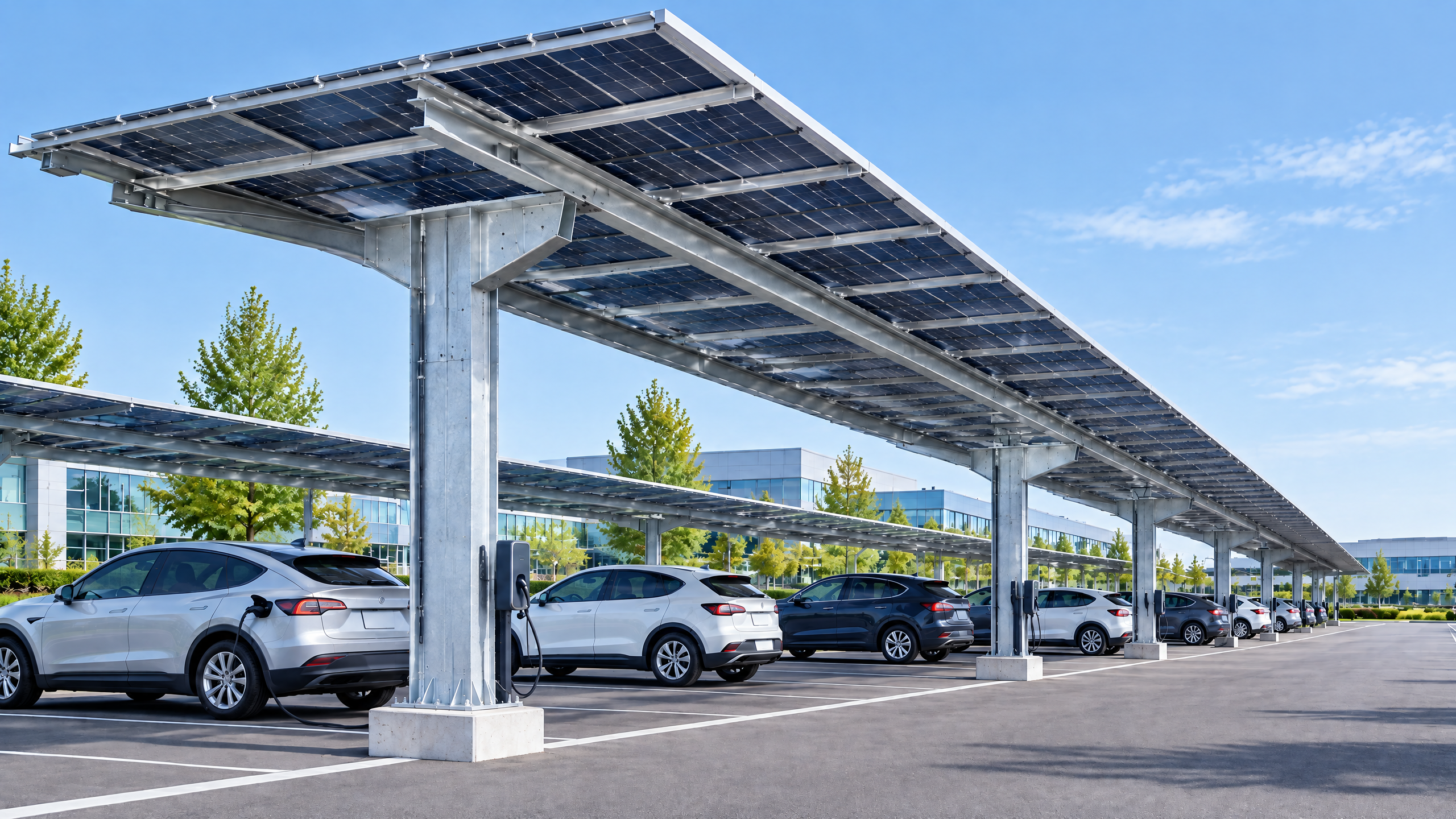
Short answer (120–180 words) Selecting a commercial solar carport supplier is a technical and commercial decision that combines structural engineering, PV integration, electrical coordination, permitting and lifecycle support. Prioritise suppliers who demonstrate tested structural systems, documented factory QA, integrated PV and electrical design workflows, clear utility and permit interface experience, and proven local-installation partners. Evaluate proposals against measurable project inputs — site geometry, wind/snow loads, foundation conditions, target energy yield, EV charging needs and available timelines. Require a documented package including structural calculations, interface drawings (roof-to-module and electrical), factory inspection reports, a production schedule and warranty terms. For complex projects, ensure the supplier can coordinate PV equipment, provide electrical pathway planning and accommodate maintenance access planning with the operations team. Finally, verify that all site-specific structural capacity, foundations, permits, electrical design, approvals, lead time, price, energy yield and warranty are established on a documented project basis with qualified local professionals, installers, utilities and authorities.
Buyer context and scope boundary
Who this guide is for
- Distributors, architects, contractors, developers, solar EPCs and fleet operators procuring covered parking, fleet shelters or architectural aluminium carports intended to host PV arrays and/or EV infrastructure.
- Decision-makers responsible for specifying, tendering, evaluating or accepting structural carports integrated with PV systems.
What this guide covers
- Selecting a commercial solar carport supplier as a distinct procurement item and system integrator.
- Project-level implications for design, procurement, factory evidence, installation, commissioning and operations.
What this guide does not cover in full
- Detailed electrical engineering design (single-line diagrams, protection settings) — those require site-specific designs by licensed electrical engineers and utility studies.
- Local permitting rules and code compliance details — local authorities set jurisdictional requirements.
- Specific PV module or inverter model performance claims — validate against manufacturer datasheets and independent lab reports.
Scope boundary definition
- “Commercial solar carport supplier” in this guide refers to suppliers whose scope includes structural carport systems, interface coordination with PV equipment, and documented handover for installation. Suppliers may deliver structures only, structures + PV procurement, or full EPC. Clarify scope early in procurement.
Core decision principle
Make the supplier decision against three primary, evidence-based axes:
- Technical interface clarity — Are structural and electrical interfaces documented and demonstrable?
- Lifecycle and operational readiness — Can the supplier demonstrate maintainability, spare parts, monitoring and warranties aligned with your asset-management requirements?
- Supply-chain and project delivery assurance — Does the supplier provide factory QA, realistic lead times, and contingency for materials or labour risks?
Why these axes matter
- Solar carports are high-value, long-lived assets where structural failure, water ingress, poor electrical access, or noncompliant interconnection can create safety, financial and reputational risks.
- Suppliers that can demonstrate integrated workflows for solar carport structural interface, PV equipment coordination and electrical pathway planning reduce rework, change orders and permit delays.
Decision thresholds (examples)
- For commercial installations above 250 kW, require supplier responsibility for structural drawings signed by a licensed engineer in the project jurisdiction.
- For projects with EV charging, require documented coordination between carport canopy loads and EV charger cable routing and metering.
- For rooftop-like carports in high-wind or heavy-snow zones, require explicit wind/snow load calculations and foundation design alternatives.
Planning inputs: what to collect before engaging suppliers
Gather and document the following baseline inputs. These form the “project basis” you will share and should be verified by local professionals.
Site and programme inputs
- Site plan and geotechnical summary (soil type, bearing capacity, water table).
- Existing utilities locations and capacity (transformer ratings, available fault-current data).
- Vehicle circulation and parking layout (dimensions, clearances, ADA or local accessibility needs).
- Target energy objectives (annual kWh, percentage of site load to be offset, demand management goals).
- EV charging intent (number of chargers, charger power levels, managed/managed charging).
- Local environmental conditions (basic wind speed, snow load map reference, seismic zone).
Regulatory and stakeholder inputs
- Local building code reference (design codes in force).
- Utility interconnection rules and timelines.
- Permitting authority contacts and anticipated permit windows.
- Site access and contractor working-hours constraints.
Performance and commercial inputs
- Budget envelope and acceptable capex vs opex trade-offs.
- Desired contract scope (structure only, structure + modules + inverters, full EPC).
- Handover acceptance criteria and warranty expectations.
Use NREL and PV tools for preliminary sizing
- Use NREL site resources and guidance for PV project planning as a starting point [1].
- Use PVWatts for early-stage energy-yield estimates and to test general PV sizing options early in procurement [2].
Document these inputs in a procurement brief (minimum 3 pages) and require suppliers to confirm any clarifications in writing before pricing.
Technical specification and interfaces
This is the heart of the selection process. The supplier must demonstrate compatible, tested solutions for multiple technical interfaces.
Structural design and materials
- Material selection: aluminium is common for architectural carports (corrosion resistance, weight benefits). Verify material grade and surface treatment (e.g., anodising, architectural powder coating) against site exposure conditions.
- Loads: supplier must provide design envelope for dead loads, PV module loads, wind uplift, snow drift, and any vehicle impact considerations. Require limit states and serviceability checks.
- Foundations: suppliers typically provide foundation options (pad, piled, combined footings). Foundation design must be confirmed with geotechnical inputs and signed by a local civil/structural engineer.
Table: Recommended carport form by common site condition
| Site condition | Recommended carport form | Key structural considerations |
|---|---|---|
| Flat open lot, low wind | Single-span cantilever or simple portal frames | Minimise foundations, optimise rack orientation for PV |
| Narrow linear parking aisles | Continuous multi-bay frames | Control expansion joints, coordinate drainage |
| High-wind coastal sites | Deeper sections, additional bracing, anchor uplift | Corrosion-resistant finish critical |
| Heavy-snow inland sites | Steeper canopy slope, reinforced rafters | Snow-shedding paths, snow drift on adjacent canopies |
Solar carport structural interface
- Define the solar carport structural interface: how PV module racks, clamps and electrical trays connect to the carport roof.
- Require cut-sheets and interface drawings that show module mounting points, bolt grades, torque values and sealing methods for weatherproofing.
- Confirm compatibility with the PV module frame dimensions and module mechanical load ratings.
PV equipment coordination
- The supplier should be able to coordinate with the PV module and inverter vendors or supply them. This includes:
- Module-to-rack attachment specification and module string routing.
- Inverter siting, ambient cooling clearance and cable path requirements.
- Access for inverter maintenance and replacement.
Electrical pathway planning
- Electrical pathways must be planned as part of the structural design. This includes conduits, cable trays, combiner box locations and AC/DC segregation.
- Require a plan showing conduit entry points, junction box locations and metering positions.
- Include electrical pathway planning in early trade coordination to avoid late rework.
Table: Electrical pathway planning decision table
| Project complexity | Typical electrical scope by supplier | Procurement acceptance criteria |
|---|---|---|
| Structure only | Supplier supplies structure and penetrations only | Drawings showing penetrations, sleeve sizes and placement |
| Structure + electrical raceways | Supplier supplies trays/conduits to combiner boxes | As-built routing, cable capacity tables, tray supports load calculations |
| Structure + balance-of-system (BOS) | Supplier supplies full DC and AC pathways, sometimes up to metering | Single-line, protection coordination, utility approval package |
Maintenance access planning
- Require clear access for module cleaning, inverter service, combiner box replacement and cable replacement.
- Specify working clearances and fall-protection fixtures where required.
- Include maintenance access planning in design reviews with operations teams.
Drainage, lighting, and ancillary services
- Water drainage off canopies must avoid pooling and not drop directly on parked vehicles or equipment.
- Lighting, signage and CCTV fixation points should be included in the structural load schedule.
- Ensure early coordination with architectural and site-lighting teams.
EV charging integration
- If EV chargers are required, coordinate power distribution, metering and cable management with chargers’ vendor specifications and the local utility.
- Confirm whether chargers will be DC fast-chargers (higher site electrical demands) or AC chargers (distributed load).
Interconnection and utility interface
- Suppliers should supply documentation needed for utility interconnection studies but do not replace the role of the licensed electrical engineer in final designs. See FERC and local utility guidance on generator interconnection best practices [4].
- Utility and permit interface are often the longest critical-path items — identify the responsible party for submissions early.
Environmental and lifecycle considerations
- Consider recyclability of materials, end-of-life removal, and PV decommissioning plans.
- Factor in corrosion allowances for coastal areas and pollution considerations for industrial sites.
Compliance and testing
- Specify required testing at handover: structural inspection, PV performance testing (IV curve where appropriate), continuity and insulation tests, protective device tests and earthing resistance tests.
- Clarify which tests are supplier scope and which are by the EPC or commissioning team.
Procurement and factory evidence
What to request from each prospective commercial solar carport supplier
- Company background and project experience: list of analogous projects (do not accept unverifiable claims).
- Factory and production evidence: factory layout, production capacity, QA procedures, raw material traceability, welding procedures, coating application controls.
- Sample components: material certificates for primary members, sample finishes, anchor bolt specifications.
- Drawings and calculations: preliminary structural calculations, connection detail drawings, module and tray interface drawings.
- Schedule and lead times: critical-path lead times for long-lead items and contingency plans.
- Warranty and post-installation support statements.
- Health, safety and environmental (HSE) policy and records relevant to manufacturing and on-site safety.
Factory audit checklist (Decision table for supplier factory evidence)
| Evidence item | Minimum acceptable evidence | Red flags |
|---|---|---|
| Material certificates | Mill test reports for primary members | No traceability to batch numbers |
| Welding quality | Welding procedure specs and welder qualifications | Random weld repairs with no records |
| Surface treatment | Coating thickness test data, curing procedure | No coating QC records |
| Dimensional QA | Sample inspection reports, jigs and fixtures | High rejection rates, inconsistent tolerances |
| Documentation control | Revision-controlled drawing register | Multiple undocumented drawing versions |
Factory acceptance and pre-shipment
- Implement an agreed factory acceptance test (FAT) protocol including dimensional checks, coating inspections and sample joint testing.
- Where budgets allow, conduct a witnessed factory audit focusing on the supplier’s process controls rather than a single production batch.
Commercial terms and contract points to negotiate
- Clear definition of scope (deliverables list), change-order mechanism, milestone payments tied to verifiable outputs (drawings, factory acceptance, shipment, site completion).
- Liquidated damages or remedies for delayed deliveries; ensure these are realistic and aligned with supply-chain risks.
- Warranty windows and scope (corrosion, structural integrity, coatings). Avoid vague warranty statements; require what is covered, exclusions and claim process.
Supply-chain resilience
- Ask about alternate material sources, lead-time contingencies and the supplier’s inventory management practices.
- For international procurement, consider incoterms, customs clearance responsibilities and import duties as part of total landed cost.
Mid-article CTA If you have a defined project brief, request a documented supplier confirmation of scope and lead time to compare options /inquiry.
Site installation and operations
Pre-installation coordination
- Finalise foundation design on the basis of geotechnical reports and issue to the supplier with the contractual schedule.
- Schedule utility coordination meetings for meter placement and interconnection requirements.
- Review staging and traffic management plans for installation, including lifting equipment, crane reach, and vehicle routing.
Installation sequencing and common pitfalls
- Typical sequence: foundation works → erect primary frames → install secondary purlins/trusses → install module racks & trays → PV module installation → electrical works & cable routing → commissioning.
- Avoid simultaneous activities that introduce safety risks (e.g., module installation during crane operations without clear exclusion zones).
- Ensure daily QA and hold-points for critical tasks (foundation check, bolt torquing, sealant application).
Onsite quality checks
- Torque verification of structural bolts and module clamps.
- Coating touch-up records after field drillings or cuttings.
- Seal integrity at penetrations to avoid water ingress.
- Validation of cable routing and support spacing to relevant electrical standards.
Commissioning and handover
- Commissioning plan should include structural sign-off, PV performance acceptance tests (as-designed vs measured yield), electrical protection validation and operation of monitoring systems.
- Handover folder should include: as-built drawings, load and wind data used for the design, foundation drawings, warranty documents, spare parts list, maintenance manual and recommended spares.
Operations and maintenance (O&M)
- Establish an O&M schedule covering periodic structural inspections (corrosion, fasteners, deflections), PV cleaning regimes, inverter servicing and cable inspections.
- Determine who is responsible for maintenance access planning and costs over the lifecycle.
Remote monitoring and performance assurance
- Require suppliers to integrate monitoring points or provide recommendations for string/inverter meters to allow performance tracking.
- Use performance baselines (from PVWatts or detailed yield modeling) to detect underperformance early [2].
Spare parts and service response
- Agree on lead times for critical spares and service response windows for major components.
- Define responsibilities for replacement of structural components after vehicle impacts or unforeseen events.
Implementation risks and mitigations
Key risk categories and recommended mitigations:
Design and interface risk
- Risk: Misaligned structural and PV interfaces causing rework.
- Mitigation: Pre-manufacture integration meetings, interface drawings signed by both structural and PV vendors, mock-up if complex.
Permit and utility delays
- Risk: Permit and interconnection delays extend project timeline.
- Mitigation: Early utility and permitting engagement; assign responsibility for submissions; maintain a permit tracker. See FERC interconnection resources for high-level guidance on generator interconnection processes [4].
Foundation and geotechnical surprises
- Risk: Unexpected soil conditions increasing foundation costs.
- Mitigation: Obtain representative geotech borings before finalising foundation type; include foundation contingency budget.
Supply-chain and lead-time risk
- Risk: Component shortages or shipping delays.
- Mitigation: Source multiple suppliers, require material traceability, set contract terms for substitutions, and plan for buffer time in the schedule.
Weather and site access
- Risk: Weather interruptions during critical lifts or foundation pours.
- Mitigation: Weather contingency windows for critical-path activities and winterisation strategies where required.
Quality and warranty disputes
- Risk: Post-handover warranty claims for coatings or structural members.
- Mitigation: Detailed acceptance criteria, staged handover with documented FATs, and defined warranty claims process.
Financial and contractual risk
- Risk: Change orders because of scope ambiguity.
- Mitigation: Clear scope definition, priced change order mechanism, and requiring suppliers to confirm assumptions in writing.
Safety and compliance
- Risk: On-site safety incidents.
- Mitigation: Enforce supplier HSE plans, require toolbox talks and third-party safety audits where appropriate.
Residual risk acceptance
- Carry a contingency budget (financial and schedule) and document remaining risks in a risk register with assigned owners.
Named six-step buyer workflow: Carportiva Six-Step Commercial Solar Carport Procurement Workflow
This is a practical workflow you can adopt, adapted for B2B buyers.
Step 1 — Project-definition and brief (weeks 0–2)
- Deliverables: Site brief, geotechnical summary, energy goals, procurement scope (structure-only or full EPC).
- Outputs to request: Supplier clarification questions window.
Step 2 — Request for Information (RFI) and shortlist (weeks 2–4)
- Issue an RFI focusing on supplier capabilities: structural systems, factory QA, example deliverables and high-level lead times.
- Shortlist 3–5 suppliers based on capability match and references.
Step 3 — Request for Proposal (RFP) and technical clarifications (weeks 4–8)
- Issue detailed RFP including design inputs. Require return of structural interface drawings, preliminary calcs, and BOM.
- Evaluate proposals with a weighted matrix: technical 50%, delivery 25%, commercial 25%.
Step 4 — Technical due diligence and factory acceptance planning (weeks 8–12)
- Conduct factory audits or request third-party inspection reports.
- Agree FAT scope and hold-points.
- Finalise foundation design responsibilities.
Step 5 — Contracting and manufacturing (weeks 12–12+manufacturing time)
- Sign contract with clear milestones, liquidated damages, warranty terms and acceptance tests.
- Supplier produces to schedule; buyer performs periodic QA reviews and pre-shipment inspections.
Step 6 — Installation, commissioning and handover (site dependent)
- Install per agreed sequence, perform commissioning tests, collect as-built documentation and obtain final permits and interconnection approvals.
- Complete operations transition including O&M plan and spares handover.
Timelines will vary by project size and location; large projects may require parallel processing of some steps (e.g., preliminary utility interconnection while finalising structural drawings).
Related B2B sourcing terms
For the same project brief, buyers may also encounter these connected search terms: commercial solar procurement. They must be interpreted against the actual project scope rather than treated as independent technical guarantees.
FAQ
Q: What is the difference between a supplier that provides structure only and a full EPC? A: Structure-only suppliers supply the carport frames, racks and related hardware; the buyer typically manages PV procurement, electrical design, permits and commissioning. Full EPC suppliers manage design, procurement, construction and commissioning of both structure and PV/BOS. Choose based on internal capability, risk appetite and contract management resources.
Q: How important is “solar carport structural interface” documentation? A: It is critical. The solar carport structural interface defines how PV modules and electrical trays attach to the structure and must be signed-off by structural and PV engineers to avoid field rework.
Q: Who is responsible for electrical pathway planning and the utility and permit interface? A: Responsibility should be contractually defined. Electrical pathway planning is often a shared task: the supplier designs mechanical supports and penetrations; an electrical contractor or EPC provides single-line diagrams, protection design and utility submissions. Utility and permit interface often requires a licensed engineer or EPC to submit and manage.
Q: What should I expect for lead times? A: Lead times vary with procurement scope, geographic location and supply-chain constraints. Long-lead items (custom structural extrusions, powder coatings, specialized clamps) can take several months. Require supplier schedules and contingencies in proposals.
Q: How do I assess maintenance access planning? A: Ensure design includes clear walking paths, fall-protection anchors, inverter replacement access, and space for lift or ladder operations. Require maintenance access planning documentation as part of design deliverables.
Q: Can I integrate EV chargers later if not included initially? A: Yes, but retrofitting increases cost and complexity. Early PV equipment coordination with EV infrastructure minimises rework and conduit rerouting.
Q: What indicators show a supplier has robust procurement processes? A: Documented factory QA, material traceability, sample inspection reports, FAT procedures, and willingness to accept third-party audits are strong indicators.
Q: Do I need to verify structural capacity on-site? A: Yes. Site-specific structural capacity, foundations, permits, electrical design, approvals, lead time, price, energy yield and warranty require a documented project basis and review by relevant local qualified professionals, installers, utilities and authorities.
Q: Are warranties transferable? A: Warranty transferability depends on supplier terms and must be explicitly stated in the warranty documents.
Q: What tools should I use for preliminary energy estimates? A: Use PVWatts for preliminary yield estimates and NREL resources for planning guidance [1][2].
Conclusion
Selecting a commercial solar carport supplier is a multidisciplinary procurement decision that must balance structural integrity, PV and BOS coordination, electrical pathway planning, permitting, and lifecycle operations. Prioritise suppliers that provide clear, signed interface documentation (solar carport structural interface and PV equipment coordination), demonstrate factory QA, plan for maintenance access, and can liaise with utilities and authorities. Use a documented project basis — with geotechnical data, load conditions, energy goals and permit constraints — and engage local qualified professionals for final structural, electrical and permitting work. For early-stage product options and integrated systems consider Carportiva’s SolarGrid commercial solar system. Explore our all systems and sourcing guides for further technical materials.
Contact us to discuss a documented project brief and supplier confirmation /inquiry
For project enquiries and technical clarifications contact info@carportiva.com
Note: Site-specific structural capacity, foundations, permits, electrical design, approvals, lead time, price, energy yield and warranty require a documented project basis and review/approval by relevant local qualified professionals, installers, utilities and authorities.
Further reading and resources
- NREL solar resources and planning guidance [1]
- PVWatts for early-stage energy-yield modelling [2]
- U.S. Department of Energy AFDC for EV infrastructure planning and guidance [3]
- FERC resources on interconnection and generator connection processes [4]
References
- National Laboratory of the Rockies PV resources: https://www.nrel.gov/solar/
- PVWatts Calculator: https://pvwatts.nrel.gov/
- U.S. Department of Energy Alternative Fuels Data Center: https://afdc.energy.gov/
- Federal Energy Regulatory Commission interconnection resources: https://www.ferc.gov/electric-transmission/generator-interconnection
Keep the project brief connected.
Bring the actual project brief to the engineering table.
Share your location, layout, target application and available technical inputs. Carportiva can help identify the relevant product-interface information before a project-specific commercial discussion.
Request a project discussion