Direct answer (120–180 words)
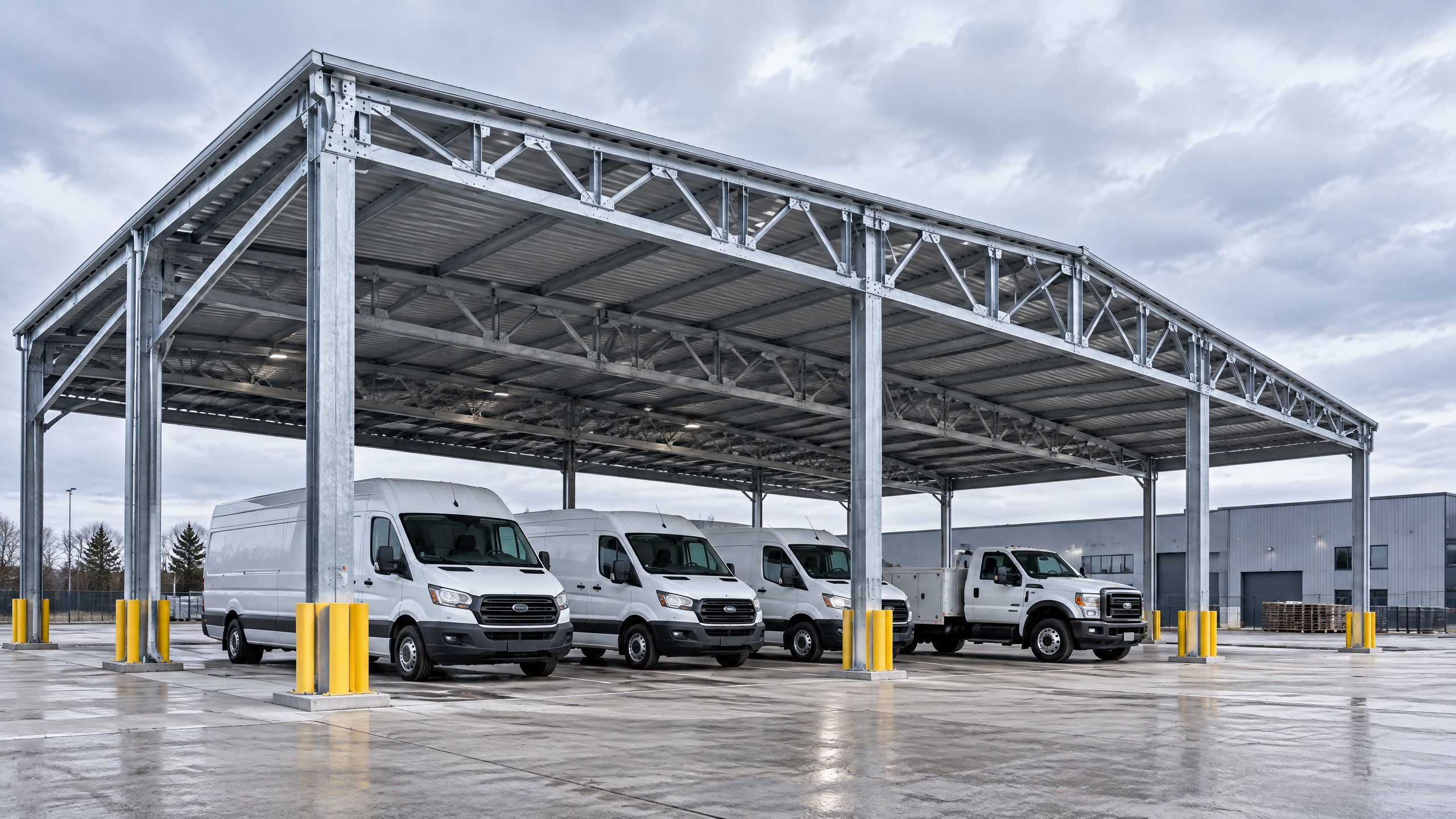
Specify industrial carport manufacturer export packing as a parallel procurement deliverable equal to structure, finishes and solar/electrical work. A robust packing specification defines damage tolerances, packing materials, lifting and handling interfaces, labelling and documentation, customs and hazardous-materials handling, and contractual responsibilities — then ties these to inspection evidence and logistics milestones. Early decisions on containerization versus break-bulk, corrosion protection, skidding, and palletization materially change cost, lead time and on-site handling. Require factory quality documentation and photographed packing records, define an explicit delivery responsibility matrix, and make export packing coordination an explicit line item in purchase orders and shipping contracts. Use project procurement controls (incoterms, third‑party inspection hold-points, insurance and acceptance criteria) to transfer risk cleanly. Finally, confirm that site-specific structural capacity, foundations, permits, electrical design, approvals, lead time, price, energy yield and warranty require a documented project basis and relevant local qualified professionals, installers, utilities and authorities.
Buyer context and scope boundary
Who this guide is for
- Distributors procuring modular carport kits for resale.
- Architects specifying pack-and-ship details for tendered packages.
- Contractors and developers managing inbound logistics and storage.
- Solar EPCs integrating framed PV arrays, inverters and cabling into shipping packs.
- Fleet operators who require sheltered assets and staged delivery.
What "export packing" means in this context
- All factory-applied and factory-supplied packing materials, protection and disassembly instructions needed to move completed carport modules from factory to project site across international borders.
- Includes crates, skids, corrosion inhibitors, strapping, bolted lifting frames, internal bracing, packing lists, certificated labels, customs paperwork, and pre-shipment photos.
- Excludes site foundations, permits, local electrical design, installation labour, and post-delivery storage beyond agreed handover.
Scope boundaries to define in your contract
- Define packaging performance (expected transit exposure, acceptable damage levels, handling units dimensions/weights).
- Define delivery point and incoterm; these determine who arranges export clearance and transport.
- Define inspection hold points and remedies for non-conforming packing.
- Define documentary deliverables (packing list, photos, certificates, lifting plans).
Mandatory project clarification
- Site-specific structural capacity, foundations, permits, electrical design, approvals, lead time, price, energy yield and warranty require a documented project basis and relevant local qualified professionals, installers, utilities and authorities.
Why this is critical
- Packing impacts cost, time-to-site, and installation sequence. Mis-specified packing increases handling, storage and rework costs and can delay energisation for commercial or solar carports.
Core decision principle
Principle: align packaging design to the weakest link in the supply chain
- Identify the single greatest risk (long ocean transit, multiple handlings, inland transhipments, tropical corrosion, limited on-site crane capacity) and design packing to mitigate that risk in the most cost-effective way.
- Do not over-engineer for unlikely events — instead specify discrete protection levels and contractual remedies.
Key contractual levers
- Delivery responsibility matrix — explicitly assign who is responsible for packing, export customs, stuffing, shipping, insurance, on‑site unloading and waste removal.
- Incoterm selection — determines whether the supplier pays for packing and export clearance or buyer does; clarify export packing coordination and inspection hold points [3].
- Hold points and evidence — require factory quality documentation, pre-shipment photos and third‑party inspection reports as contractual milestones.
Trade-offs to manage
- Protection vs cost: stronger crates and custom skids increase cost and volume, may require out-of-gauge transportation.
- Containerization vs break-bulk: containers reduce exposure to elements but impose size/weight limits; break-bulk may require heavy-lift gear and bespoke packing.
- Speed vs verification: rush shipping increases risk of incomplete documentation or inadequate packing inspections.
Planning inputs — what you must gather before writing the packing spec
Essential project inputs
- Project logistics profile: origin, destination, transit route(s), number of handling points, season (monsoon/tropical seasons), port capabilities, and maximum on-site handling equipment.
- Package geometry and weights: complete Bill of Materials (BOM) with assembled module dimensions, weight per lift, centre-of-gravity, and stackability rules.
- Product fragility and tolerance: surface finish tolerance (anodized aluminium, painted steel), glass or PV panel fragility, electrical subassemblies sensitivity.
- Regulatory constraints: hazardous items (batteries, sealants), marking and labelling, and local import rules. Use CBP and customs guidance where applicable for U.S. imports [4].
- Commercial conditions: incoterm, insurance level, inspection and payment milestones, and warranty triggers.
Data checklist for procurement teams
- Drawings of packed unit (CAD or PDF) showing lifting points, marking positions, and stacked arrangement.
- Packing weight/volume schedule per handling unit and per container.
- List of disassembly steps required at site and minimum required equipment for safe unpack.
- Required documentary deliverables (packing list, commercial invoice, certificate of origin, fumigation certificate if required).
- preferred or prohibited packing materials (e.g., avoid hardwoods without ISPM15 treatment).
Technical scope comparison and supplier selection
- Use technical scope comparison templates to compare supplier pack designs and costs, including hidden costs such as on-site handling and waste disposal.
- Require suppliers to provide packing BOMs and unit pricing for alternate pack levels (standard, heavy transit, tropical shipment) to enable lifecycle costing.
Decision table: containerization vs break-bulk vs flat-rack (examples)
| Transit profile | Preferred method | When to choose | Typical packing focus |
|---|---|---|---|
| Standard container-capable modules | Containerized (20/40 ft) | Modules fit within container dims and stacking rules | Maximise space use, palletize, secure with dunnage |
| Oversize or heavy modules with predictable lift plan | Flat-rack / break-bulk | Wide/heavy modules where container size insufficient | Custom cradles, welded lifting brackets, sea-fastening |
| Multiple short handlings, inland transfers | Containerized with transload plan | Reduce exposure and consolidate | Weatherproof crates + fork pockets |
| High-corrosion route (tropical, long ocean dwell) | Containerized + corrosion mitigation | Minimise salt mist exposure and humidity | VCI films, desiccants, sealed crates |
Use this table as a starting point; always validate with shipping and port partners.
Technical specification and interfaces
What your export packing specification must contain
- Packing performance statement: define expected environmental exposure and acceptable damage acceptance levels. Example: “No surface corrosion acceptable for anodised aluminium; visible scratches deeper than 0.2 mm unacceptable.”
- Handling unit definition: dimension, gross/net weight, lifting points and rated capacities, centre-of-gravity diagram, and single-point or multi-point lifting instructions.
- Protection measures: internal bracing, edge protectors, film wrapping, VCI (volatile corrosion inhibitor) if required, desiccants and sealed packaging for electronic components.
- Materials restrictions: ISPM15-treated timber if wooden crates used; preference for recyclable materials; banned materials flagged.
- Labelling and documentation: durable external labels with project codes, UN numbers if hazardous, container/mark packet lists, and barcodes or QR codes if using digital traceability.
- Sea-fastening and stowage: sea-fastening design for break-bulk or flat-rack shipments, including rated lashings and sea-fastening drawings.
- Unpacking and temporary storage: instructions for temporary storage on site, minimum clearances, and packaging waste removal responsibilities.
Lifting interface and structural requirements
- Provide lifting drawings and instruct the factory to include lifting lugs or removable lifting frames where required. If lifting frames attach to structural members, require engineering verification of connection points.
- Where packing uses welded lifting inserts, require NDT or inspection records for weld quality where the lift is critical.
Corrosion protection choices and guidance
- For steel components: hot-dip galvanizing or factory-applied primers and topcoats. Refer to galvanizing fundamentals for design and coating considerations [1].
- For aluminium: protection against galvanic corrosion at steel–aluminium interfaces (insulating pads, coatings) and avoidance of chloride-rich packing solutions.
- For electronics and PV: sealed enclosures, desiccants, IP-rated packaging, and clear marking for humidity-sensitive devices.
Standards and quality references
- Expect suppliers to reference relevant quality management and packaging standards where applicable. ISO management standards (e.g., ISO 9001) describe quality systems but do not replace project-specific packing requirements [2].
- For international trade and risk allocation, align packing obligations with selected Incoterm provisions [3].
Procurement and factory evidence requirements
Procurement document set to request (minimum)
- Packing specification (formal attachment to purchase order).
- Packing drawings and assembly instructions for each handling unit.
- Factory packing BOM: materials, consumables, and scrap removal plan.
- Pre-shipment inspection plan and checklist.
- Photographic evidence: staged photos of packed units (four sides, top, lifting points) and loaded containers/flat racks prior to seal.
- Test or verification reports for lifting devices or welded frames where relevant.
- Copies of export documentation: commercial invoice, packing list, certificate of origin, fumigation certificate, and any hazardous materials declarations.
Factory quality documentation and inspection
- Insist on factory quality documentation that demonstrates the factory’s process control for packing operations: signed packing checklists, acceptance signatures, and non-conformance reports.
- Require independent third-party inspection at a defined hold point for critical items or where the supplier has not passed due diligence.
- Include acceptance criteria and remedies for non-conforming packing in procurement terms.
B2B supplier due diligence
- Evaluate supplier capability to perform export packing: past export experience, photos and descriptions of similar packed products, references, and capacity to produce custom crating and skids.
- Review factory environmental controls if humidity-sensitive items are shipped.
- Ask suppliers to demonstrate storage and staging capacity for packed goods awaiting export.
Export packing coordination (operational coordination)
- Define coordination points: packing completion, inspection approval, container stuffing plan, seal application, and handover to freight forwarder.
- Clarify who issues container stuffing instruction and who seals and signs the bill of lading.
- Use a delivery responsibility matrix to close gaps between buyer, supplier and logistics partner.
Decision table: Delivery responsibility matrix (example)
| Task | Seller (Factory) | Buyer | Freight Forwarder / Carrier |
|---|---|---|---|
| Provide packing per spec | Primary responsibility | Review & approve samples | N/A |
| Pre-shipment photos & packing list | Provide | Review/acknowledge | N/A |
| Arrange export customs clearance (EXW/FCA) | If under seller incoterm | If buyer arranged incoterm | Coordinate |
| Container stuffing and sea‑fastening for break-bulk | Provide / supervise | Agree method | Execute as carrier |
| Apply container seal & issue B/L | Provide (if carrier) | Confirm seal | Carrier issues B/L |
| Pre-shipment inspection hold point | Allow inspector access | Engage inspector & pay | Attend if required |
| Delivery to named port (DDP/DAP variations) | Arrange (if seller obligation) | Receive documentation | Execute transport |
This is an example matrix — convert to a contractual table and adapt per incoterm.
Costing the packing scope
- Request line-item pricing for:
- Standard packing (factory normal).
- Enhanced packing (tropical, long transit, heavy-lift).
- Third-party inspection and correction costs.
- Container stuffing labour and sea-fastening.
- Evaluate lifecycle costs: packing price vs expected on-site handling and potential damage repair cost.
Evidence-led acceptance
- Define acceptance based on documentary and photographic evidence, and on-site inspection after arrival.
- Keep a record of non-conforming packing instances and corrective action requests to inform future procurements.
Mid-article CTA If you need help translating packing performance to contract language or reviewing supplier packing evidence, start a conversation via /inquiry or ask about our Titan industrial and logistics system and how it integrates packing, logistics and commissioning workflows. See also all systems and our sourcing guides for procurement templates.
Site installation and operations implications
Unpacking and site handling plan
- Provide an unpacking sequence in the packing documents with estimated time per handling unit, required crew, and equipment profile (forklift capacity, crane rating, slinging points).
- Include temporary protection for stored modules against weather and theft (e.g., tarpaulins, locked storage).
Foundation and structural interactions
- Packing often sets the order of installation: if modules are packed nested, site sequencing must allow for the order of unpack and installation. This affects laydown area size, foundation access and crane reach.
- If lifting frames are used for transport and to be re-used as temporary supports, confirm load paths and handover condition.
Waste management and recycling
- Require supplier to provide a packing waste removal plan, including responsibilities for disposal or return of reusable packing materials.
- Consider specifying recyclable and non-hazardous packing materials to reduce on-site disposal costs.
Safety and compliance on site
- Lifting and handling instructions must match site practice and local safety regulations. Provide labelled lifting points and rated slings. Site supervisors must verify lifting plans before first lift.
- Any site rewiring, cutting or modification of packed units should be performed by qualified personnel only.
Warranty and damage claims
- Define claim timelines and evidence requirements (photos of damage, original packed condition evidence, shipping documents). Ensure that warranty terms reflect the agreed delivery responsibility matrix and incoterm.
Implementation risks and mitigations
Common risks
- Insufficient packing leading to damage from salt spray or moisture.
- Misdeclaration of hazardous items (batteries, sealants) causing customs delays.
- Packing that prevents safe on-site handling (no fork pockets or wrong lifting points).
- Documentation mismatches (packing list vs actual contents) causing release delays.
- Incorrect incoterm allocation leading to disputes over who arranged stuffing or paid for export clearance.
Risk mitigations (evidence-led)
- Sample pack approval: require a constructed sample pack and sign-off before bulk packing begins.
- Photographic sequencing: require time-stamped photos of each packed unit and container stuffing.
- Third-party inspection: define independent inspection at pre-shipment hold point for critical or high-value shipments.
- Digital traceability: barcodes or QR codes linked to packing records for quick verification at arrival.
- Insurance and claims process: ensure cargo insurance is in place covering named perils and aligned to incoterm responsibilities.
Documentary and regulatory risks
- Cross-check required certificates early (ISPM15 for timber, fumigation certificates, certificates of origin). Obtain guidance for destination-specific rules from customs agencies such as CBP when shipping to the U.S. [4].
- For exports requiring licence or permit, add a contractual clause assigning responsibility for delays caused by paperwork.
Operational mitigation checklist
- Confirm container/container-stuffing windows with forwarder and factory to avoid last-minute repacking.
- Validate port and terminal capabilities for out-of-gauge cargo at destination before committing to flat-rack shipments.
- Ensure spare parts and critical consumables are packed in a clearly labelled "spares box" with priority release on arrival.
Six-step buyer workflow: SPECIFY — VERIFY — AGREE — INSPECT — SHIP — RECEIVE
Name: The Six-step Buyer Workflow for Export Packing
- SPECIFY (Define the packing performance)
- Produce the packing specification (referenced to the purchase order).
- Include handling unit drawings, acceptable damage levels, labelling and documentation requirements.
- Attach the delivery responsibility matrix and inspection hold points.
- VERIFY (Supplier capability and sample pack)
- Conduct B2B supplier due diligence: past export experience, references, factory photos.
- Require and approve a sample/first-article pack before full production.
- AGREE (Commercial terms & incoterm, cost lines)
- Negotiate incoterm, insurance, packing cost lines (standard vs enhanced).
- Agree storage and laydown timelines for staged shipments.
- Lock in remedies for non-conforming packing.
- INSPECT (Factory inspection and evidence collection)
- Implement factory quality documentation and pre-shipment photographic evidence.
- Commission third-party inspection where risk is elevated.
- Approve container stuffing plan and seal protocol.
- SHIP (Logistics execution and monitoring)
- Coordinate export packing coordination: container stuffing, seal, and B/L issuance.
- Monitor shipment via tracking and confirm estimated ETA.
- Ensure all documentation is sent to the nominated receiver and customs broker.
- RECEIVE (Site verification and claims handling)
- Unpack according to the unpack plan; verify items against the packing list.
- Record any damage, notify insurer and supplier per contract, and manage claims.
- Retain factory packing evidence for warranty and acceptance records.
Practical notes for each step
- Embed hold points into payment schedule: e.g., 10% payment withheld until pre-shipment inspection or photographic approval.
- Make packing a contractual deliverable with measurable acceptance criteria.
FAQ
Q: Who decides whether items are shipped in containers or on flat-racks? A: The packing specification and incoterm together decide. The buyer should define transit exposure and handling constraints. The seller proposes a packing method that meets the spec; the delivery responsibility matrix clarifies who pays for the selected method.
Q: What documentation should I require to accept delivered goods? A: Signed packing list, pre-shipment photos, container/flat-rack seal number, bill of lading, commercial invoice, certificate of origin, fumigation certificate if wooden packing used, and any third-party inspection report required by contract.
Q: How do I allocate packing cost vs transport cost? A: Price packing line-items separately (standard vs enhanced) and treat packing labour and materials as seller responsibility if under seller-paid transport (e.g., DDP). Under buyer-arranged shipping (EXW/FCA), buyer may pay for stuffing and sea-fastening. Use the delivery responsibility matrix to avoid ambiguity.
Q: How much protection is “enough”? A: That depends on the weakest link of the route. For long ocean voyages with multiple transhipments choose higher protection (sealed crates, VCI, desiccants); for short overland trips, lighter packing may suffice. Require supplier to propose protection levels and justify cost.
Q: Are photos enough to accept as evidence? A: Photos are necessary but not always sufficient. For critical items, require third‑party inspection or witness stuffing and sealed B/L as additional evidence.
Q: Should I require ISPM15 for wooden crates? A: Yes, where wood packaging is used in international trade, ISPM15-treated timber is commonly required. Confirm destination requirements and request certificates from the supplier.
Q: What are common packing mistakes that lead to delay? A: Poor labelling, missing fumigation certificates, incorrect packing list vs actual contents, unsecured loads within containers, and inadequate protection against moisture.
Q: How does export packing interact with warranty? A: Warranty terms should specify damage in transit vs manufacturing defects. Use the delivery responsibility matrix and incoterm to define who carries transit risk and who is responsible for packing-related damage claims.
Conclusion
Specifying industrial carport manufacturer export packing is a procurement and logistics discipline that should be treated as a discrete deliverable. Clear specifications, documented supplier capability, and formal evidence (packing drawings, photographed packs, and factory quality documentation) reduce risk and total lifecycle cost. Use a delivery responsibility matrix to remove ambiguity, require pre-shipment hold points and agree incoterms early. Keep packing decisions aligned to the weakest link in the logistics chain — that single decision drives protection level, handling complexity and cost. Finally, remember that site-specific structural capacity, foundations, permits, electrical design, approvals, lead time, price, energy yield and warranty require a documented project basis and relevant local qualified professionals, installers, utilities and authorities.
Closing CTA For bespoke support on contract language, sample-pack review or export packing coordination, contact our procurement team via /inquiry or email info@carportiva.com. Explore how our Titan industrial and logistics system can be applied to your project, or browse all systems and sourcing guides for templates and checklists.
Further reading and regulatory resources
- Incoterms rules and allocation of responsibilities [3].
- U.S. Customs and Border Protection basic import and export guidance [4].
- Guidance on galvanizing and corrosion protection fundamentals [1].
- ISO guidance on quality systems and management that can support factory documentation processes [2].
References
- American Galvanizers Association: https://galvanizeit.org/
- International Organization for Standardization: https://www.iso.org/
- International Chamber of Commerce Incoterms: https://iccwbo.org/business-solutions/incoterms-rules/
- U.S. Customs and Border Protection import guidance: https://www.cbp.gov/trade/basic-import-export
Keep the project brief connected.
Bring the actual project brief to the engineering table.
Share your location, layout, target application and available technical inputs. Carportiva can help identify the relevant product-interface information before a project-specific commercial discussion.
Request a project discussion