Direct answer (120–180 words)
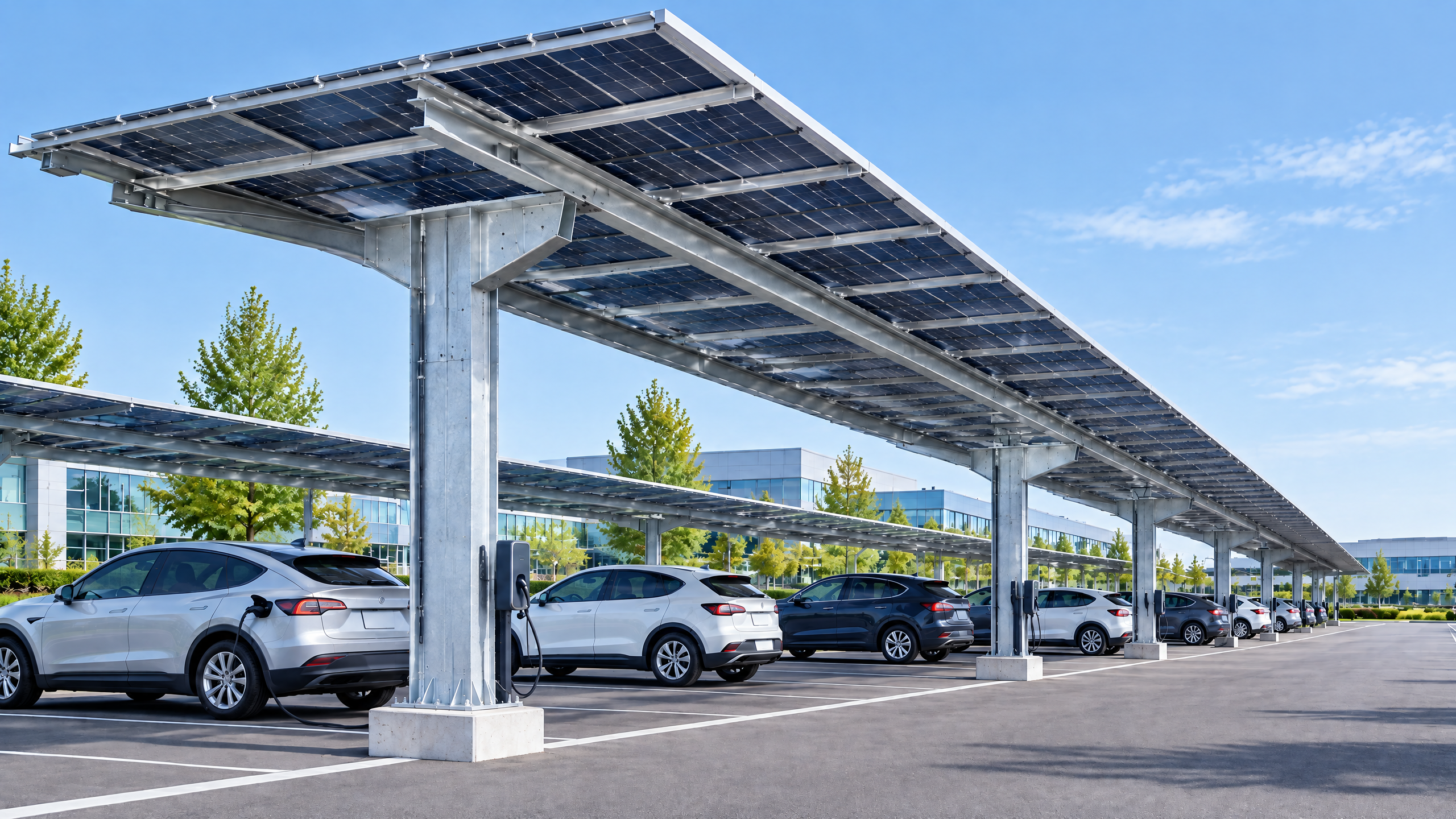
Solar carport battery storage integration matters when the project’s objectives and constraints make behind-the-meter energy flexibility, peak demand management, resilience, or time-shifted energy value material to the business case. The decision is driven by measurable inputs (site load profile, tariff structure, EV charging schedule, available roof/carport area, and grid interconnection limits), plus non‑quantitative priorities such as business continuity or sustainability reporting. In many commercial and fleet sites—where demand charges, limited grid capacity, or fast EV charging create operational constraints—integrating battery energy storage at the carport level can reduce network upgrades, enable managed charging, and provide a single integrated asset for O&M. However, the integration adds technical scope at the solar carport structural interface and in electrical pathway planning, and it requires coordinated procurement and approvals. A documented project basis and qualified local professionals are essential to confirm structural capacity, foundations, permits, electrical design and approvals, lead time, price, energy yield and warranty before committing.
Buyer context and scope boundary
Who this guide is for
- Distributors, architects, contractors, developers, solar EPCs, fleet operators and procurement teams evaluating architectural aluminium carports and commercial solar carports where battery integration is under consideration.
- Decisionmakers responsible for capital planning, operations, facilities, sustainability targets, or EV infrastructure.
What “solar carport battery storage integration” covers in this guide
- On-site battery energy storage systems (BESS) integrated physically and electrically with photovoltaic (PV) arrays mounted on carport structures.
- Interfaces covering the structural (mounting and foundations), PV equipment coordination, electrical and communications interfaces, and O&M access.
- Commercial procurement and contracting points that differ from detached PV + battery projects.
Scope exclusions
- Large utility-scale ground-mounted BESS projects and grid-scale transmission issues except where they directly affect interconnection or permitting for the site.
- Detailed electrical single-line designs and manufacturer-specific commissioning procedures (these are site- and product-specific and need professional engineering).
Note: Site-specific structural capacity, foundations, permits, electrical design, approvals, lead time, price, energy yield and warranty require a documented project basis and relevant local qualified professionals, installers, utilities and authorities.
Core decision principle: when to integrate batteries at the carport level
Decision principle Integrate battery storage with a carport when the incremental value delivered by on-site energy flexibility (reduced demand charges, avoided network reinforcement, managed EV charging, outage resilience, or enhanced energy market participation) exceeds the incremental cost and complexity of integration over the project lifecycle.
Key drivers to consider
- Load and tariff drivers: High demand charges or time-of-use differentials make time-shifting PV output valuable.
- EV charging load: Fast, predictable fleet charging produces coincident peaks that batteries can mitigate; see guidance on EV infrastructure coordination [3].
- Grid constraints and interconnection: If the local distribution network restricts export or increases costs for higher export capacity, batteries can enable higher on-site PV without network upgrades [4].
- Resilience and business continuity: Critical facilities that require uninterrupted power can justify battery capital for short-duration backup.
- Project delivery constraints: Procurement, installation sequencing and warranty complexity increase with integration; these need to be priced and managed.
Decision table — Should you integrate battery storage at the carport?
| Primary indicator | Yes: Integrate at carport | No or Defer: Consider separate BESS or PV-only |
|---|---|---|
| High demand charges / TOU tariffs | Likely yes — battery can be sized to shave peaks | No if tariffs are flat or low |
| Planned fast fleet charging (>50 kW per charger) | Yes — mitigates site peak and transformer upgrades | No if EV demand small or staggered |
| Limited grid export or expensive reinforcement | Yes — avoids grid upgrades or constrains export | Defer if grid reinforcement affordable |
| Priority on resilience/back-up for operations | Yes — battery placed close to loads for short-duration backup | Defer if resilience not required |
| Tight capex budget now but longer-term plan | Maybe — consider staged approach (PV now, BESS later) | Consider PV-only and design for future integration |
| Site structural or permitting constraints | Only if structural/permit path is feasible | Defer until structural/permit issues resolved |
Interpretation
- The table isolates core indicators. A “yes” outcome suggests battery integration will materially affect system sizing, structural works and procurement packaging. A “defer” outcome recommends designing PV for future battery addition (prewired DC/AC-ready layouts, space allocation, and structural allowance).
Planning inputs: what to collect before deciding
Essential site and business inputs
- Electric load profile: 15–60 minute resolution load data for 6–12 months if available. If not, use representative weekdays/weekends and seasonal variation.
- Tariff and billing structure: demand charges, TOU periods, export compensation, power factor penalties.
- EV charging demand forecast: number of chargers, power level, duty cycles, expected simultaneous charging events [3].
- Available carport area: quantity of stalls, orientation, shading, allowable tilt, and clearances.
- Local grid constraints: distribution transformer capacity, point-of-interconnection limits and utility upgrade policies [4].
- Structural and geotechnical baseline: existing drawings, soil reports, and foundation limitations.
- Project timelines and phasing: tie-in windows, staging constraints, and seasonal installation impacts.
- Operating objectives: reduce peak demand, increase self-consumption, provide resilience, manage charging load, or generate revenue streams.
Analytical inputs and tools
- Energy yield modelling: Use PV production tools such as PVWatts and local irradiance data as a baseline for expected generation [1][2].
- BESS sizing studies: Model charge/discharge cycles against tariff and load profiles to determine energy (kWh) and power (kW) sizing and state-of-charge constraints.
- Interconnection and export analysis: Confirm requirements with the utility and reference interconnection guidance [4].
- Financial analysis: Total cost of ownership (CAPEX + OPEX), simple payback, net present value (NPV) and lifecycle costing under realistic degradation and replacement scenarios.
Minimum deliverables for a procurement-ready brief
- Functional requirements (objectives and constraints).
- Site plan with PV and battery footprints and structural basis.
- Point-of-connection details and utility contacts.
- Acceptable standards and warranty expectations.
- A procurement schedule with milestone dates and lead-time allowances.
Technical specification and interfaces
Overview Integration is not just “attaching batteries to a carport.” It changes the design boundaries at multiple interfaces: the solar carport structural interface, PV equipment coordination, electrical pathway planning, utility and permit interface, and maintenance access planning. Below are the technical areas to specify and verify.
Structural interface (solar carport structural interface)
- Structural load capacity: Include dead loads for PV modules and racking, wind and seismic loads, plus live loads where equipment or personnel access is required.
- Concentrated loads: Battery housings, containerised BESS or inverter skids may introduce concentrated foundation loads; design footings or pads accordingly.
- Corrosion and material compatibility: Aluminium carports paired with battery housings require compatible fixings and detailing to prevent galvanic corrosion.
- Attachment points: If batteries, inverters or transformers mount to the carport or its foundations, specify connection details and access for future maintenance.
PV equipment coordination (PV equipment coordination)
- Racking and module selection: Coordinate module size, weight, and fixation with carport framing tolerances.
- Module wiring and combiner locations: Define logical cable routes that avoid mechanical pinch points and allow thermal expansion.
- Inverter/BESS proximity: Specify maximum allowed string/combiner lengths and acceptable DC wiring runs to minimize losses.
Electrical pathway planning (electrical pathway planning)
- AC and DC routing: Provide single-line diagrams showing typical and maximum routing for PV, BESS and EV chargers.
- Conduit and raceway sizing: Include spare capacity for future expansion. Design for safe segregation of AC and DC conductors.
- Metering and protection: Specify export/consumption meters, revenue meters if needed, and protective devices coordinated with utility requirements.
- Grounding and bonding: Ensure equipotential bonding across carport, battery enclosures, and existing site earthing systems.
Utility and permit interface (utility and permit interface)
- Interconnection application: Early engagement with the utility is essential to confirm export limits and protection settings [4].
- Permitting packages: Provide combined documentation showing the carport, PV and BESS in one submission where possible to simplify approvals.
- Fire and safety codes: BESS triggers additional permit requirements in many jurisdictions, including fire suppression access and signage.
Maintenance access planning (maintenance access planning)
- Access corridors: Design for safe personnel access to inverters, battery cabinets and AC combiner boxes without requiring elevated work.
- Clearances and removable panels: Include manufacturer-clearance requirements and space to replace batteries or inverters.
- Routine servicing: Ensure drainage, lighting, and secure access for O&M teams.
Communications and controls
- BMS and EMS: Define communications protocols (Modbus, CAN, SunSpec, OCPP for chargers) and network security requirements.
- Integration with site SCADA or fleet management systems where relevant.
- Remote monitoring: Specify KPIs, telemetry frequency and alarm escalation paths.
Thermal and fire safety considerations
- Battery thermal management: HVAC or passive cooling requirements for enclosed battery rooms or containerised units.
- Fire suppression and detection: Align with local code and manufacturer guidance for battery chemistries.
Compliance and standards
- Specify applicable electrical and battery standards but refrain from asserting compliance without manufacturer documentation and local approvals.
Procurement and factory evidence
Procurement approach options
- Single-source integrated package: One supplier provides carport, PV and BESS as a turn-key solution.
- Lead-contractor model: The carport supplier (e.g., Carportiva) supplies the structure and PV racking while BESS and electrical integration are subcontracted by the EPC.
- Component procurement: Buyer procures major components separately (carport, PV modules, inverters, BESS), which requires high coordination capability.
Procurement documentation checklist
- Technical specification with clear interface responsibilities (structural, electrical and communications).
- Bill of materials and submittals (module datasheets, inverter and BESS datasheets).
- Factory acceptance test (FAT) requirements for inverters and BESS (functional tests, communications verification).
- FAT witness obligations: Identify which parties must witness tests and which third-party test labs are acceptable.
- Warranties and performance guarantees: Define warranty periods, performance baselines and degradation assumptions for PV and BESS.
- Spare parts and consumables list: Include recommended spare batteries, fuses and sensors.
Decision table — Procurement responsibility matrix
| Deliverable / Responsibility | Carport supplier | PV/BESS supplier | EPC / Installer | Owner |
|---|---|---|---|---|
| Structural drawings & wind/seismic design | Lead | Review | Coordinate | Accept |
| Foundation design & geotech | Review | Review | Lead | Accept |
| PV racking & module supply | Supply | Review | Install | Accept |
| BESS supply & FAT | Review | Supply & FAT | Install & Commission | Accept |
| Electrical single-line & protection | Review | Provide | Produce & implement | Accept |
| Communications / EMS integration | Review | Provide | Implement | Accept |
| Permits & interconnection application | Support | Support | Lead | Approve |
| O&M manuals & spare parts | Provide | Provide | Handover | Maintain |
Factory acceptance and evidence requirements
- FAT scope: Run through primary functional tests (inverter anti-islanding, BMS control logic, charging/discharging cycles), communications and interoperability checks.
- Documentation: Provide FAT reports, factory test certificates, packing lists and calibration certificates for meters.
- Shipping and handling: Clarify responsibility for transport, offloading and storage conditions (temperature, humidity).
Contract levers to reduce integration risk
- Interface control documents (ICDs): Define mechanical and electrical connection points, penetrations, and data interfaces.
- Performance milestones: Link payments to acceptance tests, commissioning and measured performance thresholds.
- Warranty and latent defects: Ensure warranty covers integrated failures that involve multiple parties.
Link resources
- Consider integrated product options such as SolarGrid commercial solar system for packaged PV + carport solutions, and reference all systems when comparing system architectures. Use sourcing guides for vendor selection criteria.
Site installation and operations
Installation sequencing: recommended high-level sequence
- Mobilisation and temporary works (site fencing, erosion control).
- Foundation works and underground electrical trenches.
- Structural steel erection for carports.
- PV racking and module installation.
- Installation of inverters, combiner boxes and BESS foundations or pads.
- Electrical hookups, metering and communications wiring.
- Commissioning, protection setting and energisation with utility witness (as required).
- Site handover with O&M documentation and training.
On-site coordination considerations
- Crane and access staging: Plan lifts to avoid interfering with installed PV rows or battery enclosures.
- Cable installation windows: Minimise DC string exposure and avoid running cables where they are subject to mechanical damage.
- Weather and seasonal factors: Schedule weather-sensitive elements (concreting, adhesive cures, module installation) appropriately.
Commissioning and acceptance
- Commissioning scope: Functional testing across PV, inverter, BESS, EMS, metering, and protective devices. Verify communications and remote monitoring.
- Utility-specified commissioning: Utilities often require specific tests for interconnection – engage utility early to align schedules [4].
- Performance testing: Use energy yield models for baseline expectations [2] and document any shortfalls with root-cause analysis.
Operations and maintenance (O&M)
- Routine inspections: PV soiling, fixation torque checks, module electrical checks and BESS state-of-health monitoring.
- Battery lifecycle management: Track cycling, depth of discharge history and thermal conditions to manage warranty and replacement planning.
- Fault escalation: Define roles and SLAs for alarm response and component replacement.
- Maintenance access planning: Ensure ongoing access as specified in design to avoid costly temporary works for component replacement.
Integration with EV charging operations
- Charge management: Coordinate BMS/EMS with charger controllers (OCPP or equivalent) to limit peak draw and prioritize charging sessions.
- Queuing and scheduling: Use demand forecasts to schedule charging sessions and battery dispatch to alleviate peaks.
Safety and compliance during operations
- Isolation procedures: Implement clear lock-out/tag-out (LOTO) for DC and AC systems.
- Fire safety plans: Ensure fire response teams understand battery locations and risks; maintain required clearances and signage.
- Training: Provide site staff and first responders with battery-specific safety briefings.
Implementation risk and mitigations
Risk categories and mitigation measures
- Technical risk: incompatibility between PV inverter, BESS and EMS
- Mitigation: Early ICDs, interoperability testing during FAT, and specifying industry-standard protocols (e.g., Modbus, SunSpec).
- Structural risk: unforeseen foundation or load issues
- Mitigation: Pre-construction geotechnical surveys, allowance in budgets for remedial foundations, and conservative structural assumptions.
- Permitting and utility delays
- Mitigation: Early utility engagement and concurrent permitting tracks; allow contingency time in project schedule [4].
- Supply chain and lead-time risk
- Mitigation: Long-lead component procurement with clause for late delivery remedies; consider staged procurement for high-risk items.
- Safety and fire risk for batteries
- Mitigation: Follow manufacturer guidance for spacing, detection and suppression; adopt proven containment strategies.
- O&M and warranty fragmentation
- Mitigation: Clear contractual allocation of warranty responsibilities and a single O&M contract for integrated systems where possible.
- Financial risk: underestimated lifecycle costs
- Mitigation: Include realistic degradation, replacement and disposal costs in lifecycle modelling and require transparent assumptions from bidders.
Regulatory and interconnection risk
- Many interconnection processes change with utility rules and regional regulations. Have legal/permit resources check local rules and engage utilities early [4].
Data and cyber security risk
- Treat EMS and BMS endpoints as critical infrastructure; require secure networking, authentication and vendor responsibilities for firmware updates.
Insurance and financing considerations
- Engage insurers and financiers early to confirm acceptability of integrated BESS and carport systems in their underwriting criteria.
Named six-step buyer workflow
A practical, named workflow buyers can follow to evaluate and procure integrated solar carport + BESS projects.
- Define Objectives & Constraints (Foundation Brief)
- Document business objectives: demand reduction targets, EV charging goals, resilience needs.
- Capture constraints: budget envelope, site architecture, timeline, and procurement policies.
- Deliverable: Foundation Brief.
- Preliminary Feasibility & Sizing (Feasibility Pack)
- Collect load data, tariff info, site plans, geotech and utility constraints.
- Run baseline PV yields (PVWatts/agency data) and initial BESS sizing scenarios [1][2].
- Deliverable: Feasibility Pack with 2–3 sizing options and preliminary economics.
- Technical Specification & Tender (ICD and Tender Pack)
- Produce technical spec with interface control documents, performance KPIs and procurement matrix.
- Include FAT and commissioning requirements, warranty terms and acceptance criteria.
- Deliverable: Tender Pack and evaluation scoring matrix.
- Procurement, FAT & Contracting (Contract & FAT)
- Select supplier(s) and execute contracts with clear milestones and liquidated damages.
- Witness FATs and obtain test reports for critical components.
- Deliverable: Signed contracts and FAT reports.
- Site Delivery & Commissioning (Site Completion Pack)
- Manage site works to the sequence, coordinate with utility for interconnection, complete commissioning and performance tests.
- Train operations staff and hand over O&M documents.
- Deliverable: Site Completion Pack and commissioning certificate.
- Operation, Monitoring & Performance Review (Performance Lifecycle)
- Implement O&M plan, monitor energy yield and BESS state-of-health, conduct periodic performance reviews and warranty claims management.
- Deliverable: Quarterly performance reports and lifecycle replacement plan.
Each step should produce discrete deliverables that can be reviewed and signed off by the buyer and technical stakeholders.
Related B2B sourcing terms
For the same project brief, buyers may also encounter these connected search terms: commercial solar procurement. They must be interpreted against the actual project scope rather than treated as independent technical guarantees.
Frequently asked questions (FAQ)
Q: How do I size a battery for a carport PV system? A: Size batteries based on the problem you want to solve: if shaving demand charges, size to cover the typical peak window; if time-shifting PV to TOU periods, size to absorb midday surplus and discharge in the evening. Use high-resolution load and generation data input into a dispatch model to quantify optimal kW/kWh sizing. PVWatts and local irradiance data are useful baselines for PV yield modelling [2].
Q: Is it better to buy an integrated carport + BESS package or separate components? A: Integrated packages reduce coordination risk and can simplify warranty and O&M, but they may limit vendor choice and flexibility. Separate procurement can allow best-of-breed selection but increases coordination burden. The decision depends on your organisation’s project management capability and risk appetite.
Q: Do batteries change the structural design of carports? A: Batteries introduce additional concentrated loads and may change foundation designs if mounted to the carport frame or adjacent pads. Always validate structural capacity with a signed structural engineer’s calculation and site-specific soil data.
Q: What permits are typically affected by battery integration? A: Permits may include building permits for structures, electrical permits for high-voltage equipment, fire department approvals for battery storage, and interconnection agreements with the distribution utility. Local requirements vary; engage authorities during early design.
Q: Can batteries enable more PV without upgrading the grid connection? A: Yes—batteries can be used to buffer exports and limit peak net export, potentially deferring or avoiding distribution network upgrades. Coordinate interconnection studies with the utility early [4].
Q: Who is responsible for ongoing maintenance of the BESS? A: Responsibility should be defined contractually. Typical models include owner O&M (with manufacturer spare parts support), manufacturer-supplied maintenance contracts, or a single integrated O&M contractor for the entire carport system.
Q: How do warranties work for integrated systems? A: Separate warranties typically apply for carport structures, PV modules and inverters/BESS. The procurement contract should address responsibility for integrated failures and provide remedies when one component’s failure affects another.
Q: What are common hidden costs? A: Hidden costs include utility-mandated protection upgrades, unexpected geotechnical remediation, communications/networking work, extended commissioning, and battery replacement planning. Include contingency in the budget and confirm assumptions with suppliers.
Decision-support tables and tools
Table: Comparative value drivers for battery integration
| Value driver | Evidence to collect | Procurement implication |
|---|---|---|
| Demand charge reduction | High-resolution demand and tariff data | BESS sized for kW reduction; include performance guarantees |
| EV charging load management | Charger count, schedule, peak coincidence | EMS/charger integration, fast-response BESS, communications specs |
| Export limit avoidance | Utility interconnection constraints | BESS dispatch rules, export-limiter device, SCADA integration |
| Resilience / outage support | Critical load list and run-time requirement | Select BESS with appropriate backup topology and transfer scheme |
| Grid services / revenue | Market participation rules and compensation | Advanced controls, metering, and contractual obligations |
Table: Minimum technical checks to include in tender evaluation
| Technical area | Minimum check |
|---|---|
| Structural fit | Confirm carport frame capacity and detailed attachment designs |
| Electrical compatibility | Verify inverter/BESS voltage, grounding and protective device coordination |
| Communications | Confirm protocol support and cyber-security measures |
| FAT & commissioning | Supplier provides FAT plan and allows witness testing |
| Warranty coverage | Clear duration and coverage for integrated failures |
| Spare parts & spares policy | Supplier lists critical spares and lead-times |
Conclusion
Solar carport battery storage integration transforms a carport project from a civil and PV scope into a multi‑discipline energy asset. The decision must be evidence-led: collect accurate load and EV charging profiles, engage the utility early, and require clear interface control documents. Integration can deliver meaningful operational benefits—peak management, resilience and managed EV charging—but it also increases procurement complexity, warranty interactions and installation sequencing. Use the six-step buyer workflow to structure internal approvals and supplier evaluation, and insist on factory evidence (FATs) and clearly assigned responsibilities in contracts.
If you want to explore system options or discuss a site-specific feasibility, review product and system options such as SolarGrid commercial solar system, compare architectures under all systems, and consult our sourcing guides for procurement templates. For project enquiries and to request a tailored feasibility discussion, contact /inquiry or email info@carportiva.com.
Remember: site-specific structural capacity, foundations, permits, electrical design, approvals, lead time, price, energy yield and warranty require a documented project basis and relevant local qualified professionals, installers, utilities and authorities.
Further reading and references
- National Laboratory PV resources and high-level guidance on solar performance and technology [1].
- PVWatts energy yield tool for preliminary generation estimates [2].
- U.S. Department of Energy resources for EV infrastructure and charging coordination [3].
- Federal Energy Regulatory Commission interconnection resources and process guidance [4].
For a tailored procurement pack or to scope a pilot project, contact /inquiry or email info@carportiva.com.
References
- National Laboratory of the Rockies PV resources: https://www.nrel.gov/solar/
- PVWatts Calculator: https://pvwatts.nrel.gov/
- U.S. Department of Energy Alternative Fuels Data Center: https://afdc.energy.gov/
- Federal Energy Regulatory Commission interconnection resources: https://www.ferc.gov/electric-transmission/generator-interconnection
Keep the project brief connected.
Bring the actual project brief to the engineering table.
Share your location, layout, target application and available technical inputs. Carportiva can help identify the relevant product-interface information before a project-specific commercial discussion.
Request a project discussion