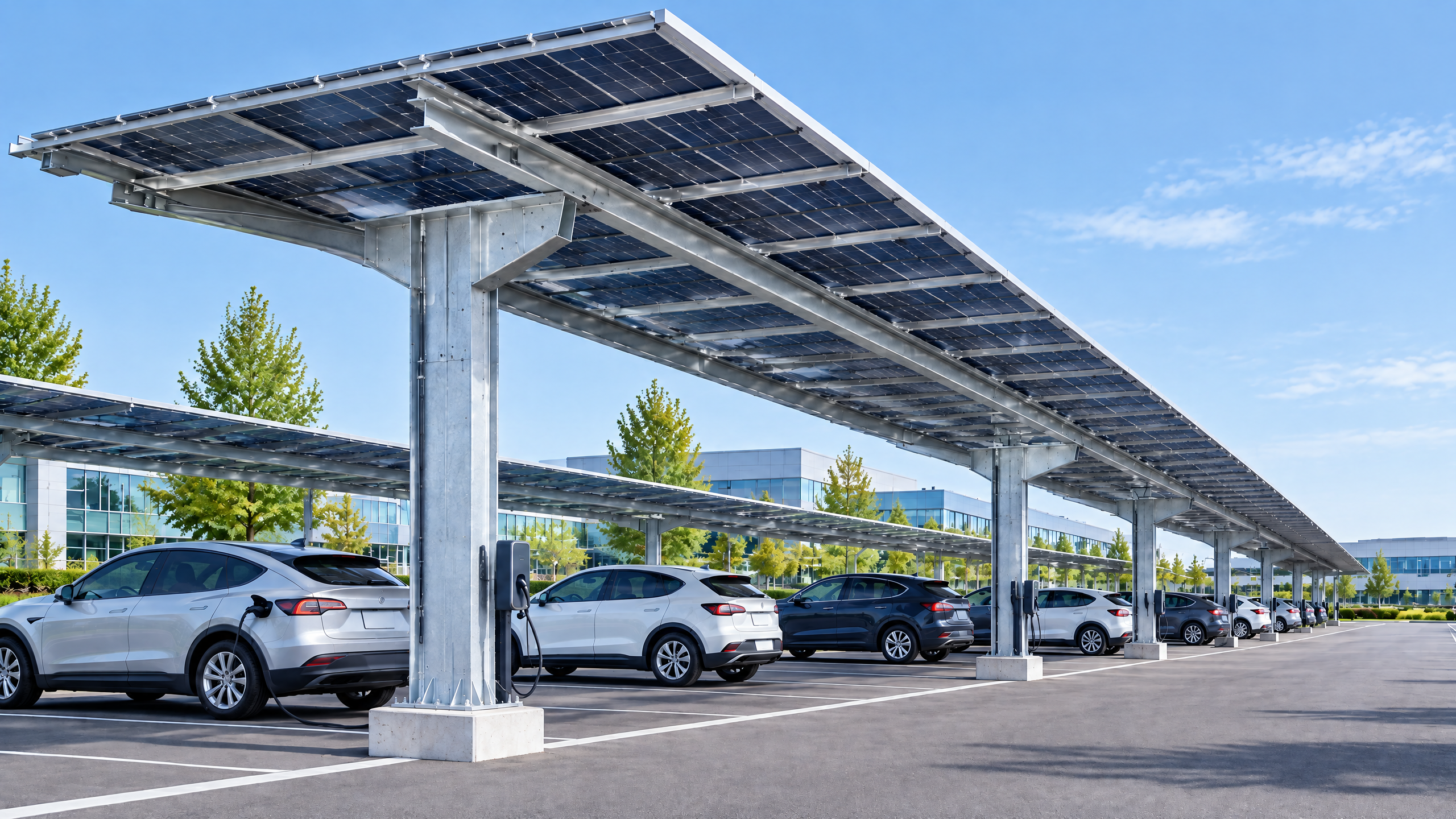
A project team should confirm the specific cost drivers that uniquely affect solar parking canopy projects, and how each one maps to the project's commercial objectives, technical constraints and schedule. At a high level, confirm: site and structural constraints (foundations, available span and column grid); detailed electrical pathway planning and interconnection requirements; PV and balance-of-system equipment selections and PV equipment coordination; manufacturer lead times, logistics and factory evidence; permit, utility and stakeholder interfaces; operations, maintenance access planning and spare-parts strategy; and the procurement model and contract terms that allocate risk and warranty obligations. These confirmations must be based on a documented project basis — firm site surveys, geotechnical and structural reports, electrical single-line diagrams and permit/utility pre-application inputs — and validated by local qualified professionals, installers, utilities and authorities. With those confirmations in hand, teams can translate technical choices into realistic capital, schedule and lifecycle cost estimates.
Buyer context and scope boundary: what "cost drivers" means for you
For B2B buyers — distributors, architects, contractors, developers, solar EPCs and fleet operators — the phrase solar parking canopy project cost drivers should be limited to variables that materially alter capital expenditure (CapEx), schedule and the early-stage operations cost profile (near-term O&M and restoration). Typical categories include:
- Site preparation and foundations, including unexpected subsurface conditions.
- Structural system complexity and architectural finishes.
- PV module and inverter class, mounting hardware, combiner boxes and cable routes.
- Electrical infrastructure: conduit, transformers, metering, switchgear and grid interconnection requirements.
- Permitting and utility interconnection timelines and fees.
- Logistics, plant fabrication capacity and lead times.
- Commissioning, testing and post-commissioning warranty responses.
- Operational access for inspection, cleaning and repairs.
Scope boundary: this guide focuses on cost drivers specific to solar parking canopies and associated PV and EV infrastructure (carport-mounted PV, chargers, EV integration). It does not replace site-specific engineering, local permitting guidance or detailed commercial contract negotiation. Where local rules, standards or market factors apply, engage qualified local professionals.
Core decision principle: prioritize decisions that change three levers
To make procurement and design decisions that control cost, align choices to the three levers that matter most:
- Capital intensity: choices that increase or reduce the installed price per kW (e.g., module selection, structural steel vs. aluminium, foundation type).
- Schedule risk: choices that change lead time and critical-path activities (e.g., long-lead inverters, bespoke canopy geometry).
- Lifecycle operability: choices that affect lifetime O&M and uptime (e.g., inverter topology, access pathways, warranty and service agreements).
Good decisions trade higher initial cost for lower schedule risk or lower lifecycle cost only when the value is explicit and quantified. For example, specifying a premium inverter platform may increase CapEx but reduce O&M and increase yield certainty; choose this only if the buyer can quantify the value across the expected lifecycle and financing structure.
Planning inputs: data and documents you must confirm early
Before a procurement or approval decision, confirm the following planning inputs. Each should be documented and budgeted:
- Site survey and as-built drawings: column positions, canopy footprint constraints, vehicular flow and setback requirements.
- Geotechnical report: bearing strata, groundwater, frost depth and recommended foundation type.
- Structural loads and wind/ seismic criteria: local design codes and envelope cases for canopy uplift and snow if applicable.
- Existing utilities and underground services mapping: locate electrical ducts, telecoms, drainage and fuel lines.
- Energy demand profile and EV charging plan: expected weekday/seasonal peaks and charger types (level 2, DC fast).
- Solar resource and yield estimate: use PV resource models or PVWatts for preliminary yield [1][2].
- Interconnection and metering requirements from the utility: point of interconnection, tariff, metering location, and any protective relay or transformer requirements [4].
- Permitting timelines and municipal design review requirements: local planning, heritage or architectural overlays.
All planning inputs must be captured in a project basis document that becomes the baseline for supplier proposals and budget estimates.
Technical specification and interfaces: where design choices drive cost
Design choices for a canopy project create interfaces that multiply cost if left unresolved. Pay special attention to five interface categories and how they interact with cost.
- Solar carport structural interface — Confirm canopy span, column grid and roof load distribution. The structural interface governs module layout, number of mounting points, and foundation depth. Complex or bespoke architectural canopies with curved profiles increase fabrication and engineering hours.
- PV equipment coordination — Document exact module dimensions, weight, connector orientation and racking attachment points. The module count, stringing layout and inverter placement affect combiner box locations and cable lengths. PV equipment coordination early in procurement reduces late design revisions and punch-list costs.
- Electrical pathway planning — Determine AC and DC cable paths, trench runs, conduit sizes, pull points and transformer location. Long DC runs or multiple inverter clusters increase cable and labor costs materially; centralized vs distributed inverter design decisions shift both materials and labor.
- Utility and permit interface — Early engagement with the utility clarifies interconnection agreement, protection requirements, and revenue meter location. Some utilities require relay testing, specific breaker types or a dedicated transformer — these items are often adders during execution.
- Maintenance access planning — Design for safe and efficient access for cleaning, inverter replacement and module servicing. Inadequate planning increases long-term O&M labor and may require retrofits (walkways, ladders, removable panels).
Technical decision table — common choices and cost implications
| Design choice | Typical cost impact (capex & schedule) | Where to validate |
|---|---|---|
| Aluminum prefabricated canopy vs on-site steel fabrication | Aluminum prefabrication can reduce site labor and schedule but may have higher material unit cost; steel may be cheaper material but higher erection labor and corrosion protection cost | Structural engineer, supplier factory drawings, logistics study |
| Central inverter room (large AC run) vs distributed string inverters | Central room reduces inverter count but increases low-voltage AC equipment and transformer sizing; distributed reduces centralized equipment but increases DC cabling and combiner boxes | Electrical engineer, PV equipment coordination, cable length estimates |
| Module type (standard glass-polymer vs framed bifacial vs thin-film) | Higher-efficiency or bifacial modules raise unit cost; may yield more energy, but require structural checks and different mounting; thin-film has different mounting/curing needs | PV vendor datasheets, yield models (PVWatts) [2] |
| Deep foundations (piles) vs shallow spread footings | Deep foundations increase cost and schedule due to piling rigs and permits; shallow footings cheaper but depend on geotech | Geotechnical report, civil contractor quotes |
| Integrated EV chargers vs later retrofit | Integrated chargers increase initial CapEx and coordination (power distribution and metering) but reduce later retrofit costs and traffic disruptions | Fleet operator, electrical planner, site operations |
Note: these are directional examples; validate with project-specific quotes.
Interfacing PV equipment and electrical planning in detail
- Module layout and stringing: Determine module orientation, tilt, string length limits and the effect of shading. Short strings reduce mismatch but increase combiner/booster cost.
- Inverter selection: Choose string vs central, transformerless vs transformer-based, and consider efficiency, low-voltage ride-through and warranty. Inverter placement decisions affect cable lengths and thermal management.
- DC and AC cabling: Plan conduit routing to minimize long runs and avoid crossing vehicular zones. Include additional capacity for future expansion or EV loads.
- Metering and telemetry: Define metering points for export, on-site consumption and EV charging. Telemetry interfaces are required for O&M and performance guarantees.
- Earthing and lightning protection: Carports are exposed and need appropriate equipotential bonding and surge protection — omitting these increases safety and warranty risks.
Cite resource planning tools: use PVWatts and NREL data for preliminary yield and resource checks [1][2]. For interconnection processes reference utility and federal interconnection guidance where applicable [4].
Procurement and factory evidence: what to demand from suppliers
Procurement should be evidence-led. When evaluating suppliers and quotes, require demonstrable factory and QA evidence to lower execution risk and foreseeable cost escalations.
Decision table — procurement evidence checklist
| Evidence / document | Why it matters | Acceptable examples |
|---|---|---|
| Factory drawings and shop drawings | Confirms fit and tolerances; reduces onsite rework | Issued-for-manufacture (IFM) drawings signed by supplier engineer |
| Bill of Materials (BoM) and line-item pricing | Enables apples-to-apples comparison and contingency estimation | Itemized BoM with manufacturer part numbers |
| Lead-time schedule and queue position | Materializes schedule risk and critical-path items | Firm lead-times from supplier and planned shipment dates |
| Quality assurance/test records | Ensures acceptability and reduces rework under warranty | Material certificates, load tests, weld inspections |
| Warranty terms and exclusions | Clarifies scope and transferability of coverage | Manufacturer warranty documents with terms and service process |
| Factory acceptance test (FAT) plan | Validates major assemblies before shipment | FAT checklist and acceptance criteria |
| Logistics/packaging plan | Avoids site damage and hidden transport costs | Crate sizes, lifting points and handling instructions |
| Installation and commissioning (I&C) scope | Defines what supplier supplies versus buyer or installer | Clear I&C duties, milestone acceptance criteria |
Require these documents at RFP short-list stage. If a supplier cannot provide them, budget an explicit contingency for unknowns.
PV equipment coordination: insist on vendor interface meetings to freeze module/inverter combos and to issue coordinated single-line diagrams and cable schedules. Where multiple vendors supply modules, inverters and chargers, create a single responsibility matrix.
Factory acceptance and FAT: for complex or bespoke canopies and integrated electrical rooms, include FAT for inverter skids, combiner assemblies and any factory-installed wiring to detect assembly or documentation issues before site freight.
Logistics and staging: large canopy components require careful route and crane analysis. Request lifting plans and staged delivery windows to avoid site storage costs or traffic disruptions.
Procurement approaches and commercial solar procurement considerations: decide between turnkey EPC, design-bid-build, or supply-only models. Each allocates different risks and cost contingencies. Under turnkey EPC, fewer contracts simplify coordination but supplier margins may be higher. Supply-only requires stronger buyer project management but can reduce markups. Ensure the procurement vehicle matches the buyer’s risk appetite and internal capability.
Mid-article action step: to align procurement with your schedule and risk profile, request a documented scope-and-risk review from suppliers early in tendering; contact /inquiry. Review Carportiva options including the SolarGrid commercial solar system. See our overview of all systems and sourcing guides for procurement templates.
Site installation and operations: sequencing, access and handover costs
Installation sequencing and site operations planning materially affect cost and downtime to site users.
- Mobilization and traffic management: design a traffic and staging plan that minimizes disruption. Night or off-peak installation can reduce user impacts but increases labor premiums.
- Crane and lifting: large canopies may require crane lifts that need permits and route assessment. Crane time is expensive and often on the critical path.
- Foundations and civil works: unforeseen soils can force piles or deeper footings. Include contingency in the budget and a rapid-response geotechnical mitigation plan.
- Integration with existing site operations (fleet or retail): coordinate installation windows, temporary parking arrangements and signage to maintain operations and avoid revenue loss.
- Commissioning and acceptance testing: define performance acceptance tests and thresholds. Include thermal imaging, string-level IV checks and inverter acceptance tests where appropriate.
- Handover documentation and training: require as-built drawings, O&M manuals, spare parts lists and on-site operator training. Poor handover increases long-term O&M costs.
Operational decisions that influence lifecycle cost:
- Accessibility for maintenance: design walkways, service platforms and removable panels to enable safe inverter or module access. Retrofits are costly.
- Cleaning and soiling mitigation: for high-dust environments, factor in cleaning frequency and access equipment. Include module tilt and canopy drainage design to reduce soiling where possible.
- Spare parts strategy: decide whether spare inverters, modules or critical electronics are stocked locally. Holding spares increases CapEx but reduces repair lead time and downtime.
Implementation risk: common risks, triggers and mitigations
Identify risks early, assign owners and quantify potential schedule/cost impacts.
- Risk: Inaccurate site survey or buried utilities. Trigger: discovered during excavation. Mitigation: pre-construction GPR and potholing; contingency budget.
- Risk: Geotechnical surprises requiring deeper foundations. Trigger: unexpected substrata. Mitigation: include alternate foundation designs in procurement and conditional pricing.
- Risk: Long lead-times for inverters or custom aluminum extrusions. Trigger: supplier backlog or raw-material shortages. Mitigation: confirm queue position in writing, consider alternate suppliers or component-level changes.
- Risk: Utility interconnection delays or additional protection requirements. Trigger: utility study outcomes. Mitigation: early utility pre-application and provisional budget for upgrade work; align with interconnection guidance [4].
- Risk: Weather-related installation delays. Trigger: prolonged rain or wind conditions. Mitigation: schedule float and weather contingency; select modular prefabrication to reduce on-site work.
- Risk: Inadequate procurement documentation leading to change orders. Trigger: incomplete BoM, missing factory drawings. Mitigation: strict RFP documentation and supplier evidence requirements.
- Risk: Safety and traffic incidents during construction. Trigger: poor traffic control. Mitigation: certified traffic management plan and contractor safety procedures.
Quantify risk by mapping likelihood and exposure to schedule/CapEx. Use this to set contingency (time and money) that is transparent in the commercial package.
A named six-step buyer workflow for solar parking canopy procurement
Follow this six-step workflow to convert site intent into a reliable budget, procurement and execution plan:
- Project basis and site validation
- Tasks: commission site survey, geotechnical report, utility survey and preliminary structural sketches.
- Deliverable: Project Basis Document (PBD) with BOM placeholders, survey drawings and geotech.
- Owner: Buyer / Owner’s engineer.
- Use-case and load definition
- Tasks: define energy, export policy, EV charging needs, hours of operation and architectural expectations.
- Deliverable: Functional Requirements and Load Schedule.
- Owner: Fleet operator / site stakeholder.
- Conceptual design and yield estimate
- Tasks: concept canopy options, module/inverter families proposed, initial yield (PVWatts) and budget ranges.
- Deliverable: Concept Report with yield scenarios [2], preliminary structural massing.
- Owner: Architect / design team.
- Procurement packaging and RFP issuance
- Tasks: develop detailed RFP with IFM drawing requirements, BoM templates, FAT expectations and schedule; include clear evaluation criteria for commercial solar procurement.
- Deliverable: Issued RFP and short-list vendors.
- Owner: Procurement lead.
- Technical evaluation and negotiation
- Tasks: supplier FAT reviews, site mock-ups if required, lead-time verification, warranty negotiation and risk allocation.
- Deliverable: Contract-ready proposal and accepted manufacturer drawings.
- Owner: Technical PM with legal.
- Construction, commissioning and handover
- Tasks: mobilize, manage logistics and traffic, complete installation, perform commissioning tests, transfer O&M docs and train local staff.
- Deliverable: Accepted and commissioned system with as-built documentation and spare parts list.
- Owner: EPC / installer with Buyer acceptance.
Use this workflow as the governance backbone for approvals and budget releases. Each step should require sign-off against the project basis to prevent scope creep.
FAQ — common procurement and technical questions
Q: What level of geotechnical detail do I need for preliminary budgeting? A: For a budgetary estimate, a desktop geotech review and representative borehole data may suffice. For firm pricing, a site-specific geotechnical report with boreholes at proposed column locations is required.
Q: How do canopy materials affect lifetime cost? A: Material affects not just initial cost but corrosion resistance, weight (thus foundation cost), and maintenance. Aluminium often reduces long-term corrosion risk but may have higher unit cost. Validate with life-cycle comparisons.
Q: Who should own the interconnection process? A: The party with the best ongoing commercial relationship with the utility typically owns interconnection. In turnkey EPC contracts the EPC manages interconnection, but the buyer should validate costs and approvals.
Q: How do I estimate the impact of module choice on yield? A: Use PVWatts or more detailed simulation tools to model efficiency differences and orientation effects [2]. Account for shading and bifacial gains only with site-validated reflectance metrics [1].
Q: What common permit surprises drive costs? A: Architectural review, stormwater/drainage modifications, or heritage overlays can cause design rework. Early municipal engagement reduces these surprises.
Q: Should I require FAT for canopy assemblies? A: For bespoke canopies, yes. FAT avoids onsite assembly issues and clarifies lifting and interface details.
Q: How do I price future EV charger expansion? A: Plan spare capacity in electrical routes, conduit sleeves and capacity in main distribution. Buy modular chargers that allow staged deployment. Price out two scenarios: immediate full install vs staged expansion.
Q: Are warranties transferable? A: Some are, some are not. Confirm transferability and the process for claims. Ensure warranty exclusions are clear in the contract.
Q: What about export-metering or net-metering implications? A: Local tariff and meter rules determine whether export revenues are available. Confirm with the utility early and budget for any revenue-metering equipment the utility requires [4].
Q: What performance tests should be included at commissioning? A: At minimum: string-level IV or power tests, inverter acceptance and firmware verification, safety and protective relay tests (if applicable), and site acceptance under representative load conditions.
Procurement negotiation and contract clauses to control cost exposure
When negotiating contracts, include clauses that clearly allocate contingencies and responsibilities:
- Fixed scope with variant pricing: require firm pricing for defined scope; include pre-agreed unit rates for common variations.
- Lead-time commitments with remedies: require lead-time confirmation and liquidated damages or escalation clauses for critical long-lead items.
- Acceptance criteria and milestone payments: tie payments to tangible deliverables (e.g., issued-for-manufacture drawings, FAT completion, site acceptance).
- Warranty and spare parts obligations: define response times, on-site spares, and transferability.
- Change-order process: clear documentation, pricing method and approval thresholds to avoid scope creep.
- Performance guarantees: if yield or availability guarantees are provided, link measurement method, exclusions (force majeure, shading changes), and cure mechanisms.
Commercial solar procurement should balance risk transfer with the buyer’s capacity to manage technical integration. For buyers with limited integration capability, a turnkey EPC reduces buyer coordination costs but can increase apparent unit price. For those with strong in-house teams, supply-only or component contracts can offer savings but require rigorous project governance.
Closing considerations and mandatory professional verification
Before committing budget, clearly state and document that site-specific structural capacity, foundations, permits, electrical design, approvals, lead time, price, energy yield and warranty require a documented project basis and relevant local qualified professionals, installers, utilities and authorities. Project-level decisions must reference the PBD and signed engineering deliverables; do not rely on conceptual-level estimates for final procurement or financing decisions.
For solar resource and yield estimation, use NREL resources and PVWatts for preliminary modelling, then progress to detailed production modelling as the design matures [1][2]. For utility interconnection and protection requirements consult the utility and relevant interconnection guidance [4]. For EV infrastructure siting and power demand profiles consult local EV charging guidance and fleet load data [3].
Conclusion: confirm, document, and allocate — then buy
Solar parking canopy project cost drivers are not mysterious: they are predictable when the project team confirms and documents the site constraints, structural interface, PV equipment coordination, electrical pathway planning, utility and permit interface, maintenance access planning, and procurement evidence. Make decisions that explicitly trade CapEx, schedule risk and lifecycle operability, and require factory and testing evidence from suppliers. Use the six-step workflow and the procurement evidence checklist to manage risk and convert technical choices into reliable budgets.
If you would like to discuss a commercial canopy solution or procurement support, contact /inquiry or email info@carportiva.com. Explore our SolarGrid commercial solar system offerings and review all systems and our sourcing guides to standardise RFP content.
Further reading and technical resources
- NREL solar resources and guidance [1]
- PVWatts production estimation tool [2]
- U.S. Department of Energy AFDC for EV charging context [3]
- Federal interconnection references and resources [4]
References
- National Laboratory of the Rockies PV resources: https://www.nrel.gov/solar/
- PVWatts Calculator: https://pvwatts.nrel.gov/
- U.S. Department of Energy Alternative Fuels Data Center: https://afdc.energy.gov/
- Federal Energy Regulatory Commission interconnection resources: https://www.ferc.gov/electric-transmission/generator-interconnection
Keep the project brief connected.
Bring the actual project brief to the engineering table.
Share your location, layout, target application and available technical inputs. Carportiva can help identify the relevant product-interface information before a project-specific commercial discussion.
Request a project discussion