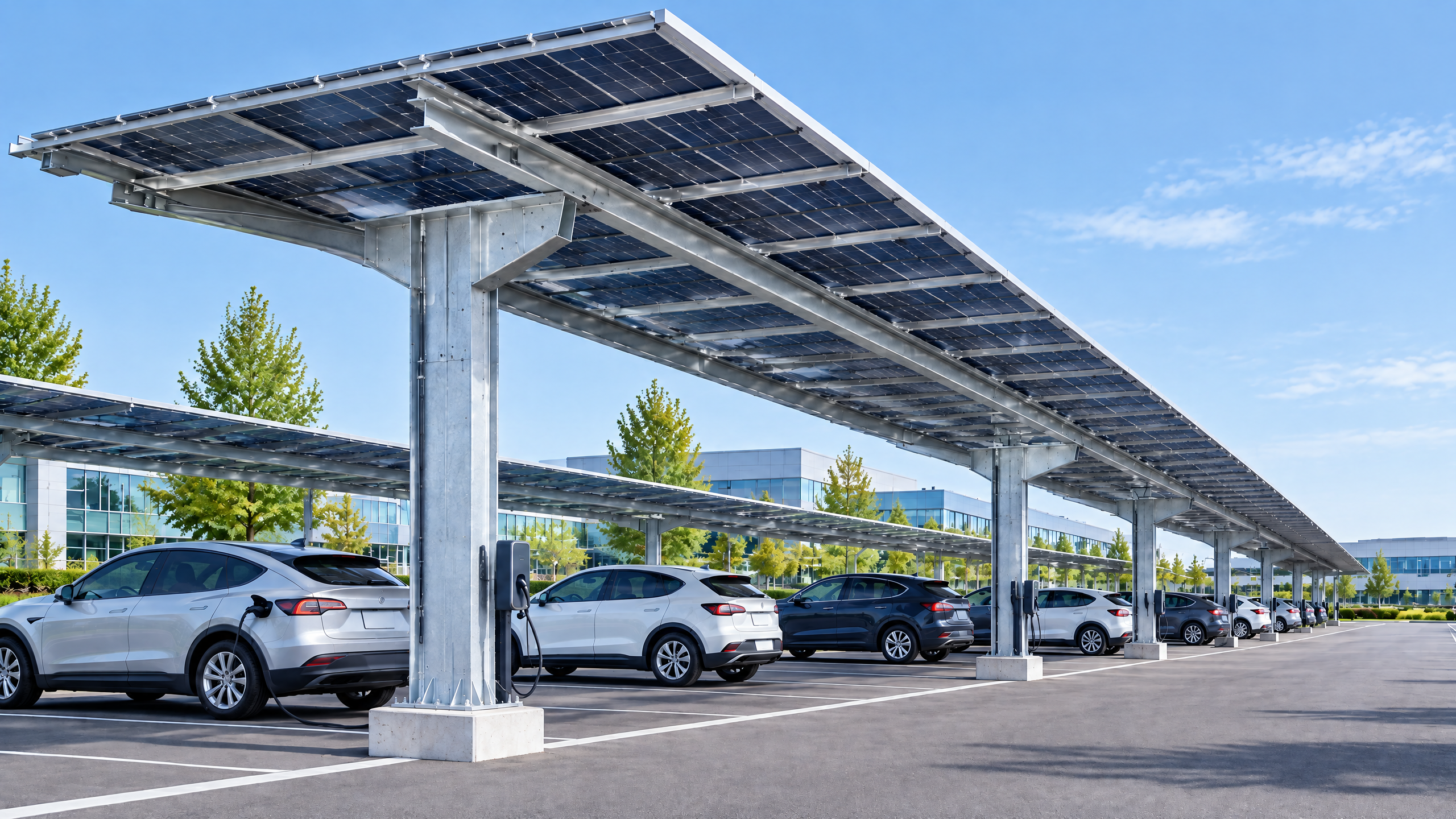
Solar parking structure site planning is the essential discipline that turns a parking area into a reliable energy asset while protecting vehicles, people and pavement. For B2B buyers — distributors, architects, contractors, developers, solar EPCs and fleet operators — evaluation should focus on four parallel outcomes: structural compatibility, predictable energy yield, safe and code-compliant electrical integration, and low-lifecycle cost operations. A robust evaluation process combines site data (topography, geotechnical, shading and utilities), a clarified product/contract boundary (who supplies carport structure, PV, inverters, O&M), and a documented procurement and approval track that preserves warranties and performance guarantees. Use evidence-based inputs (measured shading analysis, utility interconnection guidelines, manufacturer structural test reports and factory QA) and require each bid to include the same documented assumptions so technical comparisons are apples-to-apples. The rest of this guide unpacks the technical interfaces, procurement evidence, site risks and a six-step buyer workflow to make those decisions practical and defensible.
Buyer context and scope boundary
Who should read this
- Distributors and resellers evaluating product fit and logistics.
- Architects specifying canopy integration and site layouts.
- Contractors and civil engineers responsible for foundations and access.
- Developers and asset managers deciding investment metrics.
- Solar EPCs sizing PV arrays, inverters and interconnection points.
- Fleet operators planning EV charging and vehicle shelter needs.
What "site planning" covers (and what it does not)
- Covers: spatial layout (panels, columns, drive aisles), structural loads, foundations, PV module arrangement and mounting interface, electrical pathway planning, interconnection point(s), traffic and safety integration, maintenance access planning, and required permits.
- Does not cover: detailed electrical one-line designs validated by a licensed electrician, final utility approvals that require formal application, or final geotechnical designs that require licensed engineers and site-specific testing.
Define contract boundaries early
- Clarify who supplies the structural frame versus who supplies PV modules, inverters, combiner boxes, and DC/AC cabling.
- If using integrated products like SolarGrid commercial solar system, specify which elements come factory-integrated versus supplied separately.
- Use purchase documents and scopes to prevent later disputes over "interface" items such as mounting adapter plates, flashing, or penetrations.
Why a clear scope matters
- Many schedule and warranty failures originate from ambiguous scope at procurement: if the installer assumes the carport supplier provides the PV racking interface but the supplier assumes the EPC supplies it, procurement delays and on-site rework follow. A documented scope mitigates this.
Core decision principle: align lifecycle risk with responsibility
The single principle to apply throughout procurement and evaluation is this: allocate technical risk to the party best equipped (by capability, proximity, and contract) to manage it, then require evidence they will do so.
Key manifestations:
- Structural risk: allocate to the structural supplier with documented calculations, fabrication QA and statutory compliance.
- Energy yield risk: allocate to the party best able to model site yield (typically the EPC or developer) using accepted tools (see citations) and documented shading assumptions.
- Interconnection and commissioning: allocate to the party responsible for utility application and on-site testing; match performance guarantees to the entity that will operate and maintain the system.
- Warranty maintenance: align long-term O&M and warranty claims with a named responsible party in contracts.
This avoids “split-the-baby” scenarios where no one can be held accountable for interface failures (mechanical or electrical), reduces disputes and streamlines approvals.
Planning inputs: the evidence you must request and capture
Before comparing suppliers or issuing RFPs, assemble a documented project basis. Require bidders to bid to the same inputs.
Minimum site inputs to collect and share:
- Accurate site survey (horizontal location, elevations to a common datum).
- Geotechnical report with boreholes, soil-bearing data, frost depth and groundwater level.
- As-built utility drawings and point-of-connection requirements from the local utility.
- Measured solar access / shading study (sun-path, obstructions, future-build assumptions).
- Traffic and vehicle envelope drawings (for clearance, column protection).
- Floodplain, fire access and local code constraints.
- Local wind, snow and seismic design parameters (per applicable local standards).
- Desired operational outcomes: target kWh production, EV charging integration, expected duty cycle for fleet shelters.
Energy yield inputs and modeling
- Use measured or high-resolution modeled irradiance and validated tools to estimate yield. NREL’s PV resources and PVWatts are authoritative starting points for irradiance and yield modeling in many jurisdictions; reference them for consistent assumptions when comparing proposals [1][2].
- Require bidders to include clear shading assumptions and the software and version used for modeling.
Documented project basis requirement
- Site-specific structural capacity, foundations, permits, electrical design, approvals, lead time, price, energy yield and warranty require a documented project basis and relevant local qualified professionals, installers, utilities and authorities.
Data capture checklist (share with bidders)
- Survey and CAD base file
- Borehole logs and geotech recommendations
- Utility service point and existing one-line
- Shading imagery and sun-path
- Parking layout and vehicle tracking
- Expected future site changes (e.g., planned trees, canopies)
- Required performance metrics (availability, minimum production guarantees)
Technical specification and interfaces
Solar parking structure projects are integration projects where multiple technical domains meet. Below are the critical interfaces and what buyers must verify.
Solar carport structural interface
- Verify structural drawings show load combinations for dead, live, wind, snow and seismic per applicable local codes.
- Require stamped structural calculations from a licensed engineer for the final jurisdiction. Structural supplier drawings should match geotechnical recommendations for foundations.
- Check column spacing, beam sizes, and lateral bracing details against required column-free spans for vehicle movement and EV charger mounting.
- Confirm corrosion protection specifications for aluminum (or steel): mill finish, anodized coatings, or architectural paint systems, and ensure expected environment (coastal, industrial) is addressed.
PV equipment coordination
- PV equipment coordination covers module layout, racking attachment details, stringing, inverter and combiner box locations, and cable routing.
- Require a layout that minimizes DC cable runs and locates inverters/transformers near the point of interconnection or in designated electrical rooms that meet local codes.
- Ask for a coordination drawing that overlays PV module arrays on the structural drawing to show mounting points and any penetrations or adapters.
Electrical pathway planning
- Early-stage electrical pathway planning avoids ad hoc conduit routing and costly rework. Verify:
- AC and DC cable pathways from modules to inverters and to the utility meter.
- Conduit sizing and derating calculations for expected ambient temperatures and bundling.
- Equipment clearances, combiner/inverter cooling access and working space as per electrical code.
- Lightning protection or surge suppression strategy, coordinated between civil and electrical scopes.
Utility and permit interface
- The utility and permit interface must be a named deliverable in proposals. Typical steps include:
- Utility interconnection application and agreement, and identification of any network upgrades or export limits. The Federal Energy Regulatory Commission provides interconnection guidance that may be relevant for certain markets and should be referenced for process understanding [4].
- Local planning and building permit strategy, including arborist statements if trees are affected, encroachment agreements for public rights-of-way, and fire department sign-off for drive aisle widths.
- Request a permit pathway and timeline from bidders and require evidence of prior experience with similar local utility procedures where possible.
Maintenance access planning
- Maintenance access planning ensures modules, inverters and electrical junctions are reachable without unsafe work or vehicle disruption.
- Specify access aisles, service platforms or removable panel provisions. Define safe work clearances and expected frequency of access for module cleaning, inverter service and structural inspections.
- Include a plan for EV charger maintenance if chargers are part of the project.
Safety and vehicle protection
- Clarify bollard placement, wheelstops, and column protection details. Confirm load and impact-resistance ratings and integration with the carport columns.
Environmental and drainage integration
- Provide stormwater management drawings that show how canopy roof runoff ties into existing drainage. Include details of rainwater harvesting or permeable paving if part of the scope.
Interfacing items table (decision table 1)
| Interface | Buyer check | Typical deliverable |
|---|---|---|
| Structural-to-foundation | Match column loads to geotech; stamped calculations | Foundation plan + rebar schedule |
| PV-to-structure | Clear mounting details and torque specs | Coordination drawing with attachment points |
| Electrical pathways | Conduit runs, sizing, and working clearances | Single-line and cable schedule |
| Utility connection | Point of interconnection, capacity and upgrade responsibility | Utility application and PPA/interconnect terms |
| Maintenance access | Safe access defined and unobstructed | Maintenance access plan and schedule |
Procurement and factory evidence: what to require in bids
Procurement in commercial solar parking structure projects must be evidence-led. Ask vendors to submit the following with bids and evaluate consistently.
Must-have factory and supplier evidence
- Factory quality management documentation (ISO 9001 or equivalent) and a brief description of QA checkpoints during fabrication.
- Material certificates for primary structural materials (e.g., aluminum alloy specification) and surface treatment certificates if applicable.
- Drawings and calculations supporting claimed design loads; for structural elements, require stamped calculations as a condition precedent to manufacture.
- Sample test reports for fasteners and critical connections if the product claims resistance to specific loads (note: do not accept unverifiable claims; require source test reports).
- Bill of materials (BoM) with part numbers for PV modules, inverters, combiner boxes, and protection devices.
- Evidence of packing and transport strategy to protect modules and structure components; photos from factory staging are helpful.
Factory acceptance and pre-shipment checks
- Specify factory acceptance tests (FAT) and include witness rights for buyer or buyer’s representative:
- Racking fit-checks, pre-assembly checks, torque verification on fasteners.
- For integrated canopies, the electrical functional check of pre-wired components.
- Require a delivery and unpacking inspection procedure to be provided by the supplier.
Evaluation matrix (decision table 2)
| Procurement evidence | Buyer threshold | Accept / Conditional / Reject |
|---|---|---|
| Stamped structural calculations | Required | Accept only if provided |
| Material certificates | Alloy and treatment documented | Accept if matches spec |
| Factory QA description | Documented checkpoints | Conditional: audit rights preferred |
| FAT reports | Functional testing before shipping | Accept if included |
| Packaging/supply chain risk plan | Protective and timely delivery | Conditional: evaluate transit insurance |
| Warranty terms | Clear coverage period and exclusions | Accept if defined; note exclusions in contract |
Commercial solar procurement practices
- Include technical and commercial evaluation criteria: technical compliance, delivery lead-time, warranty coverage, service availability, and total installed cost.
- For commercial solar procurement, require bidders to present a full lifecycle cost estimate including expected maintenance, inverter replacement window, and module degradation assumptions.
Contract language tips
- Include liquidated schedule damages or incentive structures tied to defined milestones where appropriate.
- Define acceptance tests and performance guarantees with explicit test procedures and weather-normalization methods for energy yield claims.
- Ensure spare part lists, lead times, and escalation contacts are explicit.
Site installation and operations
Site coordination and installation sequencing
- Sequence planning should align civil works (foundations, trenching) before structural delivery. Verify that civil subcontracts include protection of conduit routes and equipment pads.
- Require a coordinated site logistics and crane plan: delivery laydown areas, lifting plans, and traffic management for public sites.
- Provide a combined schedule that ties mechanical completion to electrical commissioning and utility witness tests.
Commissioning and performance validation
- Define commissioning steps: mechanical acceptance (tightness, alignment), electrical tests (meggering, polarity checks, insulation resistance), inverter commissioning, and final DC/AC performance test.
- Require a commissioning report with as-built drawings, as-built single-line diagram, and a measured production baseline for the first 30–90 days (noting that yield normalization may be needed for atypical weather).
Operational considerations
- O&M plan: preventive tasks, frequency (monthly visual inspections, quarterly inverter checks, annual electrical inspections), and spare parts inventory.
- Cleaning strategy: module soiling rates vary by site; define cleaning triggers (e.g., performance thresholds) and who will be responsible.
- Remote monitoring and telemetry: specify required data points, alert thresholds and data retention policies.
Integrating EV charging and fleet operations
- If EV charging is planned, coordinate charger loads, diversity factors, and peak demand to avoid overloading the site transformer.
- Plan electrical pathway and ductbanks to future-proof for charger expansion.
- Consider meter segmentation (separate meter for charging) versus combined site meter depending on billing and tariff structures.
Mid-article CTA For project-specific guidance and datasheets on carport structural interfaces or integrated PV systems, contact Carportiva: /inquiry or info@carportiva.com. See SolarGrid commercial solar system, our catalog of all systems and sourcing guides.
Implementation risks and mitigations
Solar parking structure projects have distinct risk areas. Below is a non-exhaustive risk register with practical mitigations.
- Ambiguous scope leading to on-site disputes
- Mitigation: Use a single contract or a clear interface agreement; require detailed scopes and hold a pre-installation coordination workshop.
- Inaccurate geotechnical assumptions causing foundation rework
- Mitigation: Require site-specific geotechnical investigations before fabrication of pile/footing components; include contingency in schedule and budget.
- Shading and yield shortfall
- Mitigation: Use measured shading or high-resolution modeling; require bidders to include sensitivity analysis in proposals. Reference modeling tools such as PVWatts for consistent baseline assumptions [2].
- Utility interconnection delays or upgrade costs
- Mitigation: Start utility engagement early; obtain preliminary capacity information and interconnection study scope. Request bidders to confirm experience with the local utility process.
- Corrosion and environmental degradation
- Mitigation: Specify materials and coatings appropriate for local environment; require maintenance schedule for inspections and replacement parts.
- Installation safety and traffic disruption
- Mitigation: Insist on traffic management plans, lifting plans, and a safety officer during critical lifts.
- Spare parts and long lead times
- Mitigation: Define long-lead items and require inventory or lead-time assurances in contracts. Factor lead time into procurement decision matrix.
- Warranty and O&M disputes
- Mitigation: Make warranty claim processes and O&M responsibilities contractually explicit, including contact points and escalation paths.
Regulatory and approvals risk
- Because approvals and permits are jurisdiction-specific and may require local professionals, ensure that the permitting responsibility and associated timelines are defined in the contract. For transmission-level or large interconnection queries, guidance from regional/regulatory authorities may be relevant [4].
Six-step buyer workflow for solar parking structure site planning
This named workflow turns the guidance above into an executable sequence. Each step is a gate with required deliverables.
Step 1 — Establish documented project basis (Gate A)
- Actions: Commission site survey, geotechnical study, utility information request, and measured shading assessment.
- Deliverables: Project basis package (survey, geotech, utility sketch, sun-path analysis).
Step 2 — Define scope and roles (Gate B)
- Actions: Create scope matrix specifying who supplies structure, PV, inverters, commissioning, and O&M.
- Deliverables: Scope matrix and draft contract terms.
Step 3 — Request for Proposal (RFP) and evidence collection (Gate C)
- Actions: Issue RFP to shortlisted vendors with the project basis attached; require factory QA documents, stamped calculations and FAT commitments.
- Deliverables: Bid packages with required evidence (see procurement table).
Step 4 — Technical evaluation and vendor selection (Gate D)
- Actions: Evaluate bids against technical, commercial and schedule criteria; perform reference checks and optional factory audits.
- Deliverables: Evaluation matrix and awarded contract with defined milestones.
Step 5 — Pre-construction coordination and fabrication QA (Gate E)
- Actions: Convene the pre-construction meeting, finalize structural-to-PV coordination drawings, schedule FAT and permit submission.
- Deliverables: Issued-for-construction (IFC) drawings, FAT report, permits submitted.
Step 6 — Installation, commissioning and closeout (Gate F)
- Actions: Monitor construction, perform commissioning tests, secure utility permission to operate, handover O&M manual and monitoring access.
- Deliverables: Commissioning report, as-built documentation, performance baseline and O&M plan.
Each gate should have accept criteria and the right to pause fabrication or shipment until the gate is closed.
Frequently asked questions (FAQ)
Q: Who should carry the risk for foundation design and unknown ground conditions? A: Foundation design and ground condition risk should generally be held by the party best able to control and verify it — typically the civil engineer or contractor performing the geotechnical work. However, procurement allocations vary; for prefabricated foundation systems, suppliers may offer a foundation kit but still require verified site-specific geotechnical data. Always require geotech reports before final foundation fabrication.
Q: How do I validate a vendor’s structural claims without on-site testing? A: Require stamped structural calculations from a licensed engineer and material certificates. Ask for factory QA documentation and FATs on critical connection assemblies. If needed, include third-party review by a local structural engineer.
Q: What tools should be used for energy yield estimation? A: Use established tools like NREL resources and PVWatts for consistent irradiance and yield modeling baselines [1][2]. For complex shading or custom module orientations, use validated PV modeling software and require bidders to disclose software and inputs.
Q: Should the carport supplier or EPC provide the inverters? A: This is a commercial decision. If you want a single point of responsibility, ask for a turnkey bid where the supplier or EPC provides both structure and electrical balance of system. If splitting responsibilities, document the electrical and mechanical interface in detail and include acceptance tests in the contract.
Q: How do I plan for EV charging integration? A: Coordinate electrical capacity, meter configuration and demand charges early. Future-proof conduit and ductbanks, and consider providing a reserved electrical room or pad near preferred charger locations. Include load management strategies in O&M.
Q: Are permits and interconnection guaranteed by the supplier? A: No. While suppliers can assist with permit documentation and utility applications, permits and interconnection approvals are local regulatory processes that require applications and often site-specific corrections. The permitting party should be defined in the contract and submissions made in accordance with local requirements.
Q: What are reasonable performance guarantees? A: Performance guarantees should be tied to measured yield with clear normalization for weather and availability. Settle on test methods and acceptance windows in the contract. Do not accept guarantees without defined test procedures.
Conclusion and next steps
Solar parking structure site planning is a complex integration task: the structural, electrical, utility and operational interfaces must all be negotiated and evidenced before buy decisions are made. For B2B buyers, rigorous documentation — a consistent project basis, required factory evidence, clear scope allocation, and staged decision gates — is the most reliable way to reduce schedule slippage, cost overruns and warranty friction. Use the six-step workflow in this guide to structure procurement and require bidders to provide the same documented inputs for an apples-to-apples comparison.
Remember: site-specific structural capacity, foundations, permits, electrical design, approvals, lead time, price, energy yield and warranty require a documented project basis and relevant local qualified professionals, installers, utilities and authorities.
For project inquiries, product specifications or to discuss an integrated offering such as SolarGrid commercial solar system, contact Carportiva: /inquiry or info@carportiva.com. Also explore our other products at all systems and practical procurement checklists in our sourcing guides.
References
- NREL Solar resource and tools [1]
- PVWatts Calculator [2]
- U.S. Department of Energy AFDC for related EV and charging data [3]
- FERC interconnection resources for process context [4]
References
- National Laboratory of the Rockies PV resources: https://www.nrel.gov/solar/
- PVWatts Calculator: https://pvwatts.nrel.gov/
- U.S. Department of Energy Alternative Fuels Data Center: https://afdc.energy.gov/
- Federal Energy Regulatory Commission interconnection resources: https://www.ferc.gov/electric-transmission/generator-interconnection
Keep the project brief connected.
Bring the actual project brief to the engineering table.
Share your location, layout, target application and available technical inputs. Carportiva can help identify the relevant product-interface information before a project-specific commercial discussion.
Request a project discussion