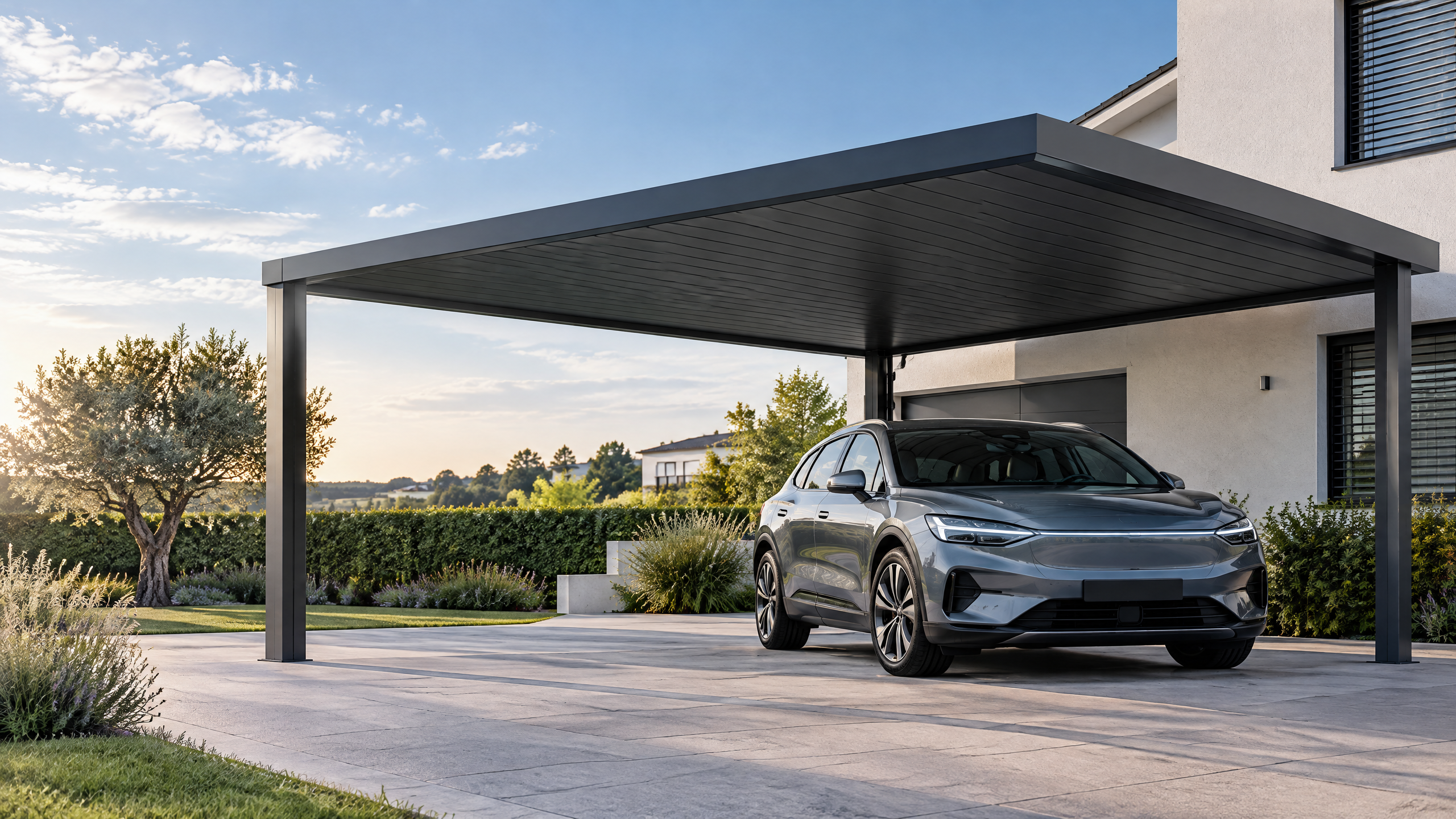
Direct answer (120–180 words)
Selecting an aluminium carport lighting manufacturer for a commercial carport project requires treating the lighting supplier as an integrated component manufacturer rather than a commodity lamp vendor. Decisions should be driven by: (a) how the lighting system mechanically and electrically interfaces with the architectural aluminium carport structure and aluminium profile selection; (b) evidence of factory quality, material traceability and finisher compatibility with the primary structure; and (c) demonstrated shop drawing review, coordinated roof drainage coordination and installation readiness in the project programme. Specify measurable acceptance criteria in the procurement documents (performance, IP/IK, thermal management, control protocols, mounting details, and warranty responsibilities) and require manufacturer-supplied verification — material certificates, test reports, and an on-site installation plan. For commercial projects, incorporate documentation and approvals for structural loads, electrical design, local utilities and authorities, and engage local qualified professionals early to translate these manufacturing criteria into a coordinated architectural carport specification.
Buyer context and scope boundary
Purpose and audience
- This guide is written for global B2B buyers — distributors, architects, contractors, developers, solar EPCs and fleet operators — involved in procuring lighting for aluminium carports, commercial solar carports and industrial/fleet shelters.
- Primary focus is the selection and specification of an aluminium carport lighting manufacturer as a distinct supply responsibility within Architectural aluminium systems procurement and implementation.
Scope boundaries — what this guide does and does not cover
- Covers: procurement criteria, technical interface requirements between lighting and aluminium carport structures, quality evidence, factory-to-site handover and operational readiness, and a six-step buyer workflow to make an informed manufacturer selection.
- Does not cover: detailed structural design of the carport foundation, project-specific electrical design or permit approval processes. Site-specific structural capacity, foundations, permits, electrical design, approvals, lead time, price, energy yield and warranty require a documented project basis and relevant local qualified professionals, installers, utilities and authorities.
Why treat the lighting manufacturer as part of the architectural system?
- In commercial carports the lighting is mounted to bespoke aluminium structural elements, contributes to occupant safety and to operational energy budgets, and must coexist with roof-mounted equipment (e.g., PV). Poor specification causes interface failures, waterproofing breaches, galvanic corrosion or delayed commissioning.
Cluster placement
- This guide sits within Architectural aluminium systems procurement and complements structural, roofing and solar system sourcing. For system-level reference see NordArch architectural aluminium system, our full catalog at all systems and sourcing guides.
Core decision principle
Define a single procurement principle for lighting on aluminium carports:
- Choose an aluminium carport lighting manufacturer capable of delivering engineered lighting assemblies (mechanical sub-assembly + electrical system) with documented material and finish compatibility, factory quality control, and a defined responsibility demarcation in structural and waterproofing interfaces.
Why a single principle helps
- It aligns procurement, design and installation stakeholders around one source of accountability for the interface between lighting and the carport structure, avoiding gaps between “lighting supplier” and “carport fabricator” that produce on-site conflicts, rework and latent defects.
Decision outcomes to expect
- Clear shop drawing review and sign-off process.
- Verified finish and fastener compatibility for aluminium-to-aluminium or aluminium-to-steel connections.
- A documented installation readiness plan with pre-packaged fixings and sequencing.
Relevant normative references
- Structural loads and wind/snow considerations must refer to local code and harmonised standards; for European projects consult Eurocodes for load combinations and structural design [1]. For aluminium material guidance see The Aluminum Association [2] for alloy selection and temper information. For coating and finish guidance consult AAMA documents on coatings and finish performance [3]. For product test methods and IP/IK references consult ISO listings [4].
Planning inputs: site, programme and responsibilities
Essential project inputs (data you must obtain before manufacturer evaluation)
- Site environmental data: latitude, altitude, typical ambient temperatures, corrosivity category (e.g., marine, industrial), prevailing wind direction, rainfall intensity and snow hazard.
- Structural design envelope: location and spacing of mounting rails, maximum allowable point loads on the carport structure, deflection limits and dynamic loading assumptions.
- Roof and canopy layout: exact positions of PV arrays (if present), roof drainage routes, and access zones for wiring and maintenance.
- Electrical scope: available switchgear, fault levels, control systems, required luminaire drivers, dimming/lighting control protocol (DALI, 0–10V, DMX), emergency lighting expectations and earthing/ bonding principles.
- Programme constraints: procurement milestones, lead time windows, and installation sequencing relative to roofing and PV works.
Roles and responsibilities matrix
- It is essential to record who owns each responsibility (Owner, Architect, Structural Engineer, Electrical Engineer, Lighting Manufacturer, Carport Fabricator, Installer, Local Authority).
- Key responsibilities to assign: structural load allowances for lighting mounting; waterproofing and roof sheet penetrations; cable containment and routing; final electrical connection and commissioning.
Example responsibility assignment (summary)
- Structural adequacy of the carport: Structural Engineer and Carport fabricator.
- Mechanical attachment method of luminaire to extrusion: Lighting Manufacturer (design) / Carport fabricator (execute per drawing).
- Roof drainage coordination and waterproofing around penetrations: Carport fabricator / Roofing specialist.
- Electrical connection and commissioning: Electrical Contractor, coordinated with Lighting Manufacturer.
Programme note
- Require manufacturer confirmation of installation readiness and lead time at RFP (request for proposal) stage to prevent schedule conflicts around weather-dependent roofing work.
Technical specification and interfaces
Define the technical acceptance criteria as measurable requirements. Provide separate sections for mechanical, electrical, environmental and contractual interfaces.
Mechanical interfaces and aluminium profile interaction
- Aluminium profile selection is an early decision that affects how luminaires attach. Provide manufacturers with a full set of section profiles, material alloy and temper, and anodic or painted finish to evaluate mounting options.
- Specify acceptable attachment methods:
- Non-penetrative clamps to structural rails where possible to preserve waterproofing.
- Bolted connections with sealed screw bosses where penetrations occur; specify sealing method, fastener material and sealant compatibility.
- Integrated extruded luminaire channels that sit within the profile recesses for a continuous aesthetic and hidden wiring.
- Fastener and contact materials:
- Specify stainless steel fasteners (corrosion class appropriate to environment) and confirm galvanic compatibility with aluminium to mitigate galvanic corrosion.
- Include finish and fastener compatibility requirements to ensure coating systems and sealants do not chemically attack coatings or anodising.
Thermal management and luminaire performance
- Aluminium carport canopies can trap heat; ensure manufacturer provides thermal derating data for lumen maintenance and driver temperature limits.
- Specify minimum driver operating temperature range and maximum case temperature, and require manufacturer to provide photometric and thermal test data for the expected mounting orientation.
Ingress, impact and environmental ratings
- Define minimum IP and IK ratings (e.g., IP66 and IK08) and require evidence of testing to relevant ISO test methods [4].
- For coastal or chemical environments, specify corrosivity category and coating system lifecycle expectations. Require product-family salt-spray test data if applicable (and reference AAMA guidance for coating selection) [3].
Electrical interface and controls
- Define control protocol and interfaces (DALI, 0–10V, simple relay). Require manufacturer to provide driver compatibility statements and wiring diagrams.
- Specify surge protection requirements, particularly for exposed canopies and external circuits.
- Define earth-continuity and bonding requirements for aluminium structures; require manufacturer to detail their earthing approach and any isolating components.
Photometrics and performance requirements
- Use objective metrics: maintained lux at ground plane, uniformity ratios (min/max), glare control (UGR or equivalent), colour temperature and CRI. Provide target lux levels for different zones (access lanes, pedestrian walkways, perimeter).
- Require IES/IESNA files and photometric distributions that reflect the approved mounting height, spacing and aiming.
Mounting and roof penetration details
- Where penetrations are unavoidable, define roof drainage coordination and waterproofing responsibilities in the architectural carport specification. Provide detail on flashing, gaskets and secondary drainage paths.
- If mounting inside extruded channels, supply profile cut sheets and ensure lighting manufacturer demonstrates mechanical tolerance compatibility.
Serviceability and maintenance
- Specify access conditions for routine lamp/driver replacement and cleaning; include allowable clearance for maintenance equipment. For LED systems, specify expected maintenance intervals and spare parts delivery timeframe.
Two decision tables below present acceptable evidence and options for mounting and procurement acceptance.
Decision table 1 — Manufacturer evidence and acceptance checklist
| Evidence / Deliverable | Minimum requirement | Accept / Reject criteria |
|---|---|---|
| Material certificate for luminaire housing | Alloy and temper declared; traceable batch report | Accept if alloy matches specified and traceable |
| Finish system data | Coating type, process, thickness; AAMA/ISO reference | Accept if coating aligns with corrosivity class and AAMA guidance [3] |
| IP/IK test reports | Test method and report to ISO/IEC where applicable [4] | Accept if ratings meet specified IP/IK |
| Photometric files (IES) | Verified IES files for specified mounting | Accept if photometrics meet target lux and uniformity |
| Thermal derating data | Driver/luminaire temperature performance | Accept if performance exceeds site max ambient |
| Shop drawing review package | Site-specific mounting, fasteners, hole patterns | Accept only after shop drawing review sign-off |
| EMC/surge protection data | Surge protection and EMC compliance info | Accept if compliant with project electrical spec |
Decision table 2 — Mounting option vs impact and control
| Mounting approach | Waterproofing impact | Structural load impact | Installation complexity | Typical best use |
|---|---|---|---|---|
| Non-penetrative clamp on extrusion | Low (no penetration) | Low point loads | Low | Retrofit or where continuous sealing is critical |
| Sealed bolted boss (sealed penetration) | Medium (requires precise sealing) | Medium | Medium | New builds requiring higher load capacity |
| Integrated extruded channel (factory fitted) | Low (factory sealed) | Low to medium | High (coordination at fabrication) | High-end architectural carports prioritising aesthetics |
| Pendant suspended from canopy | Medium to high (requires support brackets) | High | High | Large luminaires or high-bay requirements |
Procurement and factory evidence
What documents and evidence to require in RFP/Tender
- Technical bid package must include:
- Company capability statement specific to architectural carport lighting projects.
- Sample product data sheets and cataloguing of luminaire families proposed.
- Material certificates and batch traceability for housings and fasteners.
- Test Reports for IP/IK and thermal cycling, surge protection and, where applicable, salt spray data (note: request results of recognised test labs — specify tests, not invented certification names).
- Manufacturing quality system statement and inspection plan (e.g., incoming material checks, finished goods checks).
- Details of the shop drawing review process and a commitment to produce shop drawings for coordination within a specified time after PO.
- A pre-shipping inspection and packaging plan to protect finishes and assemblies.
Factory audit focus areas
- For architectural aluminium systems, audit the paint/anodising supply chain and surface preparation steps.
- Inspect fixture assembly cleanliness and potting/encapsulation processes for drivers and wire joints.
- Verify torque control for fasteners that affect earth continuity and mechanical clamping.
- Check functional testing benches for luminaire burn-in and photometric verification.
Quality acceptance tests at factory (minimum)
- Electrical safety and insulation resistance tests.
- Driver and luminaire thermal profiling at defined ambient temperatures.
- Photometric spot checks against published IES files.
- Mechanical endurance of brackets/clamps under load cycles.
Procurement contract items to include
- Clear acceptance criteria and test method references (e.g., ISO test methods for IP/IK) [4].
- A warranty matrix that differentiates luminaire LED modules, drivers, mechanical attachment, and finish. (Remember: warranty terms depend on project specifics and local law; include a documented project basis.)
- Responsibility matrix for interface failures (e.g., water ingress where a fixture penetrates the roof).
Allowances and spare parts
- Specify spares required on hand at commissioning (drivers, control modules, a percentage of luminaires).
- Define lead times for long-lead components and require the manufacturer to confirm stock or production slots.
Evidence table for procurement review (useful for bid scoring)
| Bid evaluation factor | Weighting (%) | Required evidence |
|---|---|---|
| Technical compliance (photometrics, IP/IK) | 30 | IES files, test reports |
| Interface management (shop drawing review, mounting) | 20 | Shop drawing process, sample details |
| Materials & finish traceability | 10 | Material certificates, coating specs |
| Factory QA and testing | 15 | QA statement, factory test reports |
| Delivery, lead time & installation readiness | 15 | Confirmed lead times, installation plan |
| Commercials & warranty | 10 | Warranty matrix, commercial terms |
Site installation, commissioning and operations
Pre-installation checks and coordination
- Require the lighting manufacturer to participate in a shop drawing review process where mounting details are checked against local structural drawings and roof profile tolerances.
- Confirm installation readiness: whether luminaires arrive pre-wired to trunking points, whether fixings and gaskets are included, and whether special installation tools are supplied.
- Confirm the sequence with roofing and PV installation teams; define protection and storage requirements to prevent finish damage.
On-site responsibilities and handover
- Installation party should be nominated; the lighting manufacturer can supply a certified installer where local competence is limited.
- The electrical contractor must provide isolation and final connection under local regulations.
- Require functional testing and commissioning checklists signed by manufacturer’s representative or trained agent — include photometric verification at commissioning if contractual.
Testing and commissioning protocol
- Visual inspection of mechanical fixings, sealant joints and coatings prior to energising.
- Electrical insulation and polarity check, followed by in-situ driver functional test and control integration test.
- Night-time photometric check: compare on-site lux readings with predicted values and record deviations.
- Lightning and surge protection verification, especially in exposed locations.
Maintenance and lifecycle considerations
- Provide an operations and maintenance manual that includes maintenance intervals, spare parts list, cleaning procedures and specific instructions for finish care.
- Clarify what constitutes normal wear versus a manufacturing defect under warranty.
Installation readiness checklist (include in purchase order)
- Shop drawing sign-off completed.
- Manufacturer-supplied fixings and gaskets received.
- Installer trained or manufacturer representative scheduled.
- Electrical distribution and control gear available and ready.
- Roof drainage coordination sign-off complete.
Example on-site acceptance test matrix
| Test | Acceptance criteria | Responsible |
|---|---|---|
| Mechanical anchorage | No movement under test load; torque per drawing | Installer, witnessed by QA |
| Waterproofing around penetration | No water ingress after simulated rainfall | Roofing specialist |
| Electrical operation | All luminaires energise and respond to controls | Electrical contractor |
| Photometric check | Measured lux within agreed tolerance | Lighting manufacturer / Electrical contractor |
Implementation risks and mitigation
Common implementation risks
- Interface mismatch: luminaire mounting patterns do not match fabricated extrusion holes.
- Mitigation: early shop drawing review; provide as-built profiles to manufacturer; factory-laid mounting channels where possible.
- Waterproofing failure at penetrations
- Mitigation: prioritise non-penetrative mounts; where penetrations occur, document roof drainage coordination and require proven sealing details.
- Galvanic corrosion between aluminium and dissimilar metals
- Mitigation: require finish and fastener compatibility; specify insulating washers or compatible fastener alloys and verify in materials records.
- Thermal overreach leading to reduced LED life
- Mitigation: require thermal derating and case temperature data; specify driver ambient range.
- Delayed commissioning due to missing parts or incompatible controls
- Mitigation: insist on installation readiness deliverables, prepackaged fixings and control interface testing before delivery.
- Inadequate factory QA leading to inconsistent photometric performance
- Mitigation: request factory test records, on-shore inspection or third-party witness testing.
Risk allocation matrix (high-level)
| Risk | Likelihood | Impact | Owner / Action |
|---|---|---|---|
| Interface mismatch | Medium | High | Early shop drawing review — Lighting Manufacturer & Carport Fabricator |
| Waterproof failure | Low-Medium | High | Roofing specialist & Lighting Manufacturer — sealed solutions |
| Corrosion | Medium | Medium-High | Specify materials; QA to confirm finish/fastener compatibility |
| Thermal degradation | Low | Medium | Manufacturer to provide thermal data; design margin applied |
| Delivery delay | Medium | High | Supplier to confirm lead times; include penalties or alternatives |
Note: Project-specific risks require a documented risk register and steering by the project manager. Always consult local regulations and authorities.
Six-step buyer workflow (named steps with expected deliverables)
This prescriptive workflow is intended to reduce rework and align all stakeholders.
- Requirement definition — “Define”
- Deliverables: lighting performance brief (lux levels, zones), mounting interface requirements, environmental class, control protocol and maintenance constraints.
- Actions: gather site data and structural constraints; identify lead times.
- Manufacturer pre-qualification — “Pre-Qualify”
- Deliverables: supplier capability statements, factory evidence, test report summaries.
- Actions: evaluate against procurement evidence table; shortlist 2–3 manufacturers.
- Technical engagement and mock-ups — “Design Verify”
- Deliverables: manufacturer concept details, initial shop drawing, sample luminaire or mock-up.
- Actions: confirm aluminium profile selection impacts and finish and fastener compatibility; iterate mounting options.
- Detailed tender and contract — “Contract”
- Deliverables: full technical specification, procurement contract with acceptance tests, warranty matrix and installation readiness commitments.
- Actions: score bids with the evaluation table; award and place PO with clear deliverables.
- Shop drawing review and pre-fabrication — “Coordinate”
- Deliverables: completed shop drawings, installation kit list, schedule of factory tests.
- Actions: run a formal shop drawing review and sign-off process; integrate with roof drainage coordination plan.
- Delivery, installation and commissioning — “Handover”
- Deliverables: installation checklists, commissioning reports, as-built drawings and O&M manual.
- Actions: perform on-site acceptance tests, store spares on site, ensure warranty registration.
Use the above workflow to set procurement milestones in the project schedule.
FAQ (focused, evidence-led answers)
Q: Should the lighting be specified before or after the carport extrusions are finalised? A: Coordinate both design streams concurrently. Aluminium profile selection affects mounting details; start lighting concept early and lock profiles before fabrication to avoid mismatched hole patterns.
Q: Is it acceptable to rely on generic IP ratings from a catalogue? A: Require actual test reports with traceable serials or batch numbers. Catalog IP ratings are indicative; project acceptance should be backed by test evidence and factory test witness where risk is high [4].
Q: What alloy or temper is preferred for fixtures attached to extruded aluminium? A: There is no one-size-fits-all alloy; however, choose compatible alloys (and avoid dissimilar contact with certain stainless steels) and require manufacturer to provide material certificates. For architectural extrusions, 6000 series alloys are commonly used; consult The Aluminum Association for alloy properties [2].
Q: How should lightning or surge protection be specified? A: Specify surge protection for control and power circuits based on local lightning exposure and the electrical engineer’s assessment. Require manufacturer to state surge protection measures within luminaires.
Q: Who is responsible if a luminaires causes a leaking penetration? A: Assign responsibility in the procurement documents. Best practice: use non-penetrative mounting to avoid creating a leak risk. If a penetration is required, contractually require sealed detail and make responsibilities explicit in shop drawing review.
Q: Do I need a factory visit? A: A factory audit is valuable for high-value or large-volume projects. Where not possible, request third-party inspection and full test evidence. Factory QA documentation is the minimum requirement.
Q: What controls standard should I demand? A: Match the client’s building management system and futureproof where possible (e.g., DALI as a robust, scalable control protocol). Define controls in the technical brief.
Q: Can the lighting supplier also supply the carport extrusions? A: Sometimes, but this changes responsibility allocation. If combined, ensure end-to-end scope clarity. Otherwise coordinate carefully between the lighting manufacturer and carport fabricator during shop drawing review.
Q: Are finish warranties transferable internationally? A: Warranty terms are contract-specific and depend on local enforcement; do not assume transferability — require explicit terms in the contract and note that local environmental conditions may affect the warranty.
Q: How to evaluate lead time risk? A: Request confirmed production slot dates and component lead times. Include delivery milestones in contract and consider staged delivery to match installation sequencing.
Mid-article CTA
If you would like Carportiva to review your project’s mounting profiles, shop drawings or procurement specification, start the conversation via /inquiry or email info@carportiva.com. For system-level reference see NordArch architectural aluminium system, explore all systems and consult our sourcing guides.
Procurement checklist — minimum contractual clauses
Include these clauses in the purchase order or contract:
- Deliverables and acceptance criteria referencing the specific test methods (ISO tests for IP/IK where applicable) [4].
- Requirement for shop drawing review with defined review turn-around time and limited number of revisions.
- Installation readiness confirmation date and penalties or remedies if not met.
- Requirement for material certificates and batch traceability at dispatch.
- Spare parts and on-site spares quantity and delivery timeline.
- Warranty matrix with clear start date (e.g., commissioning date) and defined remedy procedures.
- Clear interface responsibilities for roof penetrations, drainage, and electrical final connection.
Performance verification and handover
Commissioning protocols to adopt
- Agree a commissioning plan in the contract that defines test types, acceptance criteria and reporting format.
- Include pre-installation witness tests (for critical items) and post-installation night-time photometric verification.
As-built documentation
- Require as-built drawings that show exact luminaire positions, mounting details and wire routing.
- Don’t accept generic drawings; they must reflect changes from site conditions.
Handover package contents
- O&M manuals with cleaning and maintenance regimes.
- Spare parts and consumables list.
- Warranty registration documents and contact points for fault escalation.
Closing implementation considerations
- Remember the statement of limits: site-specific structural capacity, foundations, permits, electrical design, approvals, lead time, price, energy yield and warranty require a documented project basis and relevant local qualified professionals, installers, utilities and authorities.
- Maintain tight change control. Minor on-site deviations in profile dimensions can cascade into rework; insist on immediate change notices and re-issued shop drawings for any deviation.
- Record lessons learned for future projects — finishes, fastener choices, and mounting approaches often generate recurring decisions that improve over multiple deployments.
Conclusion
Specifying an aluminium carport lighting manufacturer is an engineering, procurement and coordination exercise. Prioritise manufacturers that demonstrate not only luminaire performance but the capability to manage structural and waterproofing interfaces, provide material traceability, engage in rigorous shop drawing review, and commit to installation readiness. Use objective procurement criteria, insist on documented factory evidence, and formalise interface responsibilities in contract documents to reduce risk. For system guidance and to align lighting selection with architectural aluminium systems, consult NordArch architectural aluminium system, review our sourcing guides and consider Carportiva’s integrated approach to carports and shelters.
Final call to action
- To request an initial technical checklist review or discuss project-specific coordination, contact us at /inquiry or info@carportiva.com.
References
- Eurocodes — for structural load and design guidance [1]
- The Aluminum Association — alloy and material references [2]
- American Architectural Manufacturers Association — coating and finish guidance [3]
- ISO online browsing platform — test methods for ingress and impact ratings [4]
References
- European Commission Eurocodes: https://eurocodes.jrc.ec.europa.eu/
- The Aluminum Association: https://www.aluminum.org/
- American Architectural Manufacturers Association: https://aamanet.org/
- ISO Online Browsing Platform: https://www.iso.org/obp/ui/
Keep the project brief connected.
Bring the actual project brief to the engineering table.
Share your location, layout, target application and available technical inputs. Carportiva can help identify the relevant product-interface information before a project-specific commercial discussion.
Request a project discussion