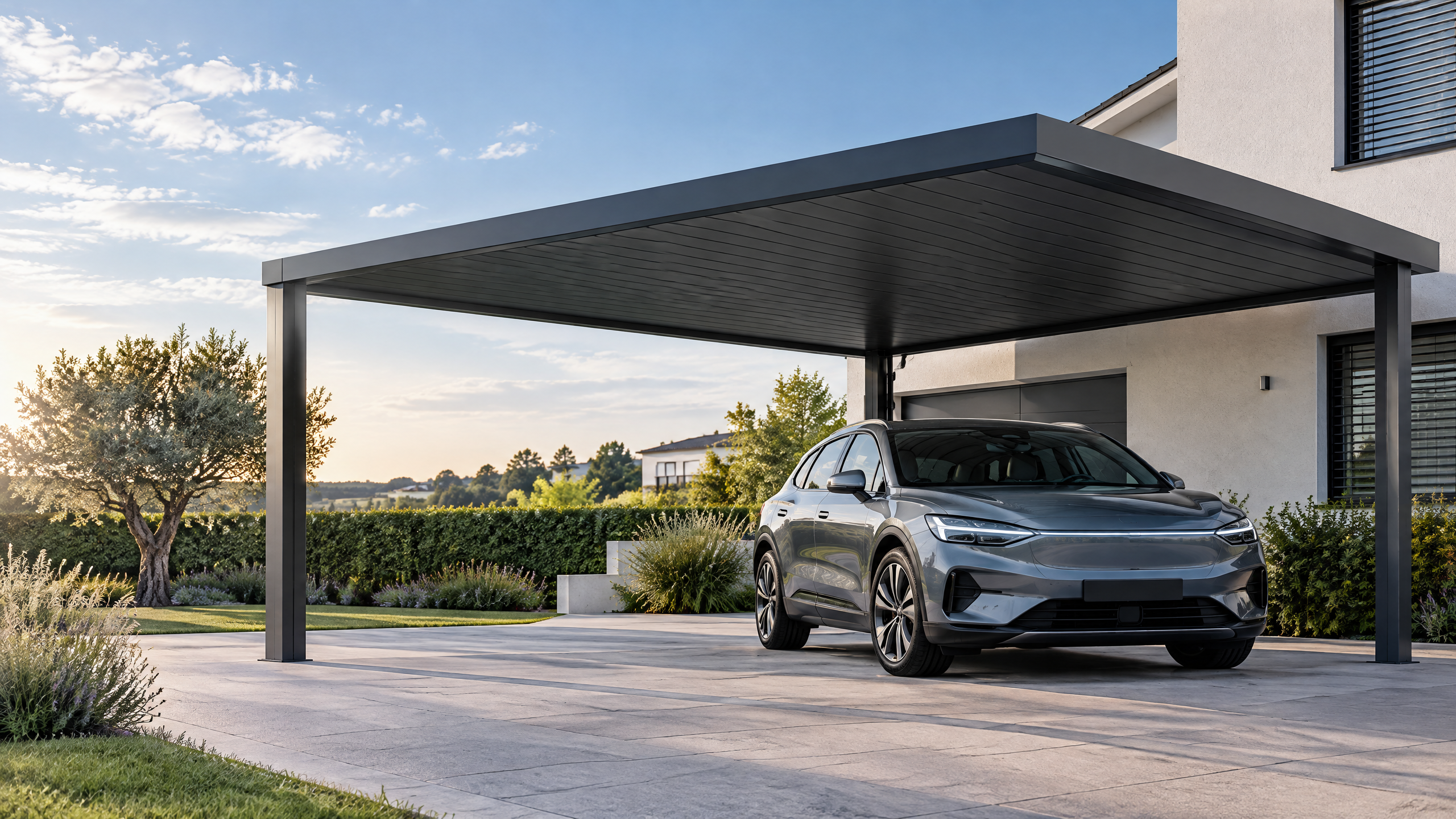
Short answer (120–180 words): The aluminium carport powder coating specification matters from the first feasibility decision through to warranty acceptance because the coating defines long-term durability, aesthetics, maintenance, and compatibility with adjacent systems (fasteners, PV modules, gutters). For procurement teams, the coating spec determines acceptable supplier pools, factory processes, inspection checkpoints, and contractual QA — and it materially affects total cost of ownership in corrosive environments, high-abrasion uses, or architecturally visible installations. Specify coating performance classes (film build, resin type, colour tolerance, UV resistance, adhesion, corrosion resistance) and require objective factory evidence (certified process control, test reports, photographic batch records, and shop drawing review) to de-risk acceptance and installation. For structural, electrical and local compliance items (foundations, permits, wind/ice loads, energy yield and warranty), always base decisions on a documented project brief and engage local qualified professionals, installers, utilities and authorities.
Buyer context and scope boundary
Why this guide exists
- Audience: global B2B buyers — distributors, architects, contractors, developers, solar EPCs and fleet operators — who specify, procure or accept architectural aluminium carports, commercial solar carports and industrial/fleet shelters.
- Primary focus: aluminium carport powder coating specification as the single technical attribute that interacts with procurement, manufacturing quality, installation readiness and long-term performance.
- Cluster: Architectural aluminium systems. Linkage to system-level choices (profiles, roof modules, drainage) is emphasised throughout.
Scope boundaries — what this guide covers and what it does not
- Covers: how powder-coating choice influences aluminium profile selection, finish and fastener compatibility, shop drawing review, roof drainage coordination and installation readiness; procurement evidence; risk mitigation and a pragmatic six-step procurement workflow.
- Does not cover: site-specific structural design, foundation engineering, electrical system design, local permitting, energy yield calculations, contract law or warranty adjudication beyond how the coating intersects these items.
- Important safety note: site-specific structural capacity, foundations, permits, electrical design, approvals, lead time, price, energy yield and warranty require a documented project basis and engagement of relevant local qualified professionals, installers, utilities and authorities.
Key definitions used in this guide
- Powder coating: a dry finishing process in which a polymer powder is electrostatically applied and cured to form a film on metal surfaces.
- Architectural carport specification: the complete set of dimensional, structural, finish and interface requirements for a carport project.
- Shop drawing review: a formal review and approval cycle for fabricated components and assemblies before manufacture and shipment.
Related Carportiva resources
- For product-level system considerations see NordArch architectural aluminium system, our system families at all systems and procurement templates at sourcing guides.
Core decision principle
Single-principle summary Select the powder-coating system that is demonstrably fit-for-environment, compatible with adjoining components, verifiable by factory evidence, and aligned with the project’s lifecycle cost and maintenance strategy. If any of these four pillars fails, coating-driven failures become procurement, warranty and reputational liabilities.
Why the coating becomes a procurement decision driver
- Visibility and specification: architectural carports are often visible public assets; finish expectation drives buyer and end-user satisfaction.
- Durability and lifecycle cost: coatings mitigate corrosion and UV degradation that otherwise accelerate replacement or maintenance.
- Interoperability: finish and fastener compatibility affect galvanic corrosion and mechanical integrity where dissimilar metals meet.
- Manufacturing control: powder coating is process-sensitive (pre-treatment, application, curing), so procurement must demand factory quality evidence, not just a standard label.
Trade-offs to accept and manage
- Higher-performance coatings increase upfront price but reduce maintenance and replacement risk; balance lifecycle costing with project budget constraints.
- Custom colours or textured finishes increase lead-times and sometimes reduce the availability of batch-matching on repairs — factor this into installation readiness and spares strategy.
Relevant standards and guidance
- Structural loads and durability requirements for aluminium structures should be informed by regional structural standards such as the Eurocodes for wind, snow and seismic design [1].
- Coating performance classes and test methods are commonly referenced against standards and industry guidance from associations such as The Aluminum Association [2] and American Architectural Manufacturers Association (AAMA) [3]. Where test standards are called out, ensure they are appropriate for the project’s jurisdiction and environment (see Planning Inputs).
Planning inputs that change the coating choice
Project variables that materially affect specification
- Exposure environment: inland, coastal (marine salt spray), industrial (acidic/alkaline atmospheres), high UV (desert/high altitude), or abrasive environments (high particulate).
- Aesthetics and visibility: continuous public exposure vs. back-of-house fleet shelters influences tolerance for colour drift, gloss loss and texture.
- Expected maintenance regime: frequent washing and inspection vs. minimal maintenance.
- Connection materials: stainless steel, galvanised steel, hot-dip galvanised fasteners, anodised aluminium, PV module frames — determine galvanic compatibility.
- Roof drainage coordination and run-off paths: water that carries contaminants or dissimilar-metal filiform attack risks — see roof drainage coordination below.
- Project timescales: custom colours or complex application processes (e.g., dual-coat, textured) increase lead time.
- Warranty and lifecycle planning: warranty terms often condition performance on specified maintenance and approved touch-up materials.
How to capture inputs in a documented project basis
- Create a short “coating requirement annex” to the technical project brief that records: environmental classification, colour and texture requirements, critical interfaces (fastener types, adjacent materials), maintenance intervals, aesthetic acceptance criteria and approved suppliers/processes.
- Use the annex during pre-bid and shop drawing review phases to enforce consistent supplier responses.
Environmental classification decision table
- A simple classification can be used to map environment to recommended coating performance requirements:
| Environment type | Typical challenges | Minimum coating considerations |
|---|---|---|
| Urban inland | Moderate pollution, UV | Standard TGIC polyester powder with pre-treatment; specify UV stability and adhesion |
| Coastal (near salt water) | Salt spray, chloride exposure | Enhanced corrosion resistance: zinc-rich pre-treatment + high-performance polyester or fluoropolymer; stricter scribe/cut protection |
| Industrial (chemical/acidic) | Acidic or alkaline atmospheres | Chemical-resistant topcoats; verify chemical exposure profile and test methods |
| High UV / desert | High solar irradiance | High-UV-stability resin systems; check accelerated UV tests |
| High abrasion / heavy use | Mechanical wear | Higher film thickness, impact-resistant powders or secondary treatments |
Note: These are illustrative; match to project data and test methods when finalising the aluminium carport powder coating specification.
Technical specification and interfaces for powder-coated aluminium carports
Key specification items to include (detailed)
- Coating system description
- Powder type (e.g., TGIC polyester, polyester-polyurethane, fluoropolymer such as PVDF): specify resin family, not marketing names.
- Film thickness (minimum dry film thickness, DFT) with measurement method (micrometer gauge, sampling frequency).
- Pre-treatment type (iron phosphate, zirconium, conversion coatings, or specified zinc-rich primer) and process control parameters.
- Application method (electrostatic, fluidised bed) and curing temperature/time windows.
- Colour and texture tolerances (Delta E tolerance, gloss range in GU or angle specification).
- Performance tests and acceptance criteria
- Adhesion (ASTM D3359 or equivalent), impact resistance (ASTM D2794), flexibility (bending tests), and salt spray exposure duration with acceptance criteria.
- UV resistance (accelerated weathering and QUV cycles) with Delta E and gloss retention limits.
- Corrosion resistance: specify scribe tests and acceptable creep from scribe at defined hours (AAMA or ISO test references where applicable).
- Chemical resistance tests if industrial exposure is present.
- Compatibility and interface control
- Finish and fastener compatibility: specify approved fastener materials/coatings and constraints on dissimilar metal contact. Include criteria to prevent galvanic corrosion (e.g., insulating washers, isolation barriers).
- Aluminium profile selection: specify alloy and temper (e.g., 6000 series typical for structural extrusions), surface finish prior to coating (as-polished, anodised pre-treatment) and tolerance for fabrication such as bending or punching.
- PV module mounting interfaces and roof drainage coordination: define interface details to avoid water traps, run-off carrying debris, or areas where coating abrasion will occur.
- Touch-up, repair and spares
- Approved touch-up materials and method statements for field repairs, colour matching procedure and batch traceability requirement.
- Spare component policy for visible elements and end-of-life repairability.
- Documentation and traceability
- Batch identification, pre-treatment records, cure charts, and final inspection reports to be supplied for each delivery lot.
How to phrase a concise coating clause for tender documents
- "Provide a powder-coated finish using [resin family], minimum DFT X µm, pre-treatment [type], with adhesion and corrosion resistance meeting specified test criteria. Supplier must provide process control records, batch photographs, and test certificates for each fabrication lot. Colour tolerance Delta E ≤ X; gloss Y–Z GU. Include approved fasteners and touch-up materials list."
Common misunderstandings to avoid
- Specifying only a colour or finish term without performance tests is inadequate.
- Confusing anodising and powder-coating: anodising is a barrier oxide finish with different performance characteristics.
- Accepting supplier claims of “architectural grade” without objective tests or factory process evidence.
Reference standards and test frameworks
- Use relevant standards where applicable. The AAMA documents provide widely used performance categories for architectural coatings [3]. Consult ISO for test method references [4]. For structural interface and load expectations, use regionally appropriate structural codes such as the Eurocodes for wind and snow loads where relevant [1].
Procurement and factory evidence to demand
Why process evidence matters
- Powder coating is a production-controlled process; uniformity, adhesion and long-term performance arise from consistent pre-treatment, correct film build, cure profiles and handling. Visual inspection at site is insufficient to prove process quality.
Mandatory evidence checklist (decision table)
- Use this procurement checklist to evaluate supplier bids and factory quality systems:
| Evidence type | Purpose | Minimum buyer requirement |
|---|---|---|
| Process control documentation | Verifies controlled pre-treatment, application, cure | Written pre-treatment procedure, cure oven profile logs for each batch |
| Test certificates | Confirms performance claims | Adhesion, salt spray, UV test reports traceable to batch or lot |
| Batch photographs & labelling | Enables visual and trace traceability | Photos of parts pre- and post-coating; unique batch ID on packing lists |
| Finished product inspection records | Shows QA acceptance | DFT readings with location map, adhesion tests, gloss measurements |
| Material traceability | Confirms alloy and temper | Mill certificates for extrusions, heat number trace to supplier |
| Shop drawing review record | Confirms dimensional and interface compliance | Approved drawing set with revision control and sign-off |
| On-site third-party witness or sample shipment | Independent verification | Option for buyer witness of process or initial sample approval |
How to structure contractual QA clauses
- Require supplier to retain QA records for an agreed period and to furnish them on request.
- Make final acceptance conditional on documented factory QC and a shop drawing review milestone. Use hold-points such as “no fabrication until shop drawing review complete” and “no shipment without batch QA records.”
Factory inspections and sample approvals
- Pre-production sample approval: request a coated sample representing complex profiles and connection interfaces, including cut edges and fastener holes.
- Witnessed trials: where risk is high (marine environments or prominent architectural finishes), require third-party or buyer witnessing of pre-treatment and coating trials.
- Acceptable tolerance and remedial action clauses: define tolerance for DFT, colour and adhesion, and the process for remediation and rework costs.
Linkage with system-level procurement
- The powder-coating requirement must be reconciled with the system choice. For system specifications see NordArch architectural aluminium system and review interface demands across all systems. If coatings are specified differently across mating components, confirm finish and fastener compatibility and avoidance of dissimilar-metal contact.
Site installation, commissioning and operations
Pre-installation checks tied to coating outcomes
- Shop drawing review: ensure all coated parts are identified with their respective finish specifications on the drawings and that cut-backs, holes and riveting/punching allowances are detailed so touch-up is planned. The term shop drawing review must be part of the installation readiness assessment and acceptance pathway.
- Installation readiness: confirm delivery manifests match batch IDs and that touch-up kits are supplied for site repairs. The buyer should include installation readiness checkpoints before cranes or fixings arrive.
Handling and storage on site
- Protect coated surfaces from mechanical damage, chemical spills and contact with dissimilar metals. Store horizontally where recommended, away from wet or acidic run-off.
- Keep a controlled environment for spares and touch-up materials; advise subcontractors on acceptable cleaning agents.
Fastener strategy and edge protection
- Finish and fastener compatibility: specify fastener materials and coatings compatible with the chosen powder coating to avoid electrochemical corrosion. Use isolation washers or non-metallic barriers where appropriate.
- Edge and cut protection: cut edges and drilled holes are higher-risk points for corrosion; specify treatments such as zinc-rich primer or approved edge-seal materials to be applied in the factory or by approved site processes.
Commissioning and handover
- At handover, require batch QA documents, touch-up kits, final inspection photos and a defect list. Explicitly state acceptance criteria for coating in the commissioning certificate.
- Plan for first-year inspection and cleaning recommendations in the operations manual.
Maintenance planning
- Provide cleaning regime guidance tied to environment classification (e.g., annual wash for inland, frequent wash in coastal/industrial), approved cleaning agents and procedures for repair of superficial damage.
- Define re-coating thresholds and responsibilities for life-cycle maintenance in the contract.
Operational considerations for solar carports
- When coating interacts with PV mounting hardware and junction boxes, ensure roof drainage coordination so that run-off does not concentrate contaminants on module frames or cause staining that could misrepresent module performance or warranty claims.
Implementation risk register: common failures and mitigations
A practical risk register by theme
- Below are common failure modes observed across architectural aluminium systems and mitigations you can include in procurement and contract documents.
- Inadequate pre-treatment leading to adhesion failure
- Risk indicator: blistering or flaking within months in areas of heavy moisture exposure.
- Mitigation: require factory pre-treatment records, adhesion tests per lot, and initial sample verification.
- Colour non-conformance and patchy repairs
- Risk indicator: visible colour mismatch after site touch-up or repairs.
- Mitigation: require Delta E tolerance, batch-traceable colour codes, and supply of touch-up material with batch number.
- Galvanic corrosion at fastener interfaces
- Risk indicator: localized corrosion around fasteners, paint undercutting.
- Mitigation: specify approved fastener materials/coatings, insulating washers and design details to avoid direct contact of incompatible metals.
- Edge corrosion on cut/ drilled edges
- Risk indicator: corrosion starting at cut edges where protective layer is disrupted.
- Mitigation: define factory edge treatment (zinc-rich primer), and accept field-treated methods only with written method statements.
- Inadequate film thickness or cure
- Risk indicator: premature wear, colour fading or soft coating.
- Mitigation: require DFT logs, cure oven profiles and periodic thickness checks on random panels.
- Water trapping due to poor roof drainage coordination
- Risk indicator: staining, accelerated local corrosion and biological growth.
- Mitigation: coordinate design early with clear roof drainage coordination notes, provide drip edges, and avoid horizontal pockets where possible.
- Incomplete documentation causing acceptance disputes
- Risk indicator: disagreement at handover over whether defects are manufacturing or installation faults.
- Mitigation: require complete supplier QA packs, shop drawing review minutes, and agreed acceptance criteria in the contract.
Assigning residual risk and acceptance
- For each project, map residual risk against budget and maintenance capability. Where risk is high and budget constrained, consider design simplifications (e.g., minimize visible powder-coated surfaces, use stainless steel for critical interfaces) or increased maintenance provisions.
A six-step buyer workflow for coating-critical carport procurement
Named workflow: The COAT-SURE six-step buyer workflow
- COAT-SURE is an actionable, procurement-centric workflow designed to embed coating-critical decisions into project delivery.
Step 1 — Capture and classify the environment (C)
- Produce a one-page environment classification (coastal, industrial, urban, UV exposure). Document in the project brief and capture implications for finish.
Step 2 — Outline system interfaces and materials (O)
- Record aluminium profile selection, PV mounting details, fastener types and drainage routes. Identify interfaces requiring isolation or special treatment.
Step 3 — Ask for a coating annex in tender (A)
- Include a concise aluminium carport powder coating specification annex that requires resin family, DFT, pre-treatment, test criteria, batch traceability and touch-up materials.
Step 4 — Test and verify factory process (T)
- Require factory process evidence: pre-production sample approval, process logs, test certificates and photographic batch records. Where necessary, arrange a witnessed trial.
Step 5 — Shop drawing review and pre-fabrication controls (S)
- Enforce the shop drawing review milestone and ensure finishes are marked on drawings. Confirm cut-back and hole treatments.
Step 6 — Undertake installation readiness and handover acceptance (URE)
- Before installation, verify delivery against batch IDs, ensure touch-up kits are present, execute the installation readiness checklist and obtain final QA packs at handover.
Practical notes
- Use the workflow as contractual milestones with clear hold points (e.g., “fabrication may commence only after step 5 sign-off”).
- Include responsibilities and a dispute resolution process for finish acceptance tied to objective test thresholds.
- Link the workflow outputs to operations manuals and maintenance responsibilities.
For buyers interested in system families and procurement templates, see NordArch architectural aluminium system, the set of all systems and practical sourcing guides.
Mid-article CTA
- To discuss a project-specific aluminium carport powder coating specification or request our procurement annex template, contact us via /inquiry.
FAQ: quick answers to recurring procurement questions
Q: Do I need to specify an exact powder brand or just a resin family? A: Specify the resin family and performance tests rather than a brand. Brands change and suppliers vary; tests and process evidence are portable measures of performance.
Q: How important is pre-treatment compared to the topcoat? A: Both are critical. Pre-treatment determines adhesion and long-term corrosion resistance; a high-performance topcoat cannot compensate for poor pre-treatment.
Q: How many microns of film thickness should I require? A: DFT depends on environment and powder type. Typical architectural polyester coatings range 40–80 µm, while high-corrosion applications may require higher film builds or primer + topcoat systems. Specify a minimum DFT and sample acceptance method.
Q: Can field touch-up restore performance? A: Touch-up restores local aesthetics and some corrosion protection but is not equivalent to factory-applied continuous coating. For cut edges and high-risk areas, prefer factory-applied edge treatment and accept touch-up only as interim repair.
Q: What test methods are acceptable references? A: Use internationally recognised test methods (AAMA categories for architectural coatings, ISO and ASTM test methods where appropriate). Reference standards explicitly in the specification and confirm applicability to the project environment [3][4].
Q: Who signs off on coating acceptance at handover? A: Acceptance should be a formal checklist agreed in contract, with hold-points and sign-off by the buyer’s representative and the supplier. For complex projects consider a third-party QA witness.
Q: How to handle warranty claims related to coating? A: Warranties often require proof of proper procurement, maintenance and adherence to specified processes. Keep QA records and maintenance logs to support claims and consult legal counsel for contract-specific obligations.
Implementation checklists and decision tables
Decision Table — Coating selection by priority and consequence
- Use the following table to balance priorities (A = highest priority for that row). This helps buyers decide when to accept higher cost for coating performance.
| Priority driver | If this is your top driver choose coating approach |
|---|---|
| Aesthetic permanence (visible, high-profile) | High-UV stable resin (PVDF or top-tier polyester), strict Delta E, gloss retention and colour matching controls |
| Long-term corrosion resistance (coastal/industrial) | Multi-stage pre-treatment (zinc or proprietary conversion), higher DFT, corrosion test criteria |
| Low maintenance budget | Durable topcoats with strong adhesion and accessible touch-up system |
| Fast delivery | Standard architectural polyester with proven factory capacity; accept standard colours or stock finishes |
| Abrasion resistance (heavy use) | Higher film thickness, impact-resistant powders, and robust edge protection |
Implementation checklist for installation readiness
- Prior to installation, confirm:
- Approved shop drawings signed and dated.
- Batch QA packs for all coated elements delivered with the shipment.
- Touch-up kits with batch references present on site.
- Fastener packs matched to finish and with isolation washers where needed.
- Installation teams briefed on handling, storage and approved cleaning agents.
- Handover acceptance criteria and first-year inspection scheduled.
Conclusion and next steps
Summary
- The aluminium carport powder coating specification matters when the project’s environment, aesthetics, maintenance strategy or interface complexity makes coating performance a determinant of lifecycle cost and risk. Treat coating as a project-level control, not an afterthought: embed the specification into tender documents, require factory evidence, and lock acceptance to shop drawing review and installation readiness.
Actionable next steps
- Prepare a short coating annex and attach it to procurement documents.
- Classify the project environment and set clear test requirements.
- Require batch traceability and pre-production sample approval.
- Insert shop drawing review hold-points and installation readiness checks into the contract.
- Ensure touch-up kits and maintenance plans are supplied with delivered components.
- Engage local qualified structural, electrical and permitting professionals early to align coating-driven design decisions with site constraints.
Final caution and compliance reminder
- Site-specific structural capacity, foundations, permits, electrical design, approvals, lead time, price, energy yield and warranty require a documented project basis and the engagement of relevant local qualified professionals, installers, utilities and authorities before committing to final procurement or installation.
Closing CTA
- To request Carportiva’s procurement annex, sample review or a tailored aluminium carport powder coating specification for your project, email info@carportiva.com.
References and further reading
- Eurocodes: structural design principles and environmental loadings [1].
- The Aluminum Association: guidance on aluminium finishing and fabrication [2].
- American Architectural Manufacturers Association: architectural coating performance frameworks [3].
- ISO: test method references for coatings and materials [4].
References
- European Commission Eurocodes: https://eurocodes.jrc.ec.europa.eu/
- The Aluminum Association: https://www.aluminum.org/
- American Architectural Manufacturers Association: https://aamanet.org/
- ISO Online Browsing Platform: https://www.iso.org/obp/ui/
Keep the project brief connected.
Bring the actual project brief to the engineering table.
Share your location, layout, target application and available technical inputs. Carportiva can help identify the relevant product-interface information before a project-specific commercial discussion.
Request a project discussion